

Bhutan’s 2026 ranking in the World Press Freedom Index published by Reporters Without Borders (RSF) has triggered renewed debate within the country’s media circle, with questions emerging over how accurately global indices reflect Bhutan’s unique media environment.
Bhutan was ranked 150th out of 180 countries in the 2026 index, a marginal improvement from 152nd in 2025. While the ranking itself has not been dismissed outright, policymakers, journalists, and media experts have raised concerns about the methodology used to arrive at the score and whether it fully captures Bhutan’s institutional and cultural context.
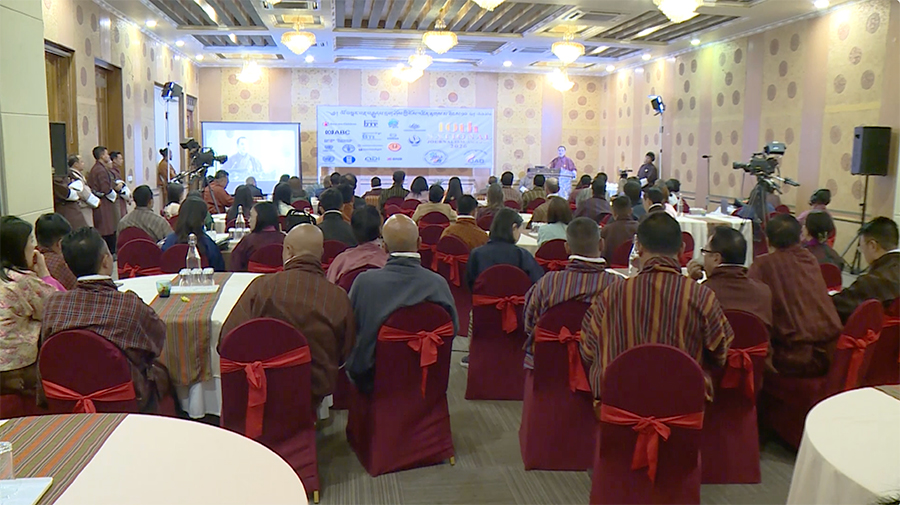
The discussion gained momentum as Bhutan observed World Press Freedom Day and hosted the Annual Journalism Awards on May 3, 2026 in Thimphu.
Speaking at the event, Minister for the Ministry of Industry, Commerce and Employment, Namgyel Dorji, questioned the evaluative framework used in global rankings, stating that Bhutan’s media environment is often misunderstood in international assessments.
He said the country’s media system has been “misunderstood and mis-measured” and argued that no single framework can fully capture the complexity of a country’s media landscape.
“No single framework can capture the whole scenario of a country,” Lyonpo said, adding that while RSF has its own mandate and objectives, its methodology may contain elements of bias and may not adequately reflect Bhutan’s institutional realities.
He nevertheless encouraged Bhutanese journalists to remain committed to professional journalism and continue contributing to nation-building despite external rankings and perceptions.
The RSF index, meanwhile, has long been debated in academic and policy circles for its reliance on perception-based data. A major line of criticism focuses on subjectivity in scoring, particularly in how expert responses are selected and interpreted. Researchers such as Jukka Ruohonen, in comparative studies of press freedom indices, have questioned how stable and objectively reproducible such rankings are, noting that perception-based systems can produce inconsistent results depending on respondent composition and interpretation.
Other scholars have also raised concerns about cross-country comparability, arguing that differences in political systems, cultural norms, security conditions, and media ecosystems make standardized ranking difficult. What constitutes media restriction in one context may not be directly comparable to another, raising questions about whether global indices can fully capture local realities.
Experts also point out that the weighting of indicators and selection of respondents may influence outcomes, leading to variations that reflect survey composition as much as actual media conditions.
These methodological concerns echo sentiments expressed by sections of Bhutanese society, who argue that global rankings often fail to account for the country’s small-scale media ecosystem and developmental context.
At the same time, experts acknowledge that measuring press freedom is inherently complex and that all global indices involve a degree of subjectivity that cannot be completely eliminated. This raises a fundamental question of what such rankings actually measure—and what they inevitably miss.
Despite criticisms, global press freedom indices continue to be widely used as reference points for identifying trends in media environments across countries.
Media professionals in Bhutan also expressed mixed views on the relevance of such rankings. During a media training programme in New Delhi earlier this year, the chairman of India TV, Rajat Sharma advised journalists not to become overly focused on rankings.
“Do your own work,” he told participants, stressing that journalism should be driven by professional integrity rather than external indices or perceptions.
However, not all media voices dismissed the RSF index. Former NDTV foreign affairs editor and independent journalist Kadambini Sharma said that while methodological questions persist, the index still provides a useful global snapshot of challenges faced by journalists.
“I still think it’s a good indicator of how journalists are struggling just to do their jobs in different countries,” she said, noting that shrinking newsroom spaces and increasing pressure on independent journalism are global concerns.
She also pointed to widespread layoffs and the decline of critical reporting in mainstream media as evidence of growing pressures on the profession worldwide.
The Executive board of the Union of Bulgarian Journalists, Vassil Sotirov, said that the index appears very year and is seriously considered in many countries. “I personally have doubts about its methodology because it is based on the Western understanding of freedom and democracy, which is not identical with that of many other countries and societies especially in Asia and Africa. I have myself tried to find a concrete description of the RSF methodology on their internet site but have not found anything convincing and reliable,” he said.
International journalists attending the same discussion also offered varied perspectives. Journalist John Tsongo from the Democratic Republic of Congo said RSF continues to play an important role in documenting abuses against journalists globally and commended its overall approach.
Senior Bangladeshi journalist Khairuzzaman Kamal described the RSF assessment as fair, while Nepali freelance journalist Anushka Nepal said the index provides a broadly accurate overview of global press freedom conditions, despite its limitations.
Meanwhile, attempts to seek clarification from RSF on Bhutan’s current ranking and methodology concerns did not receive a formal response at the time of reporting.
As the debate continues, Bhutan’s ranking has become part of a wider global conversation on whether press freedom can be meaningfully quantified across vastly different societies—or whether such rankings should be treated only as broad indicators rather than definitive judgments.
Sangay Rabten, Thimphu