


The Ministry of Infrastructure and Transport (MoIT) has clarified that the requirement for mandatory geotechnical or soil testing under the Thimphu Structure Plan (TSP) 2023–2047 and the Thimphu City-wide Design Code is intended to strengthen urban safety and improve long-term resilience in Bhutan’s earthquake-prone environment.
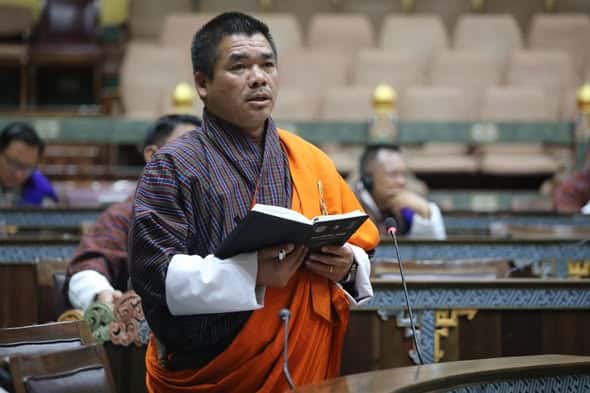
The clarification was provided during the ongoing parliament session in response to a written question raised by Member of Parliament (MP) for Khamdang-Ramjar constituency, Wangdi, who questioned the necessity of imposing mandatory geotechnical investigations on seemingly stable residential plots.
The MP raised concerns over why soil testing requirements continue to apply uniformly to flat, dry and highway-connected residential plots with no known history of landslides, despite earlier Local Area Plan (LAP) approvals already being based on terrain, topography and stability assessments.
He also highlighted the additional financial burden placed on ordinary homeowners, stating that the testing process can cost nearly Nu 150,000 in some cases.
In response, the ministry stated that Bhutan falls within a high seismic risk zone, making precautionary technical assessments essential even for plots that may appear stable on the surface.
According to MoIT, subsurface risks such as weak soil-bearing capacity, uncontrolled fill materials, groundwater issues and localized settlement risks are often not visible through surface-level inspection or earlier planning assessments.
Officials explained that the geotechnical testing requirement has been introduced as a preventive safety measure aimed at reducing the risk of structural failure during earthquakes and other environmental hazards.
The ministry stated that the requirement is intended to improve the long-term durability of buildings and infrastructure, reduce future disaster recovery costs and support safer urban expansion under the broader Thimphu Structure Plan framework.
“Plots that appear stable on the surface may still contain hidden subsurface risks,” the ministry noted in its response.
According to MoIT, geotechnical investigations are primarily required in high and medium hazard zones identified through geological and engineering studies carried out during the preparation of the Thimphu Structure Plan.
The ministry clarified that such investigations are generally necessary for sites located on steep slopes, within geological hazard zones, near rivers or unstable terrain, and in areas vulnerable to erosion, flooding, slope instability or ground settlement.
Officials explained that under earlier planning frameworks, many steep slope and flood-prone areas were largely categorized as no-construction zones.
However, under the revised TSP framework, certain developments may now be permitted in such areas provided that detailed site-specific geotechnical investigations are conducted to assess slope stability, soil conditions, structural loading capacity and appropriate mitigation measures.
The ministry said this represents a more scientifically informed and risk-sensitive planning approach that allows development while ensuring public safety remains central to urban growth.
“The approach allows for a more technically informed and resilient planning process,” the ministry stated.
The issue of affordability and social impact also emerged prominently during parliamentary discussions, particularly regarding whether imposing such additional compliance costs aligns with the principles of Gross National Happiness (GNH) and the TSP’s broader values of inclusiveness, livability, accessibility and community participation.
MP Wangdi questioned whether requiring expensive technical investigations from ordinary citizens — many of whom already face rising construction and land costs — could undermine the people-centered objectives of Bhutan’s urban development policies.
Responding to the concerns, MoIT acknowledged that affordability remains a legitimate issue, especially for homeowners who invest significant personal savings into acquiring land and constructing houses.
The ministry stated that both the GNH philosophy and the TSP framework are intended to promote inclusive, equitable and people-centered urban development that prioritizes social well-being and accessibility.
“As such, any regulation that creates substantial financial pressure on citizens raises legitimate concerns regarding fairness and proportionality,” the ministry acknowledged.
However, officials emphasized that the intention behind the geotechnical testing requirement is not to create hardship for citizens but to safeguard lives, infrastructure and long-term public safety.
The ministry stressed that disaster risk reduction and resilience remain central objectives of the Thimphu Structure Plan and the City-wide Design Code.
From this perspective, geotechnical investigations are viewed as preventive investments designed to minimize unsafe construction practices and reduce future economic and human losses resulting from earthquakes, landslides or structural failures.
MoIT further clarified that not all plots across Thimphu are automatically subjected to mandatory investigations, stating that detailed geotechnical studies are specifically required only in identified high and medium hazard zones where additional technical assessments are considered necessary beyond general geological reviews.
At the same time, the ministry acknowledged that there may be scope for introducing a more differentiated and risk-based implementation approach in the future.
Officials said there is merit in exploring ways to better balance public safety requirements with affordability, accessibility and practical implementation challenges faced by ordinary citizens.
According to MoIT, the long-term objective of the Thimphu Structure Plan and Bhutan’s broader urban planning framework is to create a city that is safe, resilient, inclusive and livable while ensuring that regulatory measures remain technically justified, socially equitable and economically practical.
Sangay Rabten, Thimphu











