

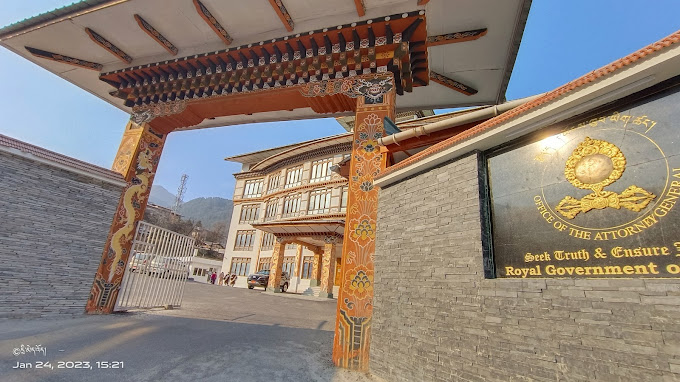
Substance abuse-related offences continued to dominate Bhutan’s criminal justice landscape, accounting for the largest share of cases handled by the Office of the Attorney General (OAG), which received a total of 1,014 criminal and civil cases during the 2025–26 financial year.
Of the total caseload, 389 cases involved substance abuse-related offences, reflecting the continued challenge posed by the trafficking and misuse of narcotic drugs and psychotropic substances.
The Royal Bhutan Police (RBP) remained the primary source of referrals, forwarding 955 cases to the OAG. The Anti-Corruption Commission (ACC) referred 14 cases, while six cases came from other government agencies. In addition, the Office handled 39 arbitration, mediation and litigation matters, highlighting the expanding scope of its legal responsibilities beyond criminal prosecution.
Among substance abuse-related cases, illicit trafficking of narcotic drugs and psychotropic substances accounted for the majority, with SP+ capsules emerging as the most frequently reported category. Of the 389 substance abuse cases, 279 involved illicit trafficking, including 220 cases involving SP+ capsules, 31 cases involving brown sugar and heroin, and 28 cases involving N10 tablets. The OAG also recorded 74 other substance abuse cases and 35 cannabis trafficking cases.
Overall, cases involving soft drugs accounted for 284 cases, significantly exceeding the 31 cases involving hard drugs.
The OAG has stated that the increasing volume and complexity of cases continue to place greater demands on legal professionals as Bhutan confronts evolving forms of crime and increasingly complex legal disputes. During the reporting period, the Office successfully concluded and closed 366 cases, while 260 cases remain under trial. Another 263 cases are under legal review, 14 cases have been appealed to higher courts, and 111 cases were returned to referring agencies for further investigation or procedural corrections.
Cases were returned mainly due to the need for additional evidence, procedural gaps, clarification on whether matters were civil or criminal in nature, or assessment of whether the public interest threshold required for prosecution had been met. Beyond prosecution, the OAG continued strengthening enforcement of court judgments. The Property and Judgment Enforcement Division handled 1,101 court judgments, achieving an enforcement rate of 54 percent and recovering Nu 36.65 million.
The recovered amount was restituted to the government, financial institutions and victims in accordance with court orders. The Division also investigated assets of convicted individuals, conducted sealed-bid auctions, referred offenders for community service and facilitated treatment for individuals suffering from substance use disorders through The PEMA Rehabilitation Centre.
In its advisory role, the OAG provided 133 legal opinions to government agencies on constitutional interpretation, legislative drafting, taxation, international agreements, finance, procurement, environmental governance and public administration.
The legal opinions supported several major legislative initiatives, including the Renewable Energy Tax Exemption Bill 2026, Insolvency and Rehabilitation Bill 2026, amendments to the Civil Aviation Act and Copyright Act, the proposed Agriculture Bill and the Surface Transport Bill.
Legal professionals deployed across ministries, agencies, dzongkhags and thromdes also remained engaged in handling more than 420 legal cases and preparing over 1,033 legal memoranda on policy and legal matters.
Among its major achievements, the OAG established the Drug Prevention and Prosecution Division and the Arbitration, Mediation and Litigation Division, while also making progress in harmonising environmental and climate laws, expanding legal advocacy programmes and launching the pilot phase of the Enterprise Legal Management System to modernise case management.
The Office’s legal awareness programmes reached 857 participants, including women, youth, local government leaders and residents of remote communities. The programmes focused on domestic violence, substance abuse laws, cyber protection and legal aid services.
However, the OAG cautioned that rising legal complexity, increasing workloads and shortages of specialised legal professionals remain significant challenges.
The Office highlighted growing demands in emerging fields such as artificial intelligence, cybersecurity, environmental law and international legal affairs, while noting that many government agencies still lack dedicated legal divisions.
Moving ahead, the OAG said it will prioritise strengthening specialised legal expertise, recruiting additional legal professionals, establishing legal divisions across government agencies, creating a Legal Research Unit and enhancing institutional capacity to meet Bhutan’s evolving governance and justice needs.
Tashi Namgyal, Thimphu