

With the resignations of the Home Minister and the Minister for Energy and Natural Resources, attention has quickly shifted to one question: Who will fill the shoes?
The immediate constitutional process is clear. The Prime Minister (PM) will have to recommend members of the National Assembly (NA) for appointment as ministers by His Majesty the King. What is less clear is whether the PM will simply fill the two vacancies or use the opportunity to rethink the composition of the Cabinet.
Two new MPs could be brought into the Cabinet while the rest of the ministers remain where they are. Or the two departures could become the catalyst for a broader reshuffle, with existing ministers moved between portfolios and new faces brought into government.
Either way, the most interesting question now is not simply which ministries need new ministers, but who will be the two new faces.
𝐓𝐡𝐞 𝐂𝐨𝐧𝐬𝐭𝐢𝐭𝐮𝐭𝐢𝐨𝐧 𝐬𝐞𝐭𝐬 𝐭𝐡𝐞 𝐛𝐨𝐮𝐧𝐝𝐚𝐫𝐲
The PM’s choices are not entirely open-ended.
Article 17(3) of the Constitution provides that the Druk Gyalpo appoints ministers from among members of the NA on the recommendation of the PM. Article 17(5) further provides that not more than two members elected from the constituencies of the same Dzongkhag shall be entitled to be appointed as ministers.
With the departures, the Cabinet’s representation includes two ministers from Samtse, while Wangduephodrang, Zhemgang, Dagana, Samdrup Jongkhar and Punakha, each have one.
PDP-held Dzongkhags without minister are Bumthang, Chhukha, Gasa, Haa, Sarpang, Trongsa, Tsirang, Paro and Thimphu.
Leaving Samtse out, which already has two ministers, the PM has several alternatives to choose from.
𝐓𝐡𝐞 𝐞𝐚𝐬𝐢𝐞𝐬𝐭 𝐜𝐡𝐨𝐢𝐜𝐞: 𝐟𝐢𝐥𝐥 𝐭𝐡𝐞 𝐯𝐚𝐜𝐚𝐧𝐜𝐢𝐞𝐬
The most straightforward option would be to fill the two vacant positions from the two Dzongkhags where the vacancies have arisen.
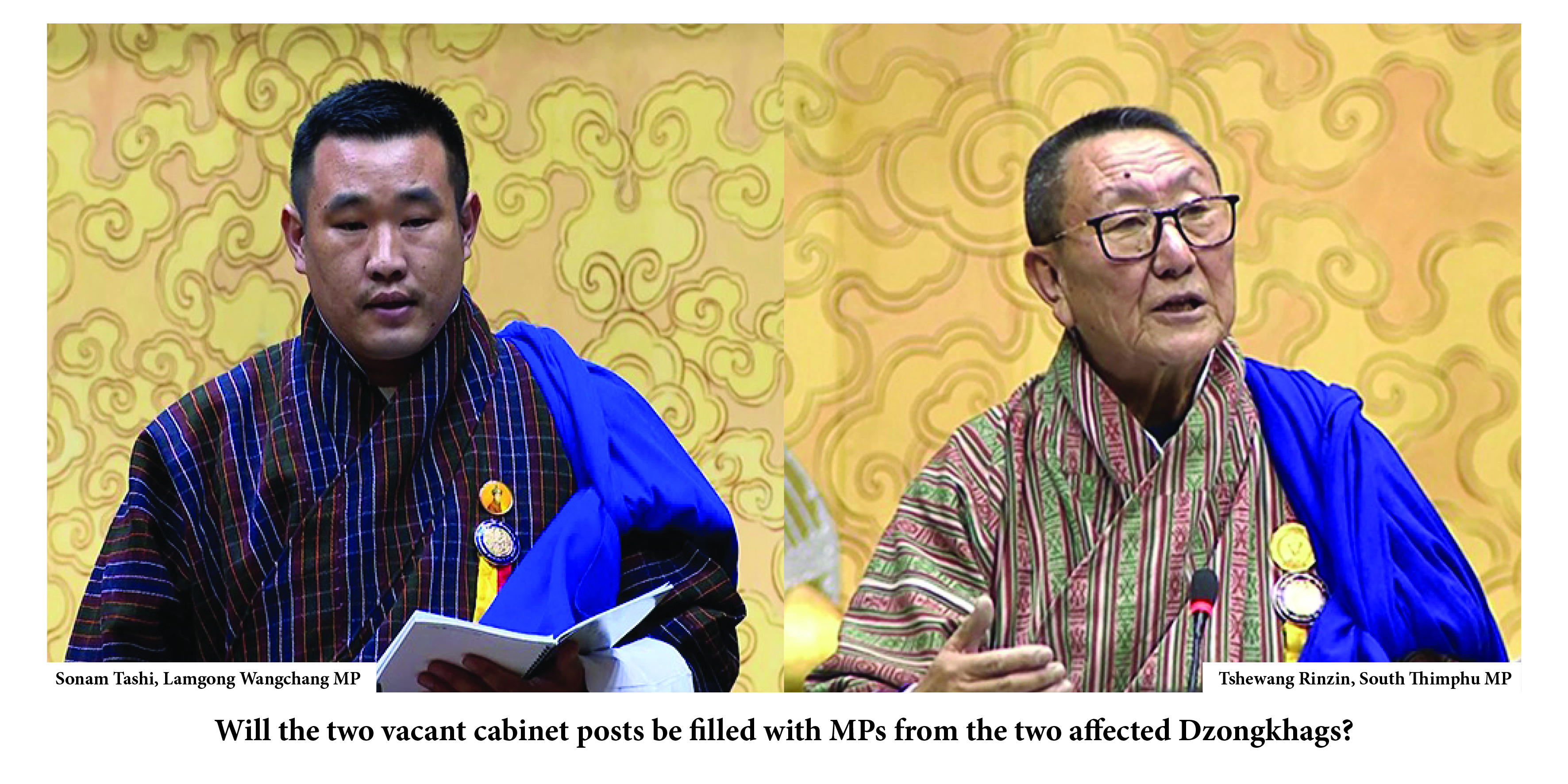
From Paro, Sonam Tashi of Lamgong-Wangchang could be considered. A young MP with an electrical engineering background from the College of Science and Technology, he would bring technical expertise and a younger voice into the Cabinet.
From South Thimphu, Tshewang Rinzin is another possibility. A former National Council (NC) member, he brings parliamentary experience beyond his current tenure in the NA.
𝐄𝐱𝐩𝐞𝐫𝐢𝐞𝐧𝐜𝐞 𝐚𝐧𝐝 𝐩𝐚𝐫𝐭𝐲 𝐬𝐞𝐧𝐢𝐨𝐫𝐢𝐭𝐲
If previous political experience and seniority within the ruling party carry greater weight, the field becomes more interesting.
In terms of age, the senior ones include: Namgay Dorji of Draagteng-Langthil, Trongsa, who is also a former Finance Minister. Harka Singh Tamang of Gelephu, Sarpang, a former Dzongdag and Kamal Bahadur Gurung of Kilkhorthang-Mendrelgang, Tsirang, are the other two. From Chumig-Ura, of Bumthang is Sonam Rinchen.
These MPs are from Dzongkhags that do not have a cabinet representation.
There are a host of others, who are younger to the above and have been with the PDP earlier to 2023.
From Dzongkhags that do not have a cabinet representation now is Rinzin Dorji of Phuentsholing, Chhukha. He is a former NA member. Similarly, from Nubi-Tangsibji, Trongsa, is Phuntsho Dendup and from Chhoekhor-Tang, Bumthang, Kuenzang Thinley. From Gasa is Pema Drukpa of Khamaed-Lunana.
Kuenga of Nyishog-Saephu, Wangduephodrang, and Sonam Dorji of Drukjeygang-Tseza Dagana, are from Dzongkhags that have a sitting cabinet member.
𝐓𝐡𝐞 𝐰𝐢𝐝𝐞𝐫 𝐩𝐨𝐨𝐥 𝐨𝐟 𝐬𝐞𝐧𝐢𝐨𝐫 𝐌𝐏𝐬
The PM could also look beyond the old PDP establishment.
Tek Bahadur Rai of Shompangkha, Sarpang, brings a medical background and would offer another possibility if professional expertise is given greater weight.
There is also Namgay Wangchuk of Lingmukha-Toedwang, Punakha, a former NA member, though not part of the PDP earlier to 2023.
𝐓𝐡𝐞 𝐜𝐚𝐬𝐞 𝐟𝐨𝐫 𝐚 𝐲𝐨𝐮𝐧𝐠𝐞𝐫 𝐂𝐚𝐛𝐢𝐧𝐞𝐭
But the PM could also look in a completely different direction: the next generation of PDP leadership. If the objective is to inject new energy into the government and give younger MPs greater responsibility, there is no shortage of possibilities.
Interestingly from Dzongkhags that do not have a sitting cabinet are new and young faces of the PDP. They are Lhendup Wangdi of Bji-Katsho-Uesu, Haa, Pempa of Bongo-Chapchha, Chhukha, Lhakpa Tshering Tamang of Sergithang-Tsirangtoed, Tsirang, and Lhaba Lhaba of Khatoed-Laya, Gasa. These choices would signal something different from simply rewarding seniority: that the government is preparing its next generation of political leadership.
𝐇𝐨𝐰 𝐰𝐢𝐥𝐥 𝐭𝐡𝐞 𝐏𝐌 𝐰𝐞𝐢𝐠𝐡
The choices are diverse and the PM could pick any depending on the factors he will need to consider. He could weigh competence, experience, party history, geographical representation, professional expertise and generational renewal, all within the constitutional framework.
He could choose continuity by elevating experienced former ministers and parliamentarians. He could choose renewal by promoting younger MPs. Or he could combine the two, bringing experience into one vacant portfolio while giving a younger MP an opportunity in the other.
The question, therefore, is no longer whether there are people capable of filling the shoes. There are. The real question is whose shoes the PM wants them to fill, and what kind of Cabinet he wants to lead the government through the remainder of its term.
The Nation is watching.
𝑇𝑎𝑠ℎ𝑖 𝑁𝑎𝑚𝑔𝑦𝑒𝑙, 𝑇ℎ𝑖𝑚𝑝ℎ𝑢
Post Views: 2,004