


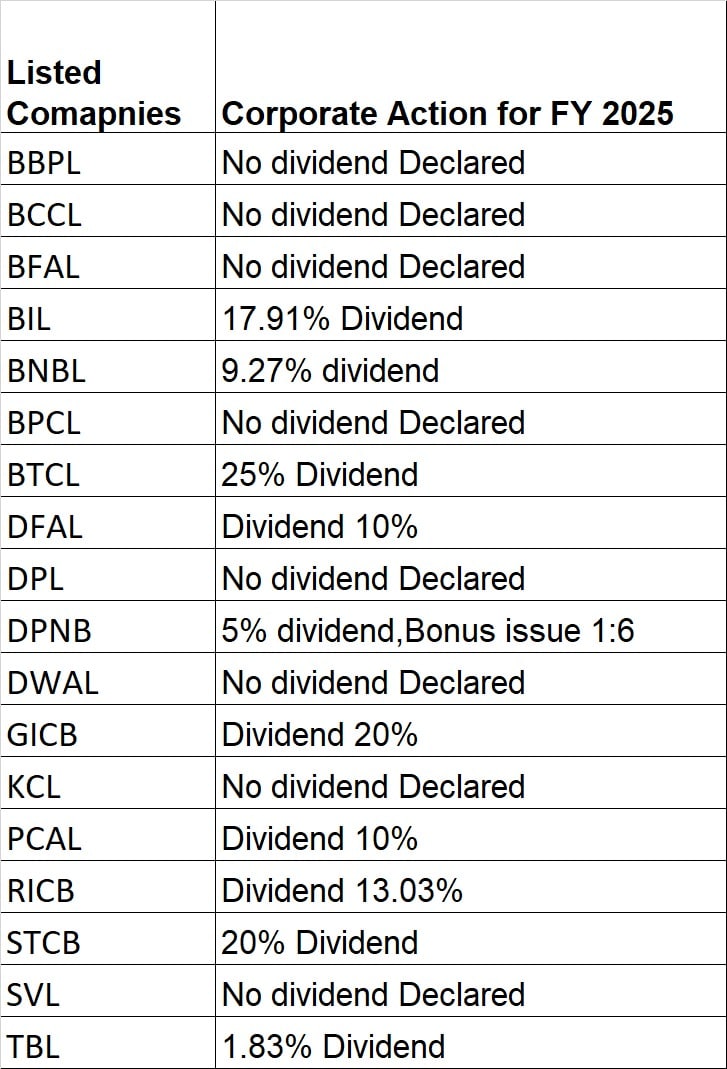
The annual general meeting (AGM) season has painted a mixed picture of Bhutan’s corporate sector, with dividend declarations for the financial year 2025 reflecting both resilience and caution across industries. While several listed companies rewarded shareholders with healthy returns, others chose to retain earnings in the face of ongoing operational and market challenges.
Of the 18 companies listed on the Royal Securities Exchange of Bhutan (RSEB), 10 declared dividends for FY 2025, while eight companies opted not to distribute profits. The dividend announcements offer valuable insights into the financial health of Bhutan’s listed firms and provide investors with an indication of how different sectors are performing as the economy continues its post-pandemic recovery and adjusts to changing business conditions.
Leading the list of dividend-paying companies was Bhutan Tourism Corporation Limited (BTCL), which declared a dividend of 25 percent, the highest among all listed firms. The payout reflects the continued recovery of Bhutan’s tourism sector following the reopening of international travel and growing visitor arrivals.
Close behind were GIC Bhutan Reinsurance Company Limited (GICB) and State Trading Corporation of Bhutan Limited (STCB), both of which announced dividends of 20 percent. Meanwhile, Bhutan Insurance Limited (BIL) approved a dividend of 17.91 percent, while Royal Insurance Corporation of Bhutan Limited (RICBL) declared a dividend of 13.03 percent. The insurance sector has traditionally been among the more consistent dividend contributors on the stock exchange, although the latest payouts were lower than some of the exceptionally high distributions seen in previous years.
In the manufacturing sector, Penden Cement Authority Limited (PCAL) and Druk Ferro Alloys Limited (DFAL) each declared dividends of 10 percent, demonstrating continued profitability despite rising production costs and fluctuating market demand.
Among the banking institutions, Bhutan National Bank Limited (BNBL) announced a dividend of 9.27 percent. Druk PNB Bank Limited (DPNB) declared a 5 percent cash dividend and also approved bonus shares at a ratio of one share for every six shares held, providing shareholders with an additional form of return while strengthening the bank’s capital base. T Bank Limited (TBL) declared a dividend of 1.83 percent.
While the payouts were welcomed by shareholders, nearly half of Bhutan’s listed companies decided against distributing dividends this year.
The eight companies that did not declare dividends for FY 2025 were Bhutan Board Products Limited (BBPL), Bhutan Carbide and Chemicals Limited (BCCL), Bhutan Ferro Alloys Limited (BFAL), Bhutan Power Corporation Limited (BPCL), Dungsam Polymers Limited (DPL), Druk Wang Alloys Limited (DWAL), Kuensel Corporation Limited (KCL), and Sherza Ventures Limited (SVL).
The absence of dividend payments does not necessarily indicate poor financial performance. Market analysts note that companies often withhold dividends for a variety of strategic reasons, including the need to reinvest earnings into expansion projects, service debt obligations, finance capital expenditures, strengthen working capital, or build reserves against future uncertainties.
In some cases, retaining profits can create greater long-term value for shareholders than distributing cash dividends, particularly when companies are pursuing growth opportunities or undergoing restructuring.
The FY 2025 dividend declarations also reveal notable shifts compared to previous years, underscoring the changing fortunes of Bhutanese businesses.
Records from the RSEB show that several companies which delivered substantial dividends in recent years either reduced payouts significantly or suspended them altogether in FY 2025.
One of the most striking examples is Bhutan Ferro Alloys Limited (BFAL), which declared a remarkable 100 percent dividend in 2024 but did not announce any dividend this year. Similarly, Druk Wang Alloys Limited (DWAL), which paid a 30 percent dividend in 2024, also refrained from distributing profits for FY 2025.
The insurance sector also recorded lower payouts compared to the previous year. Bhutan Insurance Limited had distributed a dividend of 21 percent in 2024, while RICBL had declared an impressive 42 percent dividend. Although both companies remained profitable enough to reward shareholders this year, the reduced payouts suggest a more cautious approach amid changing market conditions and business priorities.
At the same time, some companies that had previously withheld dividends returned to the list of dividend-paying firms, reflecting improvements in profitability and financial stability. This highlights the dynamic nature of Bhutan’s corporate landscape, where company performance can vary considerably from year to year depending on sectoral trends, commodity prices, investment cycles, and broader economic conditions.
The mixed dividend outcomes also mirror the broader challenges facing Bhutan’s private sector. Businesses continue to navigate rising operational costs, higher financing expenses, evolving consumer demand, labour shortages, and increasing competition. At the same time, many companies are investing in modernization, expansion, and productivity improvements to position themselves for future growth.
For investors, dividend declarations remain one of the most closely watched indicators of corporate performance. Beyond providing immediate returns, dividend policies often signal management’s confidence in future earnings and cash flow generation.
Market analysts say the FY 2025 dividend season reflects an economy in transition. While sectors such as tourism, insurance, trading, and parts of manufacturing have demonstrated resilience and improved earnings, others continue to face headwinds that require a more conservative approach to profit distribution.
Sangay Rabten, Thimphu











