The Auditor General of Royal Audit Authority (RAA) has issued an advisory series on 22 May that the government’s fuel price support scheme is becoming a significant fiscal and macroeconomic burden, while calling for targeted subsidies, stronger monitoring, and an early exit strategy.
The advisory, submitted for the consideration of the Royal Government of Bhutan, was issued under the constitutional and statutory mandate of the Auditor General and the RAA as provided under Article 25(1) of the Constitution and Section 114 of the Audit Act.
According to the advisory, the National Fuel Price Smoothening Framework (NFPSF) was introduced as a timely macroeconomic stabilisation measure to cushion citizens, businesses, and the wider economy from the impact of global fuel price shocks. The RAA acknowledged that the framework provided immediate relief by moderating rising fuel prices affecting transport, logistics, construction, agriculture, businesses, and household living costs.
However, the authority stated that the cumulative fiscal exposure has increased substantially and exceeded the initial allocation under the Economic Stimulus Plan.
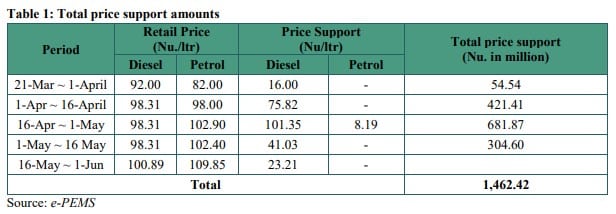
“Total expenditure has reached Nu. 1.46 billion, exceeding the initial Nu. 1 billion allocation and reaching about 90.63 percent of the projected Nu. 1.6 billion threshold referred to in the Cabinet directive,” the advisory stated.
The RAA noted that diesel consumption remains the main driver of the growing fiscal burden. As of the latest fuel price revision announced on May 16, the retail price of petrol remained at Nu. 109.85 per litre without government support, while diesel was maintained at Nu. 100.89 per litre through government intervention.
Without government support, diesel prices would have reached Nu. 124.10 per litre, implying a subsidy of approximately Nu. 23.21 per litre.
The advisory warned that continued high fuel consumption and dependence on imported fuel have broader macroeconomic implications beyond direct subsidy expenditure. It stated that high fuel imports contribute to foreign currency outflow, pressure on external reserves, current account imbalances, inflationary pressure, and reduced fiscal space for other national priorities.
The RAA also observed that the present broad-based fuel support mechanism does not sufficiently distinguish between essential and non-essential fuel use.
Under the current system, all consumers benefit from the same supported fuel price regardless of whether the fuel is used for agriculture, public transport, private vehicles, commercial activities, government operations, or re-export-related purposes.
“As a result, farmers, public transport operators, emergency service providers, private vehicle owners, contractors, commercial entities, government agencies, and re-export-related users may all benefit from the same supported price, even though the economic and social value of their fuel use differs,” the advisory noted.
The report highlighted concerns regarding petrol-driven taxis following the withdrawal of petrol price support. According to vehicle statistics cited in the advisory, Bhutan currently has 6,020 petrol-driven taxis compared to only 413 diesel-driven taxis.
Prior to March 21, 2026, petrol prices stood at Nu. 63.29 per litre. By May 16, prices had risen to Nu. 109.85 per litre, representing an increase of approximately 74 percent.
Although temporary support was provided in April, petrol subsidies were fully withdrawn after May 1, leaving taxi operators exposed to increased operational costs while fares remain regulated.
The RAA warned that this situation could severely reduce taxi operators’ incomes and expose them to economic distress.
The advisory also noted that the framework has limited linkage between price support and actual end users or the purpose of fuel consumption, making it difficult to prevent non-essential or unintended beneficiaries from accessing subsidised fuel.
To address the growing fiscal exposure, the RAA recommended that the Ministry of Finance immediately undertake a fiscal impact assessment to determine whether total expenditure under the framework is likely to exceed the projected Nu. 1.6 billion ceiling before June 2026.
The advisory further recommended introducing targeted fuel subsidies with stronger monitoring mechanisms, especially for diesel-intensive sectors such as transport, logistics, construction, industry, agriculture machinery, and heavy vehicles.
The RAA suggested that support continue for essential services, food production, public transport, and priority economic activities, while non-essential and high-consumption uses could face phased rationalisation or limits.
Specific recommendations included maintaining targeted support for agriculture to protect food security and rural livelihoods, rationalising support for industry and construction through capped assistance, and continuing support for essential service sectors such as health, education, logistics, and public service delivery.
The authority also recommended continued support for public transport services, including buses, taxis, and school transport, alongside stronger promotion of pooled transportation systems to reduce private vehicle use.
For government agencies, the RAA proposed stricter fuel budgeting, vehicle pooling, reduced official travel, walk-to-work arrangements, and remote working measures to reinforce fuel conservation.
The advisory stressed the need for robust monitoring systems to ensure compliance with non-fiscal measures such as remote work arrangements, public transport promotion, route optimisation, and fuel conservation campaigns.
Additionally, the RAA urged the Ministry of Finance and the Ministry of Industry, Commerce and Employment to develop an early recoupment and exit mechanism to ensure the fuel support remains temporary and fiscally sustainable.
“Without a clear recoupment and exit mechanism, the support may become an unrecovered fiscal cost and place additional pressure on the national budget,” the advisory stated.
The RAA said the recommendations are intended to support informed policy deliberation and help preserve fiscal space, promote macroeconomic stability, and ensure public resources are directed toward areas of highest public value.
Staff Reporter