

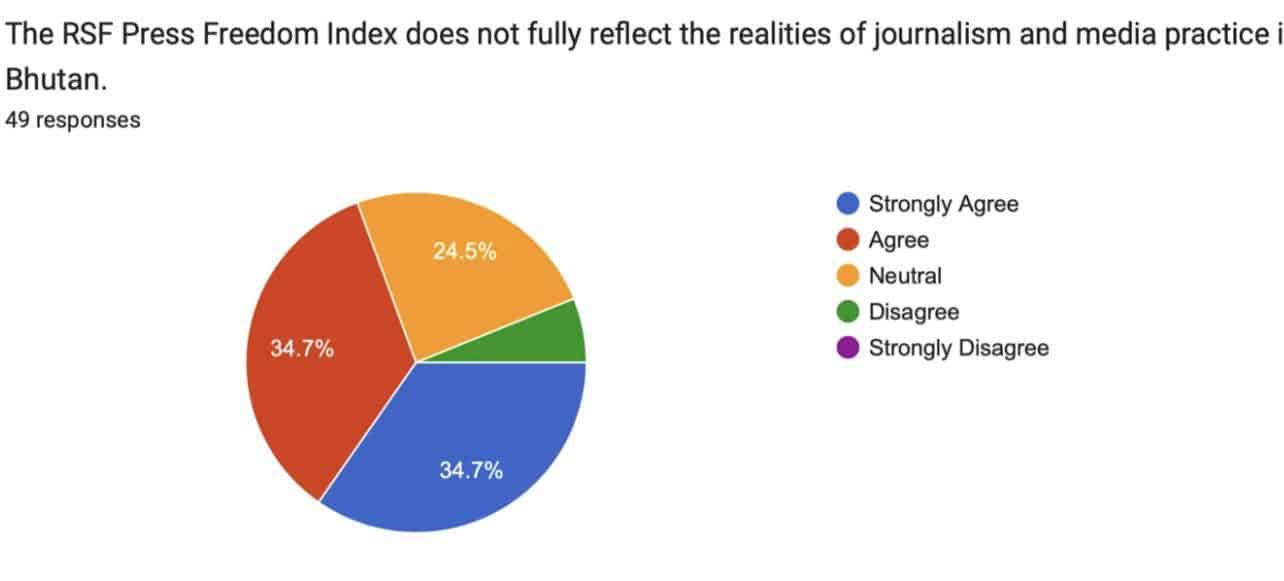
Bhutan’s placement at 150th in the latest global Press Freedom Index by Reporters Without Borders (RSF) has triggered growing concern and debate within the country’s media fraternity, with a recent survey indicating that many journalists and media professionals believe the ranking does not accurately reflect the realities of journalism and media practice in Bhutan. Instead, the message is: while press freedom assessments remain important, they must be more transparent, representative, and grounded in local realities if they are to command credibility among those working on the frontlines of journalism in Bhutan.
The findings emerge from a survey involving 49 participants, including journalists, editors, media professionals, government officials, and individuals familiar with Bhutan’s media environment. The survey paints a picture of a media community that acknowledges the challenges facing journalism in Bhutan but strongly questions whether international press freedom assessments are adequately capturing the country’s unique democratic, cultural, and economic context.
At the heart of the concern lies a fundamental question: Does Bhutan’s ranking truly represent the state of press freedom in the country, or is it a reflection of methodological limitations? For many respondents, the answer leaned heavily toward the latter.
A significant 77.5 percent of participants expressed concern over insufficient transparency in how RSF collects data, selects respondents, and conducts its assessments. Questions were raised about the representativeness of survey participants and whether practicing Bhutanese journalists, those working directly within the country’s media landscape, are sufficiently consulted during the ranking process.
Several senior journalists reported that despite spending decades in the profession, they had never once been approached to participate in any RSF survey or consultation, leading some to question the legitimacy of conclusions drawn without broader local engagement.
This absence of consultation has contributed to a growing perception that the methodology may be disconnected from on-the-ground realities and risks producing outcomes that fail to reflect the actual conditions under which journalism operates in Bhutan.
The survey’s respondent profile itself lends weight to the findings. Of the 49 respondents, 65.3 percent identified as journalists or media professionals. Importantly, the largest group of respondents, 30.6 percent, reported having between one and five years of experience, closely followed by 28.6 percent of respondents with over a decade of professional experience, offering insights from seasoned practitioners familiar with the evolution of Bhutanese journalism.
For many respondents, Bhutan’s media ecosystem is too small, context-specific, and economically constrained to be assessed solely through standardised global indicators.
Participants argued that broad international frameworks often struggle to distinguish between economic fragility and political repression, resulting in assessments that may inadvertently portray countries facing market limitations as having press freedom restrictions comparable to politically repressive states.
This distinction, respondents emphasised, is critical in Bhutan’s case.
The survey found broad agreement that Bhutan’s media sector faces challenges, but respondents overwhelmingly characterised them as structural and economic rather than politically repressive.
Unlike countries where journalists face imprisonment, violence, intimidation, or systematic state censorship, respondents emphasised that Bhutan’s media environment does not exhibit the kinds of direct repression commonly associated with countries ranked poorly in global press freedom indices.
Instead, the challenges facing Bhutanese journalism appear to be rooted in economics.
An overwhelming 91.9 percent of respondents identified the financial sustainability of private media houses as the biggest challenge facing the sector, underscoring widespread concern over the viability of independent journalism in a small and commercially limited market.
At the same time, 81.7 percent cited delays in access to information and bureaucratic hurdles from public institutions as a significant concern, highlighting frustrations over slow responses and institutional bottlenecks that can hinder timely reporting.
At the same time, respondents argued that international assessments often overlook several strengths of Bhutan’s media environment.
Among the positive characteristics frequently highlighted were a relatively safe environment for journalists, traditions of responsible journalism, strong public trust in mainstream media, social harmony, and the influence of Bhutan’s Gross National Happiness (GNH) philosophy, which shapes both public discourse and media culture.
A common recommendation emerging from the survey was the need for larger and more representative samples, greater transparency in respondent selection, clearer communication regarding methodology, and deeper engagement with practicing journalists, editors, and local experts.
Respondents also called for international press freedom assessments to adopt more context-sensitive indicators capable of distinguishing structural and institutional constraints from genuine threats to journalistic freedom.
The survey was conducted by the Journalists Association of Bhutan.
Nidup Lhamo, Thimphu