

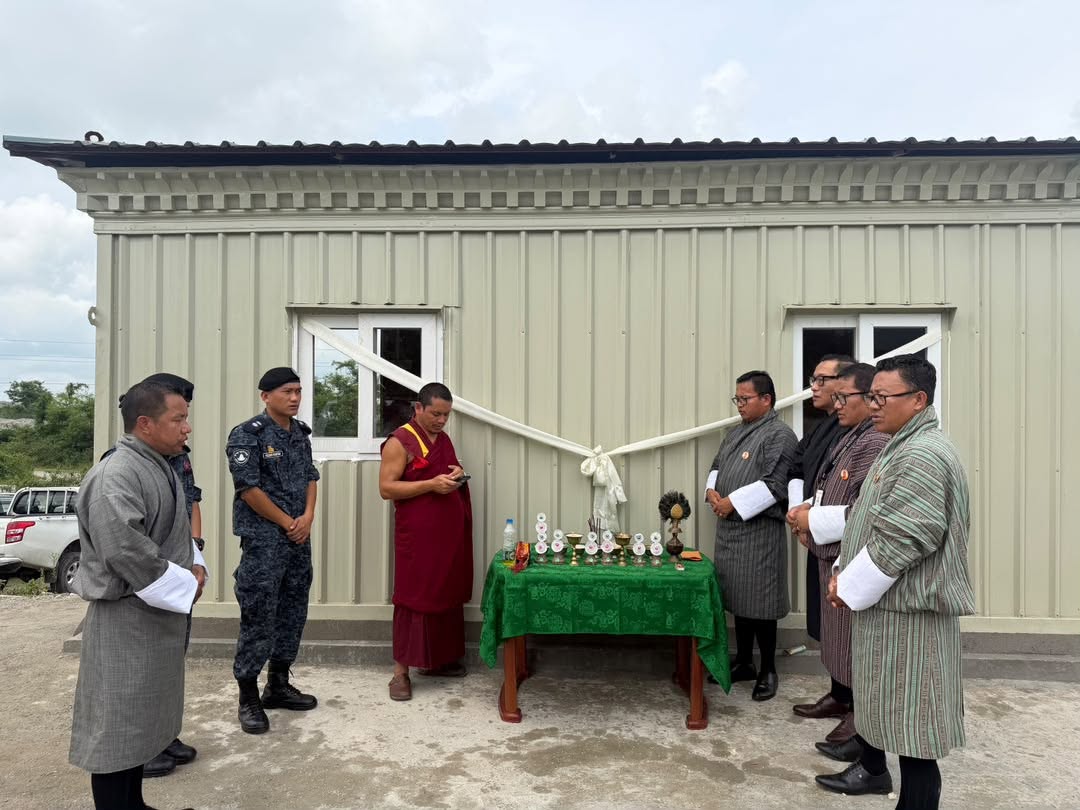
In what is a strategic initiative aimed at improving cross-border cargo movement and supporting the rapid industrialization of the Norbugang Industrial Park (NIP), the Budhini Immigration Facilitation Office in Samtse was opened earlier this week to strengthen its trade facilitation infrastructure. The facility is expected to streamline immigration clearance for industrial trucks transporting raw materials into Bhutan and finished products to export markets, reducing logistical bottlenecks that have long affected industries operating in the country’s largest emerging industrial hub.
Established under the Standard Operating Procedure (SOP) for the Facilitation of Industrial Trucks, the office will exclusively serve industries located at the NIP, ensuring quicker processing of industrial vehicles and uninterrupted movement of goods across the Bhutan-India border.
According to trade officials based in Samtse, the initiative reflects Bhutan’s broader efforts to improve trade logistics, reduce the cost of doing business and strengthen the competitiveness of its manufacturing sector as the country seeks to diversify its economy under the 13th Five-Year Plan.
“Providing dedicated immigration clearance for industrial trucks will reduce delays, improve supply chain efficiency and help industries maintain uninterrupted production,” an official said.
Business leaders say the facility addresses one of the operational challenges faced by manufacturers, particularly those dependent on imported industrial raw materials and export-oriented production, while believing that the initiative will enhance investor confidence by improving the reliability of Bhutan’s industrial logistics system.
Manufacturers have frequently cited border delays as a factor affecting production schedules, inventory management and transportation costs. With a dedicated immigration office now in operation, industrial trucks will be able to complete immigration formalities more efficiently, reducing waiting times and improving the predictability of cargo movement.
The opening of the immigration office coincides with the rapid transformation of the NIP into one of Bhutan’s most significant manufacturing zones. What was once a largely undeveloped stretch of land along the Diana River, near Bhutan’s longest bridge, is today emerging as a major industrial cluster with the establishment of large ferro-silicon manufacturing plants and other export-oriented industries.
Spread across 195 acres, the industrial park represents one of the country’s largest industrial infrastructure investments. The development of roads, utilities, drainage systems and supporting infrastructure is estimated to cost approximately Nu 3.6 billion. The park has been designed with a 300 MW (300 MVA) power capacity, providing sufficient electricity to support energy-intensive industries, particularly ferro-alloy manufacturing.
To meet this demand, construction of a 400/220/66/33 kilovolt indoor gas-insulated substation commenced in February 2024, creating one of the country’s most advanced electricity transmission facilities dedicated to industrial use.
The industrial estate is linked to the national highway through the upgraded 8.3-kilometre Samtse-Norbugang Industrial Road, while the recently completed Dram Zam Bridge at Buduney has strengthened transport connectivity between the industrial park and surrounding areas.
Completed in March this year at a cost of approximately Nu 305 million with financial support from the Government of India, the bridge has substantially improved access for heavy vehicles transporting industrial cargo. Together with the new immigration office, these investments form an integrated logistics network designed to facilitate the efficient movement of goods into and out of the industrial park.
The establishment of the Budhini Immigration Facilitation Office also complements the government’s ongoing efforts to improve Bhutan’s business environment through regulatory reforms, streamlined procedures and enhanced trade facilitation.
Over the past several years, Bhutan has introduced measures aimed at strengthening private sector development, attracting investment and expanding export-oriented manufacturing.
Efficient logistics and border services are increasingly recognized as essential components of industrial competitiveness, particularly for manufacturers operating in regional supply chains where delivery schedules and transportation efficiency directly influence production costs. Business leaders say infrastructure investments that reduce administrative delays can significantly improve productivity while making Bhutan a more attractive destination for industrial investment.
The NIP, strategically located close to the Indian market, is expected to play a key role in expanding Bhutan’s manufacturing base and increasing exports of value-added industrial products. It is also expected to generate wider economic benefits for Samtse and neighboring districts by stimulating demand for transport, logistics, warehousing and other ancillary services and create employment opportunities, encourage private investment and contribute to regional economic development.
Tashi Namgyal, Tsirang