

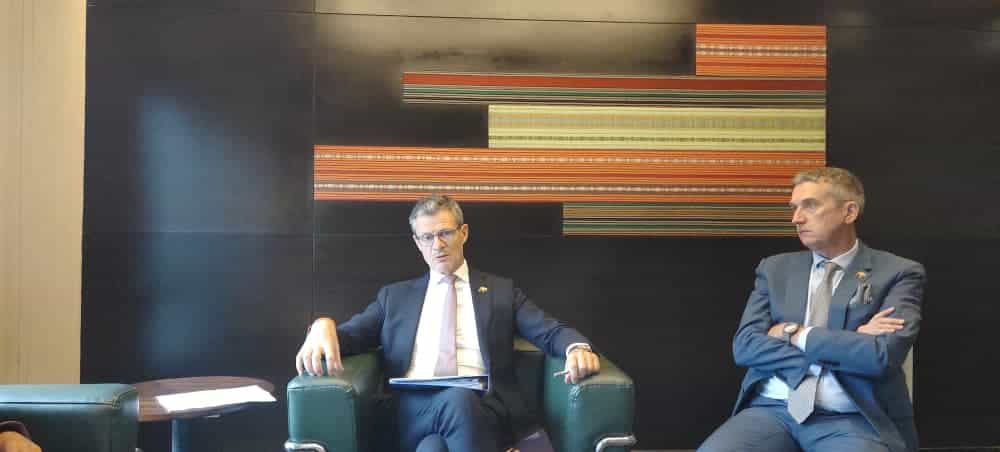
The European Union (EU) is stepping up its engagement with Bhutan by actively facilitating platforms to connect the country with potential European investors, with a particular focus on the Gelephu Mindfulness City (GMC) project, according to the EU Ambassador to Bhutan and India, Hervé Delphin.
During his visit to Bhutan this week, Ambassador Delphin described GMC as a “unique project” that is steadily taking shape and holds strong potential to become a model for sustainable and values-based economic development. He said the EU’s approach is shifting beyond traditional development assistance towards investment facilitation and long-term economic partnerships.
“We are trying to support Bhutan by giving platforms to meet investors from EU member states,” he said, noting that the EU’s role is increasingly focused on enabling business linkages rather than direct aid-based cooperation. “Our objective is to help create opportunities for partnerships that can support sustainable development in Bhutan.”
A key initiative in this direction was the first-ever EU–Bhutan Investor Forum and investment roadshow, held from January 26 to 29 in Brussels, Frankfurt, and Prague. Organised under the EU’s Global Gateway strategy, the forum marked a significant milestone in bilateral economic engagement, bringing together policymakers, investors, and business leaders to explore investment opportunities in Bhutan.
The event was designed to mobilise both public and private capital for sustainable projects, with a strong emphasis on the GMC, envisioned as a green, innovation-driven urban hub anchored in mindfulness, environmental stewardship, and long-term sustainability principles.
Prime Minister Dasho Tshering Tobgay led a high-level Bhutanese delegation to the forum in Brussels on January 26, followed by investor roadshows in Frankfurt on January 28 and Prague on January 29. The delegation included senior government officials, GMC representatives, and private sector participants, who presented Bhutan’s investment priorities and development vision directly to European stakeholders.
Ambassador Delphin said the EU is particularly interested in supporting the development of sustainable value chains in Bhutan, especially in agriculture and agro-processing, which could complement the long-term economic ecosystem envisioned under GMC. These value chains, he noted, have strong potential for export-oriented growth while also strengthening rural livelihoods and local production systems.
During his visit, the Ambassador held a series of high-level meetings with senior Bhutanese leaders, including the Bhutanese PM and ministers responsible for foreign affairs, finance, home affairs, agriculture, and industry. He also had an audience with His Majesty the King, underscoring the importance of the growing partnership between Bhutan and the EU.
Discussions during these engagements focused on the future direction of EU–Bhutan cooperation, with emphasis on expanding private investment, strengthening green energy infrastructure, enhancing digital connectivity, and supporting reforms in education and public service delivery.
Building on the momentum of earlier engagements, both sides also explored concrete business-to-business opportunities in sectors such as agriculture, agro-processing, renewable energy, hospitality, wellness industries, and digital services. Officials noted that these areas align closely with Bhutan’s development priorities as well as the EU’s Global Gateway investment strategy, which aims to promote sustainable and high-impact infrastructure and economic cooperation globally.
As part of his visit, Ambassador Delphin also toured several EU-supported initiatives in Bhutan, including the Mountain Hazelnuts project, which has been widely cited as a successful example of climate-smart agriculture and inclusive rural development. He also met local leaders and communities in Bumthang, Trongsa, and Wangduephodrang, gaining first-hand insights into rural development challenges and opportunities.
In addition, the Ambassador delivered a keynote address at the Bhutan Agrifood Trade and Investment Forum (BATIF 2.0) on May 21, where he highlighted agro-food development as a key pillar of EU–Bhutan cooperation. He emphasised that strengthening agricultural value chains and improving market access would be critical to enhancing rural incomes and ensuring balanced regional development.
The relationship between Bhutan and the European Union spans more than four decades. Cooperation began in 1982 with early development assistance in renewable natural resources, followed by the formal establishment of diplomatic relations in 1985. Today, the EU remains one of Bhutan’s key development partners. Under the 2021–2027 EU–Bhutan Multiannual Indicative Programme, valued at EUR 48 million, the EU is supporting Bhutan in three priority areas: climate change and green growth, good governance for inclusive socio-economic development, and digital transformation in education and public service delivery.
Additional EU-funded initiatives also focus on sustainable tourism, civil society engagement, parliamentary strengthening, and private sector development, reflecting a diversified and expanding partnership.
Sangay Rabten, Thimphu