

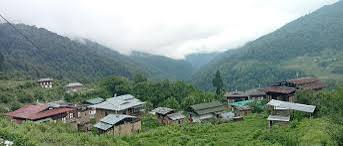
Govt. says no land will be taken before compensation, replacement land or livelihood support is secured under Bhutanese law and ADB safeguards
The government has assured communities affected by the Bunakha Hydropower Project that compensation, resettlement and livelihood restoration will be carried out with due diligence, in accordance with Bhutanese laws and additional safeguards required by the Asian Development Bank (ADB).
The assurance comes as the project prepares for the acquisition of private land and implementation of measures to support households whose land, homes or natural-resource-based livelihoods will be affected by the project.
The Bunakha Resettlement Plan identifies 44 affected households, comprising 30 titleholder households and 18 resource-user households, with an overlap of four households to avoid double counting. Of the 44 households, 35 are classified as severely affected and nine as vulnerable affected households.
The government says the resettlement framework has been developed to comply simultaneously with Bhutan’s legal requirements and ADB’s safeguard standards. These include the Land Act of Bhutan 2007, Land Acquisition and Compensation Rules and Regulations 2022, Land Rules and Regulations 2025 and National Energy Policy 2025, together with ADB’s Safeguard Policy Statement 2009 on involuntary resettlement.
“The approach is intended to ensure that ADB safeguards supplement, rather than replace, protections already available under Bhutanese law. A key safeguard is that affected families will not be displaced before they have received the compensation and assistance to which they are entitled,” the Ministry of Energy and Natural Resources (MoENR) noted.
Under the resettlement plan, affected people can choose land-for-land compensation, cash compensation at full replacement cost, or a combination of the two. For private land, cash compensation will be based on the applicable government valuation rate with a 20 percent replacement-cost supplement, while structures will be compensated at current construction costs without depreciation deductions.
The sequencing is particularly important for households that depend on agricultural land.
Under Section 158 of the Land Act, the government cannot take possession of affected land until either substitute land has been registered in the affected household’s name or full cash compensation has been paid. For households opting for land-for-land compensation, the project therefore cannot take possession of existing land before replacement land is formally registered.
Replacement land will be identified through a statutory priority system, beginning with land in the same Chiwog, followed by the Gewog and then the Dzongkhag. The Dzongkhag Administration will conduct feasibility assessments to identify suitable State land. Households choosing land-for-land compensation will also receive support for developing the replacement land for agricultural use.
The project is expected to permanently acquire 31.38 acres of private land, while requiring about 1,108.46 acres of State Reserved Forest Land, representing 97 percent of the project’s total land requirement. The resettlement plan also recognises people who depend on natural resources even where they do not hold formal land titles.
In particular, 18 households at Chanachen that collect fiddlehead ferns, or Nakey, from the area to be submerged have been recognised as affected resource users. Their inclusion is significant because it extends project protection beyond registered landowners and provides for livelihood restoration and, where feasible, restoration of access to non-timber forest products.
The project has estimated a Nu 44.72 million resettlement budget, including Nu 26 million for compensation. The compensation estimate covers the full value of the 31.38 acres of private land based on a cash-compensation scenario. The valuation rate will also be indexed to the Consumer Price Index to reflect changes in prices between the original valuation and the time of payment. A further 10 percent contingency has been included to accommodate implementation variations.
The government has also sought to ensure that compensation reflects replacement costs rather than merely relying on outdated administrative valuations.
For private land, the Property Assessment and Valuation Agency rate will form the basis, with a 20 percent supplement and applicable transaction costs added. Structures will be valued using the Bhutan Schedule of Rates 2026, reflecting current construction and labour costs, without depreciation deductions. Households will also retain salvageable materials. Fruit trees and timber will be assessed separately, with additional compensation where necessary to cover the cost of re-establishing equivalent productive trees.
The project also provides additional protection for vulnerable households. The nine vulnerable households will be reassessed during the detailed measurement survey, while vulnerability screening will also be extended to non-titled resource users to ensure vulnerable families are not excluded simply because they do not own land.
Their entitlements include priority access to livelihood restoration, skills development and employment-related assistance, as well as additional consultation and implementation support.
Livelihood restoration is being treated as a condition for project implementation rather than a post-construction commitment. The programme must be operational before civil works begin in affected areas, while compensation must be completed before land possession or displacement. Contractor work programmes will also require certification that compensation and assistance have been delivered before construction begins in the relevant area.
For the one household expected to be physically relocated, additional assistance includes replacement housing or cash for self-relocation, transitional and rental support, a six-month food-security allowance, moving assistance and financial-management training where cash compensation is chosen. Support must be provided before the household vacates its existing residence, with at least 30 days’ written notice.
The government has also put in place grievance and appeal mechanisms. Affected households can challenge cadastral assessments and raise broader concerns through a free, two-tier grievance mechanism, while retaining their right to seek administrative or judicial remedies. Complaints are to be acknowledged within three working days, with Tier One resolution targeted within 10 working days.
“The stated objective is therefore not simply to compensate landowners for assets lost to hydropower development, but to ensure that all affected households and communities receive fair treatment, appropriate compensation and meaningful livelihood support according to the nature of their losses,” the ministry noted.
Meanwhile, the government says the broader lesson from previous hydropower projects is that compensation alone may not be sufficient. “The Bunakha project aims to ensure that communities bearing the local costs of hydropower development are protected from premature displacement and supported in restoring, and where possible improving, their livelihoods,” it noted.
Tashi Namgyal, Thimphu