

Bhutan continues to perform strongly on governance integrity indicators, but the Anti-Corruption Commission (ACC) has warned that underlying weaknesses in internal control systems could gradually erode public trust if not addressed through deeper institutional reforms.
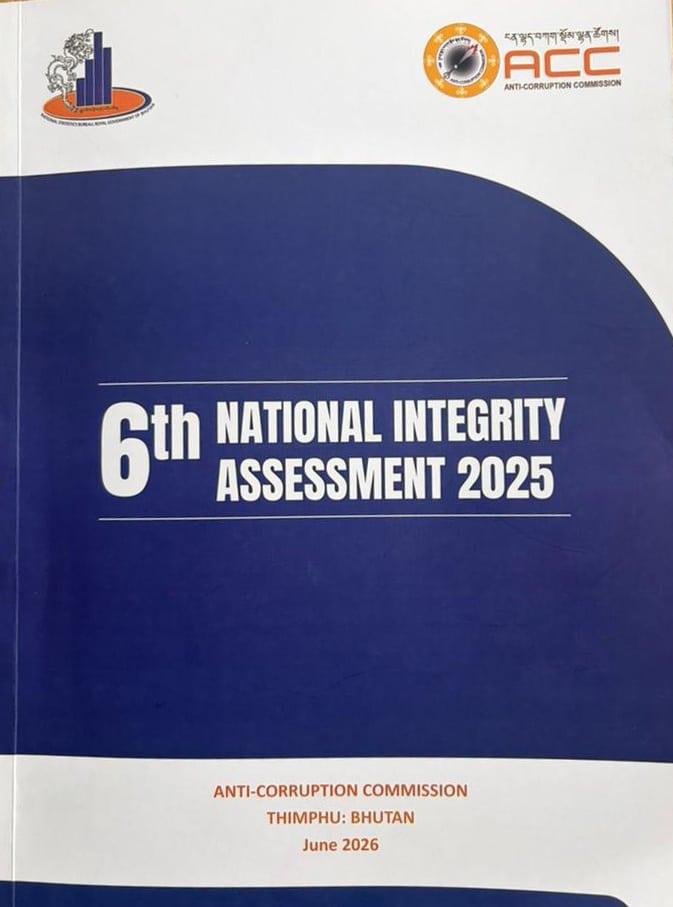
As outlined in the National Integrity Assessment (NIA) 2025 Report, which was launched by Prime Minister Dasho Tshering Tobgay on June 26, Bhutan’s overall integrity score is 8.15, which places Bhutan in the “Good” category, while the Public Sector Integrity score of 8.41 is rated “Very Good”, reflecting generally strong frontline service delivery and institutional ethics.
However, the ACC cautions that these headline achievements mask emerging governance risks that are less visible but potentially more damaging over time.
A key concern is the decline in the Corruption Control Systems score, which fell from 7.52 in 2022 to 6.70 in 2025. The drop signals weakening preventive and oversight mechanisms within institutions, even as direct bribery remains uncommon.
According to the report, Bhutan’s corruption landscape is increasingly shaped by “low-visibility” risks such as favoritism, informal influence, reciprocal arrangements and conflicts of interest, forms of misconduct that are harder to detect but can significantly distort fairness and decision-making.
The ACC argues that Bhutan has reached a stage where the challenge is no longer simply reducing corruption, but strengthening systems that prevent its subtle evolution. To address these risks, the Commission calls for tighter internal governance structures across public agencies. It recommends clearer separation of approval, execution and verification functions, stricter procedural standardization, improved documentation practices and mandatory disclosure of gifts and conflicts of interest.
The report also highlights persistent weaknesses in complaint handling and grievance redress systems, noting that many agencies still lack responsive and accessible mechanisms for citizens and employees. It urges institutions to ensure timely resolution of complaints, systematic feedback on actions taken and regular analysis of grievance patterns to identify recurring administrative failures.
A major institutional gap identified in the assessment is the limited protection for whistle blowers. The ACC warns that fear of retaliation continues to discourage reporting of misconduct. It therefore calls for robust legal and administrative safeguards to ensure confidentiality, anonymity where necessary and protection from punitive action against whistle blowers.
Beyond reporting mechanisms, the report places strong emphasis on strengthening accountability frameworks within government institutions. It recommends clearly defined job descriptions, standard operating procedures and codes of conduct to reduce ambiguity in roles and responsibilities. These, the ACC argues, must be backed by measurable performance standards that link ethical behavior, compliance and service quality to career progression, incentives and promotion decisions.
The Commission also stresses the need for regular internal audits, performance reviews and compliance checks as routine governance tools rather than reactive interventions. It further calls for consistent and transparent disciplinary action against misconduct to reinforce deterrence and institutional discipline.
A central concern of the NIA 2025 is what it describes as “soft corruption,” informal practices such as preferential treatment, personal influence and unequal access to services. While not always illegal, these practices undermine fairness and weaken public confidence in institutions.
To counter these risks, the ACC recommends a stronger “Digital First” governance model, expanding end-to-end online public services to reduce face-to-face interactions and discretionary decision-making. Digitalization, the report notes, is critical to improving consistency, transparency and traceability in service delivery.
The Commission also urges greater proactive disclosure of service standards, eligibility criteria, processing timelines, fees and procurement information, arguing that transparency is essential to reducing dependence on personal connections. Improved citizen engagement mechanisms, including responsive help desks, digital query systems and real-time notifications, are also recommended to make public services more accessible and predictable.
In addition, the ACC calls for sustained public education campaigns and regular ethics training for civil servants to reinforce professional values and strengthen awareness of citizens’ rights and grievance mechanisms.
While acknowledging Bhutan’s strong overall integrity performance, the report concludes that maintaining progress will depend on moving beyond compliance-based governance toward a more resilient system built on transparency, accountability and institutional vigilance.
The ACC warns that without timely reforms, subtle governance weaknesses could accumulate and gradually undermine the country’s long-standing reputation for clean governance.
Meanwhile, the Commission argues that strengthening internal controls today is essential not because corruption is rising sharply, but because Bhutan’s governance system must evolve to prevent it from taking more complex and harder-to-detect forms in the future.
Sangay Rabten, Thimphu