

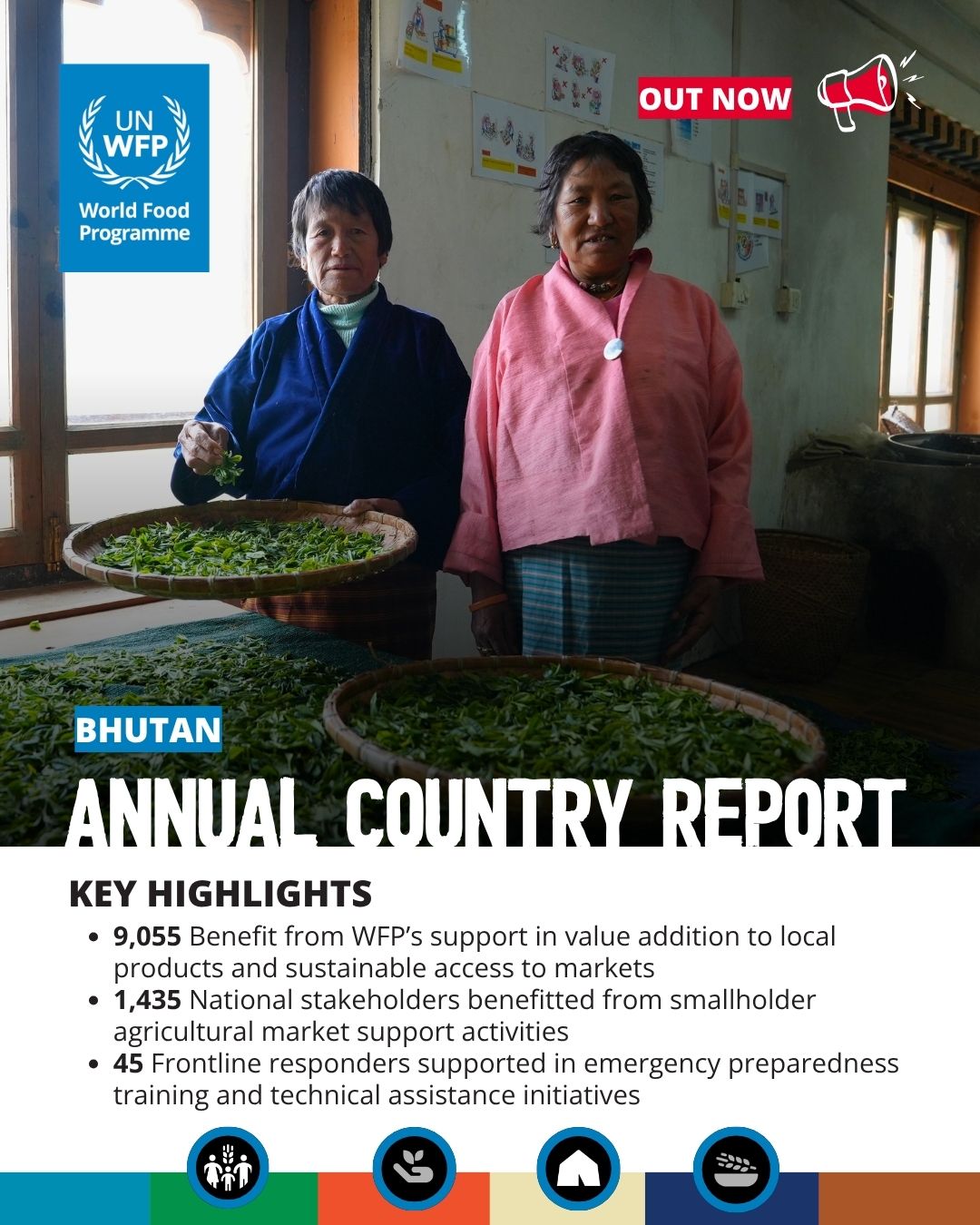
The World Food Programme (WFP) in Bhutan has reported significant progress in strengthening food security, nutrition, and climate resilience in 2025, surpassing several key targets while aligning its interventions with Bhutan’s ambitious economic transformation agenda under the 13th Five-Year Plan and the Vision 2050 roadmap.
According to WFP Bhutan’s 2025 Annual Country Report, launched last month, the agency’s focus on capacity building, nutrition-sensitive agriculture, and value chains has strengthened resilience among farmers, cooperatives, women, youth, and local institutions against climate shocks and food insecurity.
WFP’s programmes align with Bhutan’s 13th Five-Year Plan and the 21st Century Economic Roadmap, which prioritises agriculture and aims for tenfold economic growth by 2050 through a shift to high-value, export-oriented farming. Its interventions also support the Gelephu Mindfulness City (GMC) initiative, expected to create new economic opportunities.
Through its Building Resilient Commercial Smallholder Agriculture (BRECSA) project, WFP developed Agriculture Resilience Plans in districts neighboring the GMC, including Trongsa, Tsirang, and Zhemgang, with the initiative expected to serve as a model for replication across other parts of Bhutan.
In 2025, WFP surpassed several programme targets, with participation in capacity-strengthening initiatives more than doubling expectations through work in nutrition-sensitive agriculture and value chains. The agency trained community mobilizers, district stakeholders, women, and youth in agriculture, nutrition, and behavior change, while establishing 25 nutrition model gardens and providing training on climate-smart farming, dietary diversity, livestock, and mushroom cultivation.
The agency also established district-level Multi-Stakeholder Platforms to facilitate enterprise development around key agricultural commodities, while supporting stakeholders to formalize these platforms as sustainable entities.
Sector Investment Plans were developed for coffee, spices, dairy, piggery, and poultry, creating improved commercial opportunities for farmers and cooperatives.
According to the report, WFP achieved twice its target for smallholder farmer group membership and supported more than 100 farmer groups across target districts. More than 300 value chain actors, including private sector entrepreneurs and market players from Thimphu, Phuentsholing, and Paro, also benefited from training and market linkage support.
The report shows that 50 percent of targeted smallholder farmers reported increased production of nutritious crops in 2025. Agricultural sales through WFP-supported aggregation systems also exceeded expectations, with farmers selling 650 metric tonnes of produce—well above the 500 metric tonnetarget set in 2024.
WFP attributed this achievement to targeted training programmes in dairy, poultry, piggery, vegetables, and spices, along with extensive community mobilization across 37 gewogs and the establishment of Multi-Stakeholder Platforms in all target districts.
Despite these achievements, WFP acknowledged several challenges.
The agency noted that strong partnerships with government institutions, farmers, cooperatives, and civil society organizations were critical to effective programme delivery. However, limited participation of women and youth—largely due to household responsibilities—remains a challenge, alongside the need for regular follow-up after training to ensure sustainability.
Nutrition education materials and campaigns targeting women and youth groups were developed as part of nutrition-specific programmes and supported school-based programmes by linking nutrition sensitive farming with schools. These supports were implemented as Bhutan faces rising malnutrition challenges.
While the introduction of the School Menu Planner Plus has been successful, WFP said its long-term impact will depend on continued user training and sustained application.
The agency also highlighted the need to strengthen Bhutan’s national emergency preparedness systems to respond to all types of emergencies.
On resource mobilization, WFP said Bhutan’s reclassification as a lower middle-income country has reduced the likelihood of receiving support from traditional donors, creating additional funding pressures for the Country Office.
To address this, WFP said it is diversifying its donor base, demonstrating measurable results to existing partners, and enhancing programme visibility. Increased efforts were made for better visibility and improved media partnerships.
WFP added that it has strengthened internal accountability systems, with staff receiving training to prevent fraud, corruption, harassment, and abuse of authority, while improving risk awareness related to health, safety, and security.
WFP continued to strengthen partnerships with the Ministry of Agriculture and Livestock, Ministry of Education and Skills Development, Ministry of Health, and Ministry of Home Affairs, alongside local governments.
Its collaboration with Tarayana Foundation was also strengthened through the deployment of 37 Sanam Jabchorpas, who supported community mobilization, nutrition-sensitive agriculture, and market linkage activities for smallholder farmers.
WFP said these partnerships remain central to achieving sustainable food systems and improving nutrition outcomes in Bhutan’s most vulnerable communities.
Sangay Rabten, Thimphu