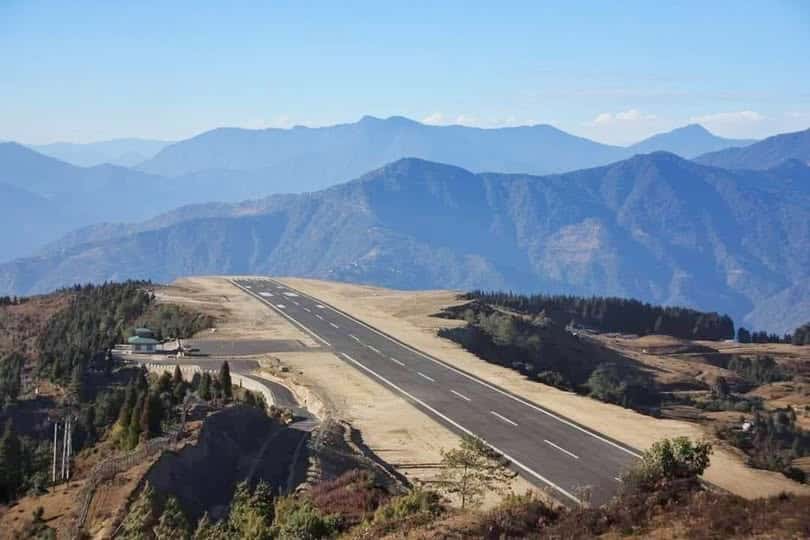
Eastern Bhutan’s only airport at Yongphula in Trashigang has long faced challenges stemming from difficult terrain, adverse weather, and runway limitations, all of which undermine operational reliability. However, some of these issues could soon be addressed, with the government allocating Nu 38 million under the 13th Five-Year Plan (FYP) for a proposed runway lighting system.
The allocation follows the government’s decision to abandon an earlier proposal to install a Precision Approach Path Indicator (PAPI) system after technical consultations and assessments.
According to the Ministry of Infrastructure and Transport (MoIT), the PAPI system which provides glide path guidance to pilots during landing, would have offered limited operational benefits given Yongphula’s challenging terrain and weather conditions.
Instead, the funding will be redirected towards assessing and installing a runway lighting system aimed at improving visibility and enabling safer take-offs and landings during low-light and poor weather conditions.
The decision comes amid growing concerns over operational challenges at Yongphula Airport, where mountainous terrain, frequent cloud cover, mist, and poor visibility often disrupt flight operations.
A ministry official said the project will be implemented in phases, beginning with a detailed technical and feasibility assessment in the 2027–2028 financial year.
“The installation and full commissioning of the runway lighting system at Yonphula Domestic Airport is planned in a phased manner,” the Ministry stated. “Subject to the outcome of the assessment and completion of resurfacing works, the installation of the runway lighting system is expected to commence thereafter.”
The full commissioning of the system is tentatively projected for the 2028–2029 financial year.
While the removal of the PAPI component has raised questions about the absence of glide slope guidance at the airport, the Ministry shared that the runway lighting system would still significantly strengthen operational safety.
According to an official, the proposed lighting infrastructure will improve runway conspicuity and provide critical visual references for pilots, particularly during low visibility conditions when terrain and runway markings become difficult to distinguish.
The Ministry said that a properly designed runway lighting system would provide improved runway alignment and depth perception cues through medium- and high-intensity runway edge lights. “These visual aids are expected to help pilots maintain proper lateral alignment and runway perspective, particularly in sloping or terrain-constrained environments such as Yonphula.”
Threshold and runway end lights are also expected to improve visibility of runway limits, reducing the risk of runway misidentification during adverse weather conditions including fog, mist, and cloud cover.
“In low visibility conditions, lighting is often more visible than terrain or runway markings,” the Ministry said, adding that the system would provide the visual references necessary for pilots to safely manage descent and landing operations.
Moreover, an official shared that while the runway lighting system would not replace instrument-based glide slope guidance, it would substantially improve the airport’s visual operational capability during difficult weather conditions.
The investment is being viewed as part of broader efforts to strengthen domestic air connectivity and improve aviation infrastructure in eastern Bhutan, where reliable air services remain critical for connectivity, emergency access, tourism, and regional economic development.
Residents and frequent travelers from eastern dzongkhags have long called for improvements to Yonphula Airport.
A second-year student at Sherubtse College, Tshering Tobgay, said the current situation causes significant inconvenience, especially during the monsoon season when many students and residents depend on flights for travel. “Most of the time, there will be either delays or cancellations because of bad or foggy weather,” he said.
Sonam Zangmo from Samdrup Jongkhar, who frequently travels to Thimphu for medical check-ups, said improved airport infrastructure would greatly benefit patients requiring emergency referrals from eastern dzongkhags.
Meanwhile, Yonphula Domestic Airport was originally constructed by the Indian Army in the 1960s as a basic airstrip. For decades, the airport remained largely underutilized until the government initiated major renovation works in the early 2000s to transform it into a functional domestic airport.
Although the project was initially expected to be completed in 2010, the airport was eventually inaugurated in December 2011. However, operations were short-lived. Within six months, Drukair suspended flights citing safety concerns, leading to the closure of the airport for runway repairs.
Reports at the time indicated that budget limitations had resulted in only partial “patchwork repairs” to sections of the runway, which had not undergone major resurfacing since the 1960s. The airport later reopened in January 2013 following a complete resurfacing of the runway, but scheduled commercial operations continued to face technical and regulatory challenges.
Among the major concerns raised were the steep runway gradient, difficult terrain, strong crosswinds, and limited visual guidance for pilots during landing and take-off operations. Drukair had also highlighted concerns over the airport’s runway profile and surrounding hillocks, particularly during poor weather conditions.
In October 2013, the airport was again closed to allow major structural repairs and improvements to safety infrastructure. The closure lasted more than four years before the airport officially reopened in October 2017 after runway upgrades were carried out to improve operational standards.
Nidup Lhamo, Thimphu