

The country’s labour market showed signs of recovery and resilience in the second quarter of 2026, with employment levels rising and unemployment declining, according to the latest Labour Force Survey Report released by the National Statistics Bureau (NSB).
The latest figures indicate that more Bhutanese, including young people, are finding employment opportunities. However, the data also highlights persistent structural challenges, particularly low labour force participation among women and the need to create more diverse and higher-value employment opportunities.
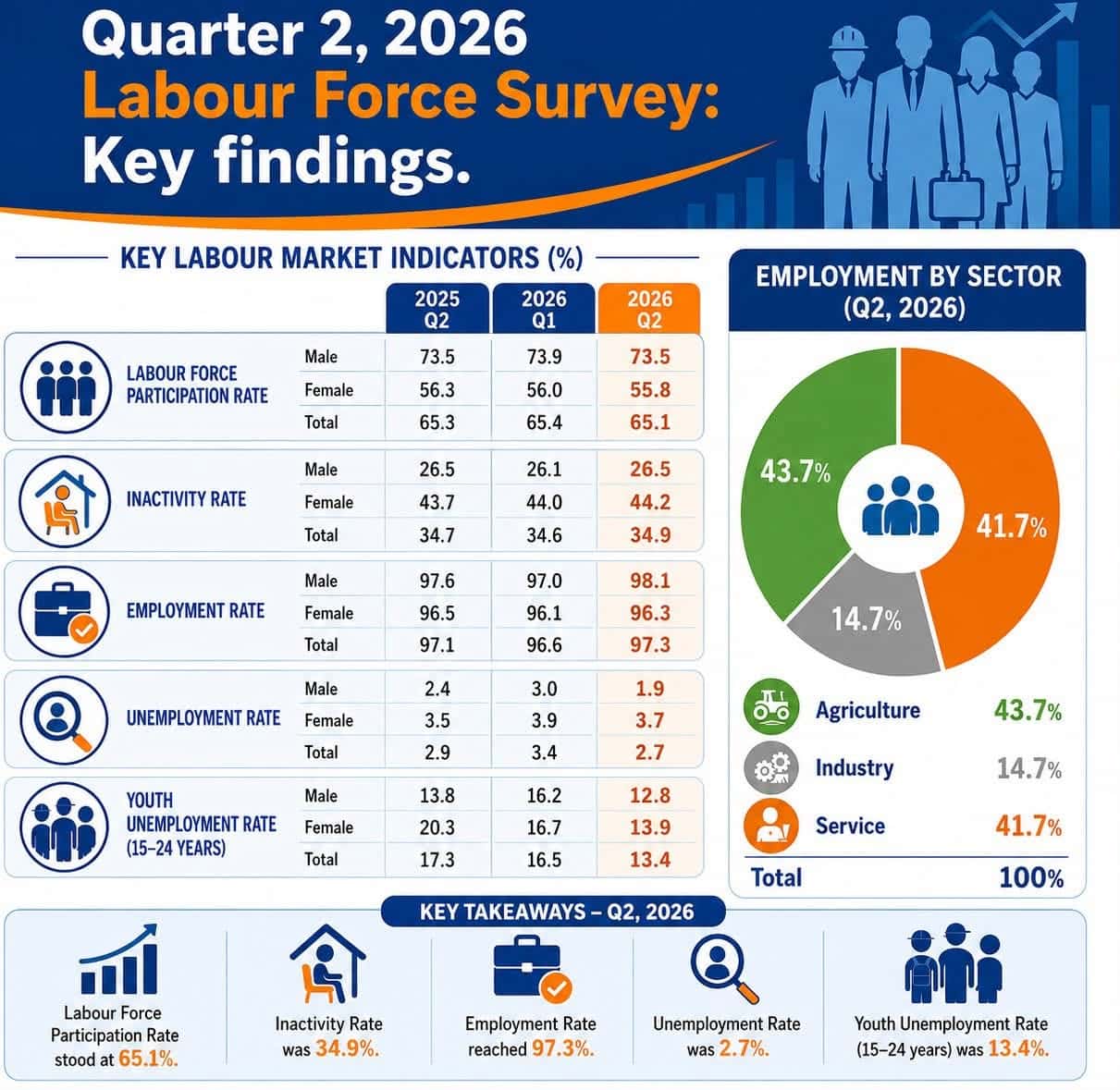
According to the survey, the overall employment rate increased to 97.3 percent in the second quarter of 2026, compared to 96.6 percent in the first quarter. At the same time, the national unemployment rate declined from 3.4 percent to 2.7 percent, indicating an improvement in the ability of job seekers to secure employment.
The decline in unemployment comes at a time when Bhutan continues to focus on strengthening private sector growth, expanding economic opportunities and addressing youth employment challenges.
One of the most encouraging developments was the improvement in youth employment. The unemployment rate among young people aged 15 to 24 years declined to 13.4 percent, down from 16.5 percent in the previous quarter. The reduction was recorded among both young men and women, suggesting improved opportunities for Bhutan’s emerging workforce.
The NSB said the survey provides critical information to understand labour market movements and support evidence-based policymaking.
The bureau stated that the Labour Force Survey follows nationally and internationally accepted statistical standards, ensuring that the data remains reliable, consistent and comparable over time. Such information is essential for designing policies related to employment creation, skills development and economic planning.
Despite the positive employment trends, the survey reveals that Bhutan’s labour force participation remains a key challenge. The labour force participation rate stood at 65.1 percent in the second quarter, slightly lower than 65.4 percent recorded in the first quarter.
This means that while employment opportunities are improving, a significant portion of the working-age population remains outside the labour market, either because they are not seeking employment or are unable to participate.
The gender disparity remains particularly notable. Labour force participation among men stood at 73.5 percent, while participation among women was significantly lower at 55.8 percent. The inactivity rate among women was 44.2 percent, compared with 26.5 percent among men.
The figures highlight the need for stronger measures to encourage greater female participation in the economy. Expanding access to skills training, childcare services, flexible employment arrangements and entrepreneurship opportunities could help bring more women into the workforce.
Sector-wise, agriculture continues to remain the largest source of employment, accounting for 43.7 percent of total employment. The service sector followed closely with 41.7 percent, while industry accounted for 14.7 percent.
The figures show that although Bhutan’s economy is gradually shifting towards services and emerging sectors, agriculture continues to play a central role in providing livelihoods, particularly in rural communities.
However, the changing economic landscape also points to the need for greater employment diversification. Expanding opportunities in sectors such as tourism, technology, manufacturing, renewable energy and entrepreneurship will be essential to create more productive and sustainable jobs.
The decline in unemployment, particularly among youth, is a positive signal. However, the quality of employment remains equally important. Creating jobs that provide better income opportunities, career growth and long-term security will be crucial as Bhutan seeks to transform its economy.
The NSB emphasised that regular labour force surveys play an important role in tracking employment patterns and identifying emerging challenges. Reliable labour statistics allow policymakers, businesses, researchers and development partners to better understand workforce dynamics and design targeted interventions.
As Bhutan continues its economic transformation, the latest labour market data presents a mixed but encouraging picture—more people are working, unemployment is declining, but greater efforts are needed to expand participation, especially among women, and create a more inclusive and future-ready workforce.
Sherab Dorji, Thimphu