

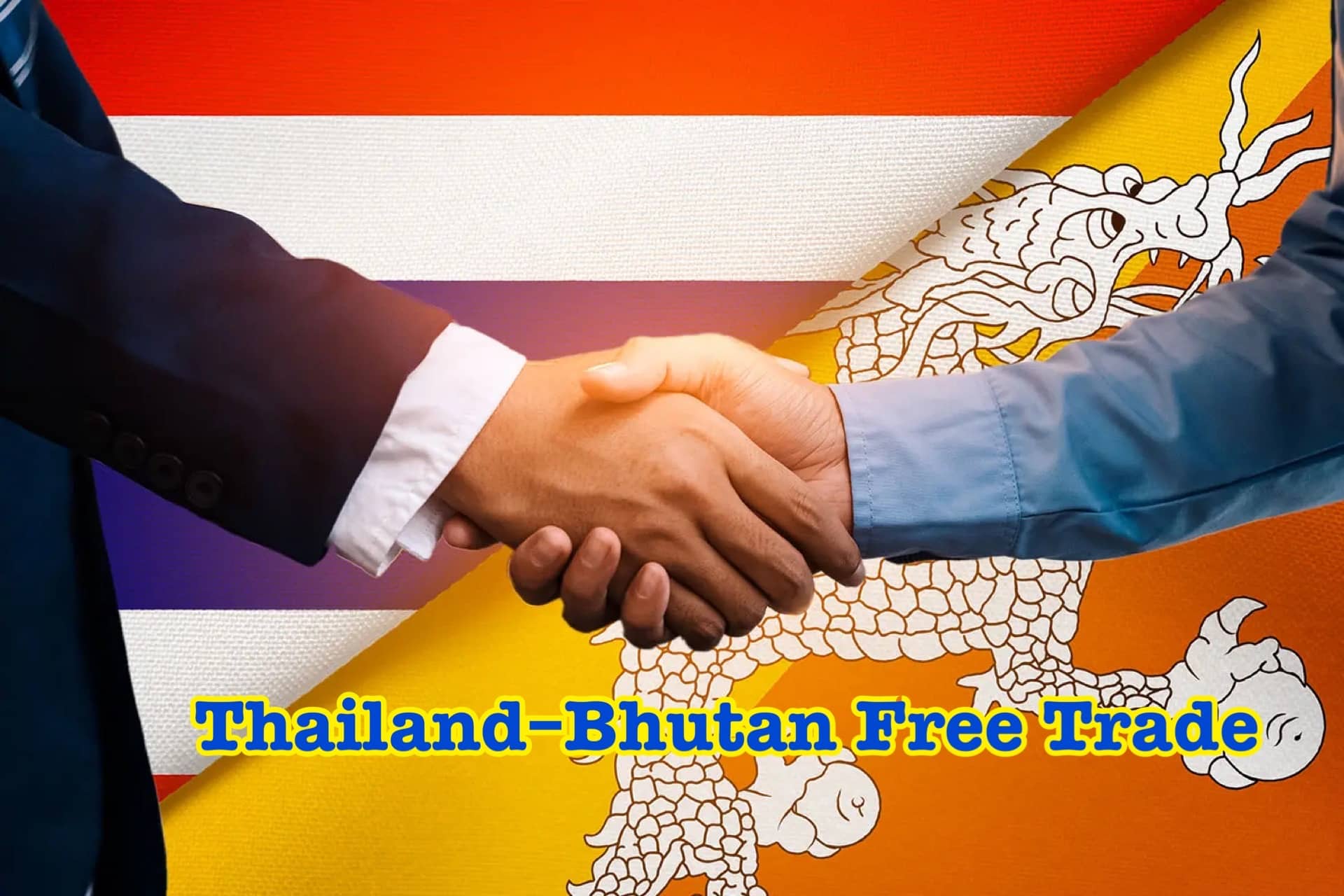
In a milestone for Thailand-Bhutan trade, Thailand’s Cabinet on June 10, 2026, approved the Thailand-Bhutan Free Trade Agreement (FTA) and authorized its submission to Parliament under Section 178 of the Thai Constitution. The move comes after both countries concluded negotiations and signed the agreement as part of efforts to strengthen long-term economic relations. This paves the way for Thai parliamentary endorsement and its anticipated entry into force on January 1, 2027.
The FTA covers ten chapters and four annexes, addressing tariff liberalization, trade facilitation, economic cooperation and investment promotion. It also includes provisions related to Bhutan’s Gelephu Mindfulness City (GMC), positioning the emerging economic hub as a potential destination for Thai investment.
Under the agreement, Bhutan will eliminate customs duties on 99.8 percent of tariff lines for Thai products, while Thailand will provide duty-free access for 94 percent of Bhutanese products entering its market.
The arrangement would offer Bhutan unprecedented access to Southeast Asia’s second-largest economy while opening avenues for Thai businesses seeking opportunities in Bhutan’s emerging sectors.
For Bhutan, the agreement comes at a critical time as the country seeks to diversify its economy, reduce dependence on a narrow export base and attract foreign direct investment. It would create new opportunities for Bhutanese agricultural products, including potatoes, green tea, fruit juices, jams, medicinal herbs, cordyceps and matsutake mushrooms, which could gain improved access to Thailand’s large consumer market.
Trade data illustrates both the opportunities and challenges ahead.
In 2023, Bhutan imported goods worth approximately Nu 1.76 billion from Thailand, including electronics, medical equipment, industrial machinery, processed foods and consumer products. During the same period, Bhutan’s exports to Thailand amounted to only Nu 11.25 million, largely consisting of high-value niche products such as cordyceps, matsutake mushrooms and herbal products.
The figures highlight a substantial trade imbalance that Bhutan hopes to narrow through enhanced market access and increased export competitiveness.
Economic studies conducted by Thai authorities, reported in Thai media project substantial benefits from the agreement. Thailand estimates that exports to Bhutan could increase by between 229 and 266 percent annually, while Thailand’s GDP could grow by between 4.13 billion and 4.34 billion baht per year.
Meanwhile, Bhutanese parliamentarians have welcomed the development, describing it as a strategic opportunity to expand Bhutan’s economic partnerships beyond its traditional markets. Lamgong-Wangchang Member of Parliament (MP), Sonam Tashi said that this agreement will give Bhutanese producers preferential access to one of Southeast Asia’s largest markets while providing Bhutanese consumers and businesses access to a wider range of goods at potentially lower costs.
“The FTA opens the door but the benefits will depend on how effectively Bhutanese producers, entrepreneurs and institutions walk through it. The agreement provides preferential access to a major regional market and our task now is to enhance competitiveness, improve quality, attract investment and seize the opportunities arising from increased trade, tourism and economic cooperation with Thailand,” he said.
Another MP said the agreement could help Bhutanese producers access a sophisticated regional market while encouraging local industries to improve competitiveness.
“This agreement opens an important gateway into Southeast Asia. The challenge now is ensuring that our farmers, entrepreneurs and exporters are prepared to meet market standards and take advantage of the opportunities being created,” he said.
Several parliamentarians also highlighted the potential role of the agreement in supporting the success of Gelephu Mindfulness City (GMC).
“The inclusion of GMC within the framework of the FTA sends a strong signal to investors. It demonstrates that Bhutan is creating an enabling environment for international partnerships and long-term economic cooperation,” one parliamentarian noted.
Beyond traditional trade, the agreement is expected to stimulate investment cooperation in tourism, wellness industries, digital infrastructure, renewable energy and services.
Particular attention has been placed on GMC, where Thai investors are expected to explore opportunities in hospitality, healthcare, wellness tourism and urban development.
Among the emerging sectors expected to benefit are organic agriculture, eco-tourism, wellness tourism, handicrafts and renewable energy.
Bhutan’s growing reputation for organic products and sustainable tourism aligns well with increasing consumer demand in Thailand for environmentally responsible products and experiences.
The agreement is also expected to strengthen people-to-people ties that have long underpinned relations between the two kingdoms.
Thousands of Bhutanese travel to Thailand annually for education, healthcare and business, while Thailand remains one of the most popular destinations for Bhutanese tourists and students. Educational exchanges, scholarship programmes and cultural cooperation have further strengthened bilateral relations over the years.
Meanwhile, for Bhutan, the agreement represents more than a trade deal. It is a strategic step toward economic diversification, greater regional integration and the realization of new opportunities in sectors ranging from agriculture and tourism to digital innovation and sustainable development.
Tashi Namgyal, Thimphu