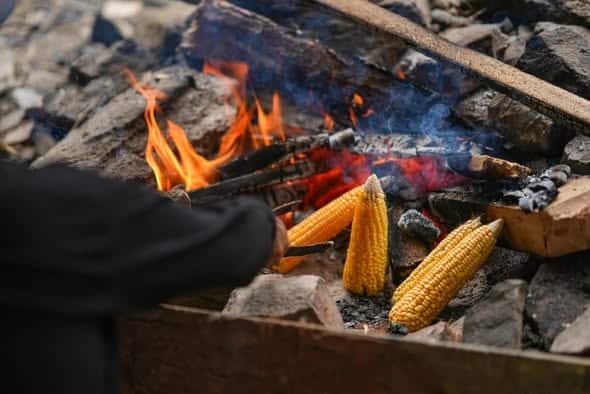
Lagging local production fuels vendors to transport maize all the way from bordering Indian towns
Along one of Bhutan’s busiest corridors, the sight and smell of freshly roasted maize cobs have become a familiar roadside experience. From the outskirts of Thimphu to the winding stretches toward Punakha, small vendors line the highway, tending charcoal fires and serving roasted corn to a steady stream of travelers.
What appears to be a simple roadside trade, however, reveals a deeper story about Bhutan’s agricultural economy – one where strong consumer demand is increasingly being met through imports rather than local production.
Despite maize being widely cultivated in Bhutan, particularly in rural areas, farmers and traders along the highway say that domestic supply alone is no longer sufficient to sustain the growing demand for roasted corn. As a result, a significant portion of maize sold along the route is sourced from across the border, transported from Indian towns near the southern belt.
“Local maize finishes quickly, especially during peak tourist months,” says Kado, a roadside vendor in Thinleygang. “We depend on imports to keep the business running throughout the season. Otherwise, we would have nothing to sell for weeks.”
The roadside maize trade has evolved into a reliable source of income for many small-scale vendors. For travellers, it is an affordable and convenient snack. For sellers, it represents a steady daily earning opportunity, particularly during weekends and holiday seasons when traffic volumes increase.
This reliance on imported maize has raised concerns among farmers and agricultural officials, who see it as a missed opportunity for strengthening domestic production and rural livelihoods.
In the warmer subtropical regions of southern Bhutan—where agro-climatic conditions are ideal for maize cultivation—large tracts of arable land remain underutilized or fallow. Farmers say a lack of market linkage, labour shortages, and limited incentives have constrained production, even as demand continues to grow in urban and peri-urban markets.
“We used to grow more maize before,” says Karma Dema, a farmer from Tsirang. “But with fewer people working on farms and no guaranteed buyers, many fields are left unused. If there was a proper system to connect us to markets like Thimphu, we would definitely produce more.”
Agriculture officials acknowledge that while maize remains a staple crop in Bhutan, its commercial potential—particularly in linking production to specific markets such as roadside vendors—has not been fully realised.
“There is a clear demand-supply gap,” says an agriculture extension officer based in Punakha. “What we are seeing along the highway is a thriving market. The question is why local farmers are not able to fully benefit from it.”
Buyers, meanwhile, express a preference for locally grown maize, citing its taste and freshness. However, availability remains inconsistent.
“Local maize is always sweeter and better. But most of the time, vendors say they don’t have enough. So we end up buying whatever is available,” laments Dorji Wangdi, a regular commuter between Thimphu and Punakha.
For vendors, the choice between local and imported maize is often driven by practicality rather than preference. Imported maize, they say, is more readily available in bulk and arrives in a more consistent form, making it easier to manage daily sales.
“It’s not that we don’t want local maize,” says Ngawang Pem, a vendor in Mendagang. “But supply is unpredictable. With imported maize, we can plan our business better.”
Agriculture officials argue that this gap between demand and domestic supply presents an opportunity for policy intervention. “By investing in maize production in subtropical regions, improving post-harvest handling, and creating direct supply linkages to roadside vendors, Bhutan could reduce its dependence on imports while boosting rural incomes,” the extension officer reiterates.
“There is potential to develop a value chain specifically around maize for roasting,” he further adds. “If farmers are supported with seeds, irrigation, and market access, and if vendors are linked directly to producers, this could become a sustainable local industry.”
Such an approach could also contribute to broader national goals, including food self-sufficiency, rural employment, and the productive use of fallow land. Farmers in southern districts say they would welcome such initiatives, particularly if they include guaranteed purchase arrangements or cooperative models that reduce market uncertainty.
“If we know there is a stable market, we will grow more,” a farmer from Sarpang opines. “Right now, the risk is too high for many of us.”
At the same time, vendors along the highway say they would prefer sourcing locally if supply chains were more reliable and pricing competitive.
“Buying local would reduce transport costs and support our own farmers,” Kado adds. “But the system has to work for both sides.”
Tashi Namgyal, Tsirang