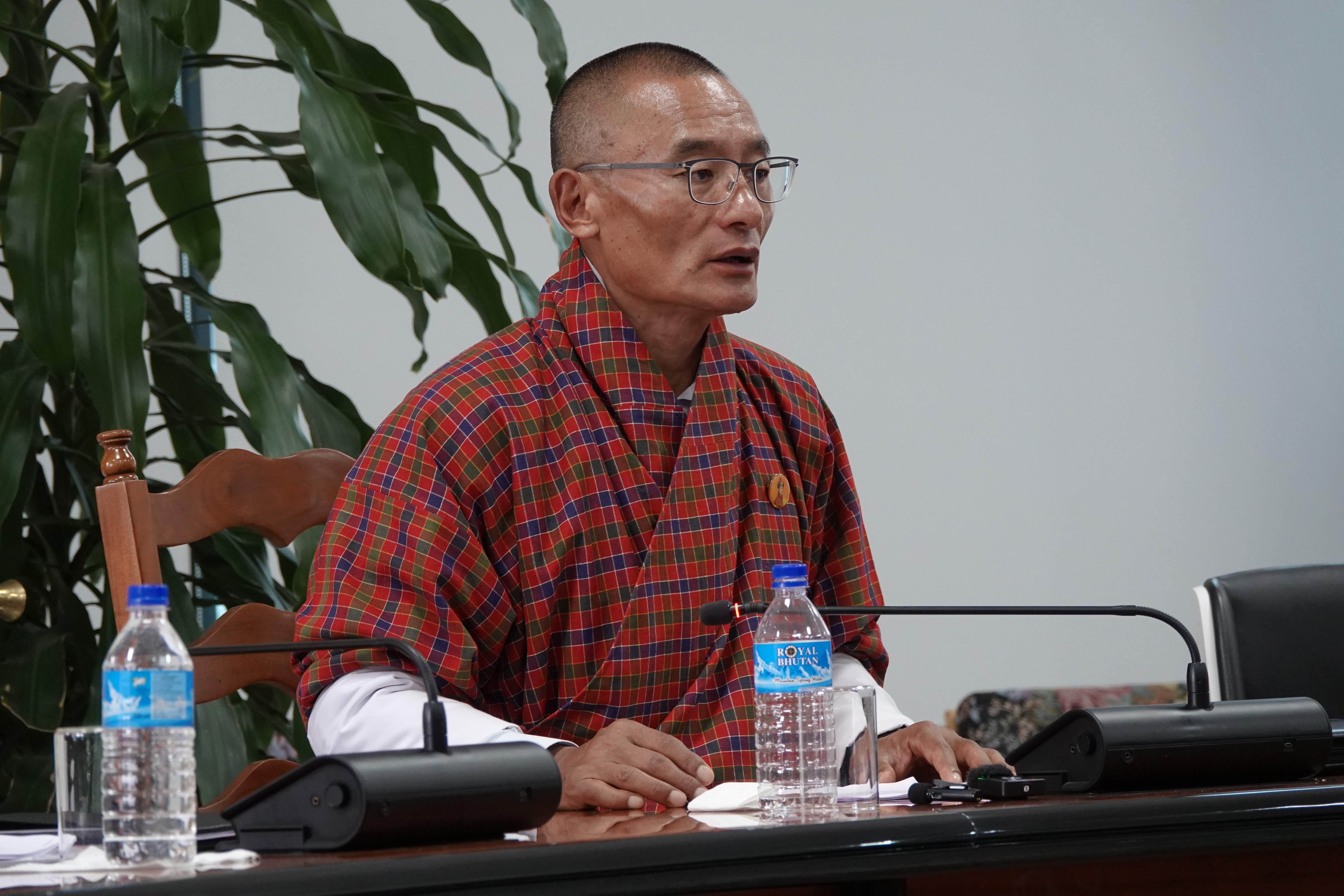
Prime Minister (PM) Dasho Tshering Tobgay has said that Bhutan could indirectly benefit from stronger coordination between India’s Central Government and the Government of West Bengal following the formation of a new government in the eastern Indian state.
Responding to a question during the 28th Meet-the-Press session on whether Bhutan stands to gain from the emergence of a so-called “double engine government” in West Bengal, the PM emphasized that Bhutan respects India’s democratic processes and internal political choices.
“Bhutan respects the democratic choice of the people of India,” he said. “The formation of a government in West Bengal is an internal matter of India, and we look forward to working closely with both the Government of India and the Government of West Bengal.”
He underlined that Bhutan’s engagement with India is guided not by political configurations but by continuity, trust, and practical cooperation across key development sectors.
The PM highlighted the strategic importance of West Bengal for Bhutan, noting that the state serves as one of the country’s principal gateways to India and beyond. Through its ports, trade corridors, rail networks, and border infrastructure, West Bengal remains central to Bhutan’s external connectivity.
“West Bengal is of particular importance to Bhutan,” he said. “It serves as one of our principal gateways to India and onwards to the rest of the world through trade routes, transport networks, ports, and border infrastructure.”
He explained that a large share of Bhutan’s imports and exports pass through corridors connected to the eastern Indian region, making efficiency and coordination in this area directly relevant to Bhutan’s economic interests.
According to the PM improved coordination between India’s Central Government and the West Bengal state government could help accelerate a range of ongoing and planned initiatives that are important to Bhutan. These include trade and transit facilitation, border infrastructure upgrades, rail connectivity, movement of goods and people, and broader regional economic integration.
“Any arrangement that facilitates stronger coordination between the Central Government and the State Government has the potential to benefit us indirectly,” he said.
He added that smoother administrative alignment between different levels of government in India could reduce delays, improve implementation timelines, and enhance the overall efficiency of cross-border projects that Bhutan depends on.
Dasho Tshering Tobgay noted that Bhutan and India are currently engaged in discussions across multiple sectors, including trade and transit, transport connectivity, energy cooperation, border infrastructure development, and regional economic integration. Many of these initiatives require coordination across central and state authorities in India, particularly in transit states such as West Bengal.
He said that faster decision-making and better institutional coordination could help translate bilateral plans into timely implementation, ultimately benefiting both countries.
At the same time, the PM stressed that Bhutan’s relationship with India remains strong and stable regardless of political changes in any Indian state or at the Centre.
“That said, Bhutan’s partnership with India has remained strong regardless of which political party is in office, whether at the Centre or in the states,” he said. “What matters most is continued cooperation and the shared commitment to advancing projects that benefit both countries.”
He reiterated that the Bhutan–India relationship is rooted in deep historical ties, mutual trust, and a shared vision of development cooperation, which continues to guide engagement across all levels of government.
Looking ahead, the PM said Bhutan remains firmly focused on achieving practical and tangible outcomes that directly improve the lives of its people. These include better connectivity, smoother trade and transit systems, enhanced economic opportunities, and stronger integration into regional value chains.
“For Bhutan, the focus remains on achieving practical outcomes, better connectivity, smoother trade and transit, enhanced economic opportunities, and support for transformative initiatives such as the Gelephu Mindfulness City (GMC),” he said.
He added that flagship national initiatives such as the GMC will particularly benefit from improved regional coordination, as they depend heavily on efficient logistics, cross-border infrastructure, and seamless movement of goods and services.
The PM reaffirmed Bhutan’s commitment to working closely with all partners in India, both at the national and state levels, to further strengthen cooperation and ensure that development projects deliver real and lasting benefits for both countries.
Bhutan, he said, will continue to prioritize friendship, connectivity, and shared prosperity as the foundation of its engagement with India in the years ahead.
Sherab Dorji, Thimphu