

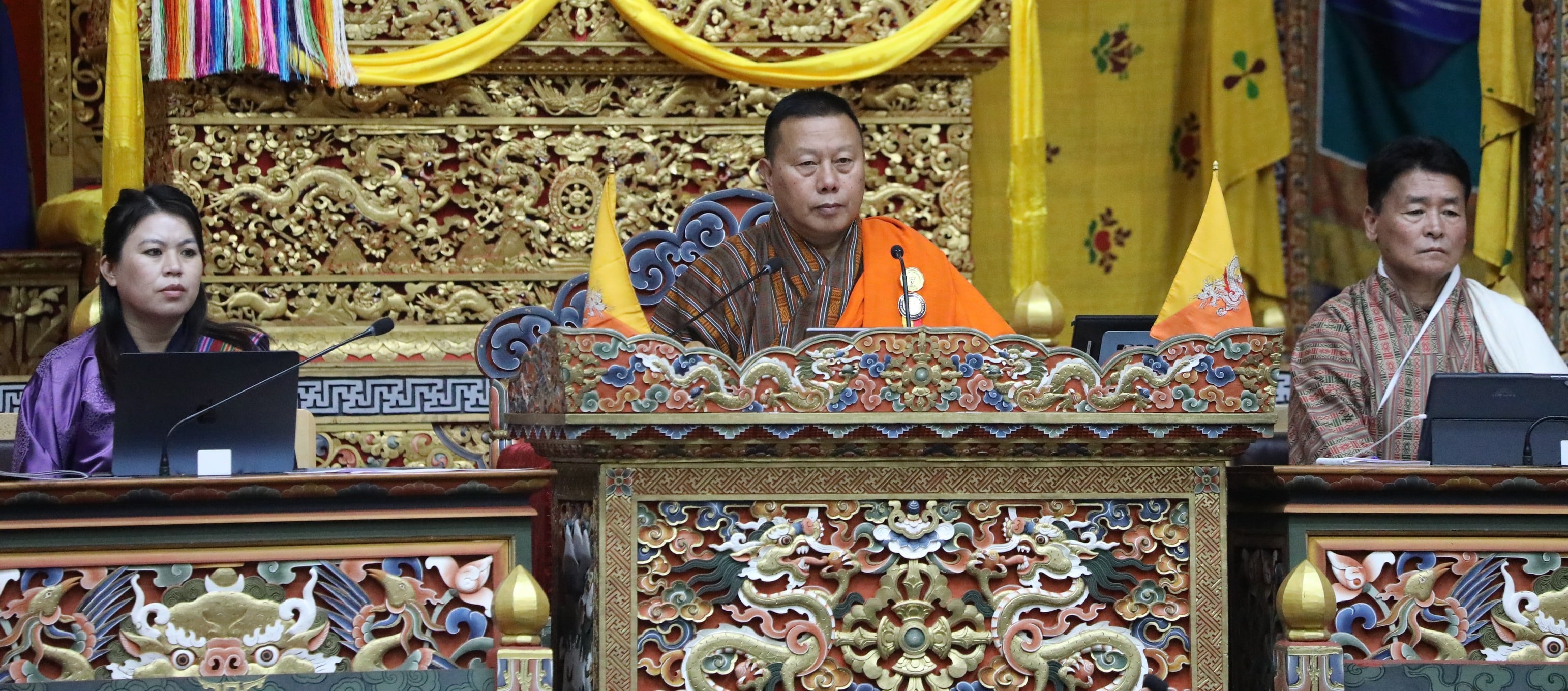
The Speaker of the National Assembly (NA) Lungten Dorji has directed the Ministry of Finance to table the long-awaited National Pension and Provident Fund (NPPF) Bill during the Summer Session of 2027, amid mounting concerns among Members of Parliament (MPs) over delays in introducing legislation considered critical for Bhutan’s long-term social security system.
The directive came during parliamentary deliberations on the Action Taken Report on the NPPF Bill, on May 22, 2026, where MPs across party lines expressed concern that despite nearly 18 months of discussion and consultations, tangible progress on the bill remained limited.
The Speaker underscored the importance of pension reform, stressing that the government should prioritise the legislation given its national significance. The debate reflected growing frustration among parliamentarians, many of whom questioned why a bill considered essential to the country’s future social protection framework had yet to be introduced.
Opposition Leader Dasho Pema Chewang raised concerns over what he described as insufficient clarity from the Finance Ministry regarding the bill’s progress and future direction.
“Though the Finance Ministry has pointed out many challenges in regard to the pension system in the country, the Ministry has not mentioned any way forward nor the details on what they have discussed with the relevant stakeholders,” he said.
Echoing similar concerns, MP Namgay Dorji of Khamdang-Ramjar questioned the lack of visible outcomes despite the extended period of consultations.
“Even after 18 months, the Ministry has not progressed and there isn’t any result or outcome from what they have discussed with the concerned agencies,” he said, urging the government to accelerate its work on the bill.
MP Rinchen Wangdi of Bartsam-Shongphu also stressed the need for measurable progress, arguing that delays without visible outcomes undermine the purpose of ongoing deliberations.
Meanwhile, South Thimphu MP Tshewang Rinzin raised concerns about representation within the pension governance system, noting that pensioners themselves are currently absent from decision-making structures.
“There is a need for at least one pensioner as a board member. Currently, the board does not have any pensioners as members,” he told the House, calling for greater inclusivity and representation in pension-related institutions.
Despite pressure from MPs for quicker action, Finance Minister Lekey Dorji cautioned against rushing legislation that could have significant long-term implications for the country’s fiscal and social protection systems.
He acknowledged the urgency surrounding the bill but maintained that pension reform required careful analysis and evidence-based policymaking.
“Such a bill will need time to make a proper decision,” the Minister said.
“Though the Ministry will be the happiest to submit the bill, there are very high chances that the bill might affect the country in the long run if it is not properly analysed and decided on the best possible approach,” he added.
The Finance Minister also pointed out that pension systems in several countries have encountered sustainability challenges, underscoring the importance of designing a framework that is financially viable and suited to Bhutan’s demographic and economic realities.
The parliamentary discussion gained further momentum following the presentation of the Action Taken Report by Kinzang Wangchuk, Deputy Chairperson of the Good Governance Committee.
The Committee highlighted growing structural concerns surrounding Bhutan’s pension system, including the absence of a comprehensive national pension policy, low coverage levels, and investment limitations affecting long-term sustainability.
According to the Committee, Bhutan’s current pension system remains highly limited in scope, covering only about 9 percent of the population, leaving large segments of society, including private sector employees, informal workers, and monastic communities—without adequate retirement protection.
“The current pension system covers only around 9 percent of the population, with continued difficulties in enrolling private sector and informal sector workers,” Kinzang Wangchuk told the House.
The Committee stressed that meaningful structural reform is urgently needed to ensure a more inclusive and sustainable pension framework capable of addressing the needs of a changing labour market and an ageing population.
At the same time, the Ministry of Finance informed Parliament that it has already begun work on a broader pension reform framework with technical assistance from the World Bank.
The reform process includes stakeholder consultations, actuarial modelling, and evaluation of various pension scenarios to determine the most sustainable and equitable path forward.
Many parliamentarians pointed to the need for pension mechanisms that include not only civil servants but also private sector workers, informal labourers, and monks, groups that often remain outside formal retirement protection systems.
Members stressed that the NPPF Bill must strengthen both the legal and institutional foundations of Bhutan’s pension architecture while ensuring greater equity, sustainability, and financial resilience over the long term.
Sherab Dorji, Thimphu