

Bhutan is positioning its agrifood sector as one of its most attractive investment destinations, backed by sweeping policy reforms, expanded foreign investment opportunities, and an ambitious national target to double the value of the sector by 2029.
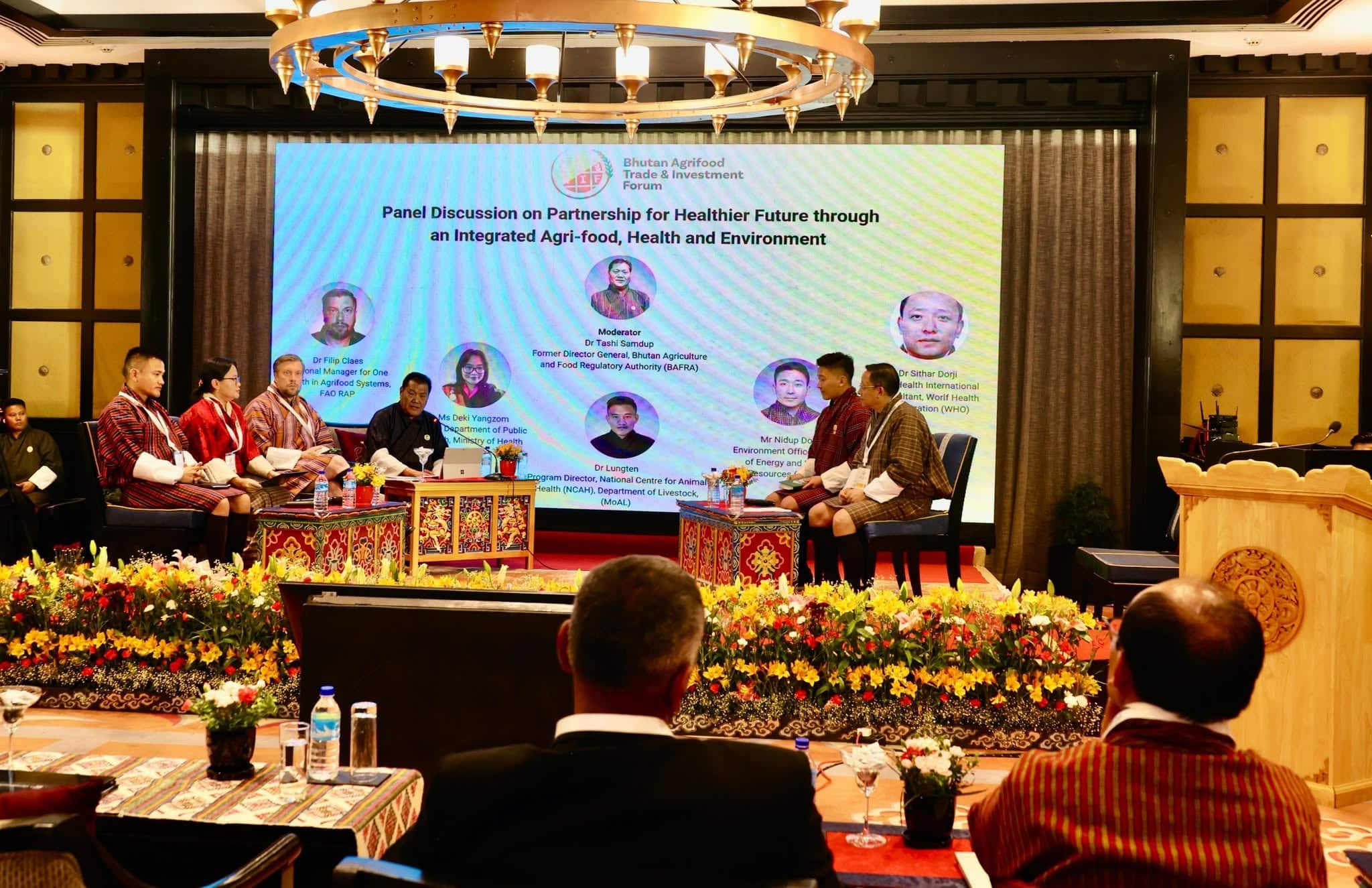
Speaking at the Bhutan Agrifood Trade and Investment Forum (BATIF) 2.0 held recently, Director of the Department of Agricultural Marketing and Cooperatives (DAMC), Tashi Dorji, said the country offers a unique combination of premium agricultural products, strategic market access, and a rapidly evolving policy environment aimed at scaling up investment.
He noted that Bhutan’s high-altitude farming systems, pristine environment, and growing portfolio of geographical indication (GI)-tagged products provide a strong branding advantage in international markets. Cardamom alone generated about Nu. 2 billion in export earnings in 2025.
Bhutan also benefits from duty-free access to key regional markets, including India and Bangladesh, while expanding trade linkages with the European Union, Singapore, Thailand, the Middle East, and Japan.
“Reforms across the Ministry of Agriculture and Livestock, the Ministry of Industry, Commerce and Employment, the Ministry of Finance, and the Royal Monetary Authority reflect a coordinated national strategy rather than isolated interventions,” Tashi Dorji said. “The goal is to transform the agrifood sector into a major driver of growth.”
Following Bhutan’s graduation from Least Developed Country (LDC) status in December 2023, the government has placed agriculture at the centre of its diversification agenda under the 13th Five-Year Plan (2024–2029), which targets a doubling of the agrifood economy.
Policy reforms have further strengthened investor confidence. The Foreign Direct Investment (FDI) Rules and Regulations 2025 now allow up to 100 percent foreign equity ownership in agriculture and livestock ventures, up from the previous 74 percent cap.
Agriculture remains a cornerstone of Bhutan’s economy, employing 41.7 percent of the national workforce in 2024 and contributing Nu. 39.6 billion, or 14.15 percent of GDP. Labour productivity in the primary sector has tripled since 2013, marking the strongest growth among all sectors.
Despite this progress, Bhutan continues to face a widening agricultural trade deficit. In 2024, the agri-trade gap stood at around Nu. 9 billion, with imports of Nu. 13.7 billion against exports of Nu. 3.9 billion. Key imports include rice, edible oils, dairy products, and cheese, with rice alone accounting for Nu. 2.91 billion.
To address this imbalance, the 13th Five-Year Plan sets ambitious targets. Agrifood GDP is projected to rise from Nu. 31 billion to Nu. 50 billion by 2029, requiring annual growth of 8.89 percent. Agricultural exports are expected to double from Nu. 3 billion to Nu. 6 billion, while rice and vegetable self-sufficiency is targeted to increase from 30 percent to 80 percent.
These goals are supported by an investment plan of Nu. 14.98 billion. About 72 percent will be directed toward smallholder resilience through productivity improvements, irrigation, electric fencing, and crop and livestock insurance. A further 13.5 percent is allocated to commercial-scale farming, while 12 percent will support access to finance, insurance, and business development services.
Domestic investment indicators are also improving. The GDP-to-public expenditure ratio has increased from 3.31 to 5.49, reflecting improved efficiency in public spending. The government also plans to expand Internal Control Systems (ICS) among farmer groups and cooperatives from eight to 50 by 2029, alongside the establishment of three federations for dairy, poultry, and cardamom producers.
Financial inclusion is expected to deepen further through the Royal Monetary Authority’s Financial Inclusion National Action Plan (FINAP), which aims to expand digital financial services in rural and agricultural communities.
Foreign investment interest is also rising. As of December 2025, Bhutan had 135 approved FDI projects valued at Nu. 73.76 billion, up from 121 projects the previous year.
To support future expansion, 11,557 acres of land across eight dzongkhags have been identified for agricultural investment. The National Land Commission Secretariat has approved 274 fallow land lease applications, while the FDI Rules 2025 formalise extendable 30-year state land leases for investors.
Institutional support is being strengthened through DAMC’s market facilitation services, Invest Bhutan’s one-stop coordination platform, blended finance mechanisms under the Ministry of Finance, and financial inclusion programmes led by the Royal Monetary Authority.
However, challenges remain. The Asian Development Bank’s Country Partnership Strategy 2024–2028 identifies the absence of a single-window approval system as a key barrier to investment. Stakeholders also cite the Nu. 20 million minimum FDI threshold, high lending rates, and limited agricultural financing products as constraints.
Several reforms are already underway, including the rollout of national crop and livestock insurance schemes, expanded credit access facilities, and ongoing legislative improvements to enhance the investment climate.
Tashi Dorji said BATIF 2.0 marks an important step in translating policy intent into real investment outcomes.
“Bhutan’s agrifood sector is entering a defining phase. The partnerships and investments forged today will shape the future of food systems, rural livelihoods, and inclusive economic growth,” he said.
Ministry of Agriculture and Livestock Secretary Thinley Namgyal said Bhutan has developed a 21st-century economic roadmap and is actively engaging potential investors to realise its agrifood transformation agenda.
Sangay Rabten, Thimphu