

India and Bhutan have further deepened their longstanding partnership across energy, connectivity, trade, education and development cooperation following Indian External Affairs Minister (EAM) Dr S. Jaishankar’s three-day official visit to Bhutan, which concluded on Friday.
The September 16–18 visit brought a series of tangible outcomes, including a new concessional line of credit for energy projects, progress on cross-border connectivity, expanded education opportunities, support for Gelephu Mindfulness City (GMC), new development projects and the completion of two-way digital payment connectivity.
The visiting Indian EAM received an audience with His Majesty The King Jigme Khesar Namgyel Wangchuck, called on Prime Minister Dasho Tshering Tobgay and held bilateral discussions with Foreign Affairs and External Trade Minister D.N. Dhungyel in Bumthang. The two sides reviewed the full range of bilateral cooperation as well as regional and international issues of mutual importance.
One of the most significant outcomes was in energy cooperation, traditionally a central pillar of Bhutan-India relations.
Bhutan and India welcomed the signing of the earlier agreement on a INR 4,000 crore concessional Line of Credit for energy projects in Bhutan, while also noting progress in hydropower cooperation. The two sides recalled the recent inauguration of the 1,020MW Punatsangchhu-II Hydroelectric Project and the resumption of dam construction at the 1,200MW Punatsangchhu-I project.
During the visit, Jaishankar and Lyonpo D.N. Dhungyel also laid the foundation stone for the 500-kilowatt Lunana Hydropower Project.
India and Bhutan welcomed the growing participation of Indian companies in Bhutan’s hydropower projects and expressed satisfaction with progress under the Joint Vision on Energy Partnership.
Connectivity was another major focus of the visit as Bhutan seeks to strengthen links with India and regional markets.
The two sides welcomed the operationalisation of a new Land Customs Station at Samrang in Assam and reviewed progress on the proposed Gelephu-Kokrajhar and Samtse-Banarhat cross-border railway links.
India also reaffirmed its commitment to establish an Immigration Check Post at Hatisar in Assam to facilitate the movement of investors and visitors to Gelephu. The development assumes particular significance as GMC emerges as a major new economic centre in southern Bhutan.
The two sides also agreed to continue discussions through the Joint Working Group on GMC, with India reaffirming support for His Majesty The King’s vision for the project.
Trade and transit cooperation also remained on the agenda, with discussions continuing on the renewal of the Agreement on Trade, Commerce and Transit.
Bhutan welcomed India’s recent notification allowing the export of 17 species of timber from Bhutan to India and expressed appreciation for the continued supply of petrol, diesel and LPG amid global supply-chain disruptions.
The visit also produced outcomes that directly affect the movement and daily lives of people between the two countries.
The second phase of international Unified Payments Interface (UPI) connectivity was launched, allowing Bhutanese nationals visiting India to make digital payments through participating Bhutanese mobile banking applications.
Together with the existing facility allowing Indian visitors to use UPI in Bhutan, the development completes two-way digital payment connectivity between the two countries.
The visit also saw India hand over 54 electric vehicles to the Royal Government of Bhutan and transfer 43 pureline Jersey cows to the National Cattle Breeding Centre in Bumthang.
The initiatives cover areas ranging from sustainable transport to livestock development, reflecting the increasingly broad scope of bilateral development cooperation.
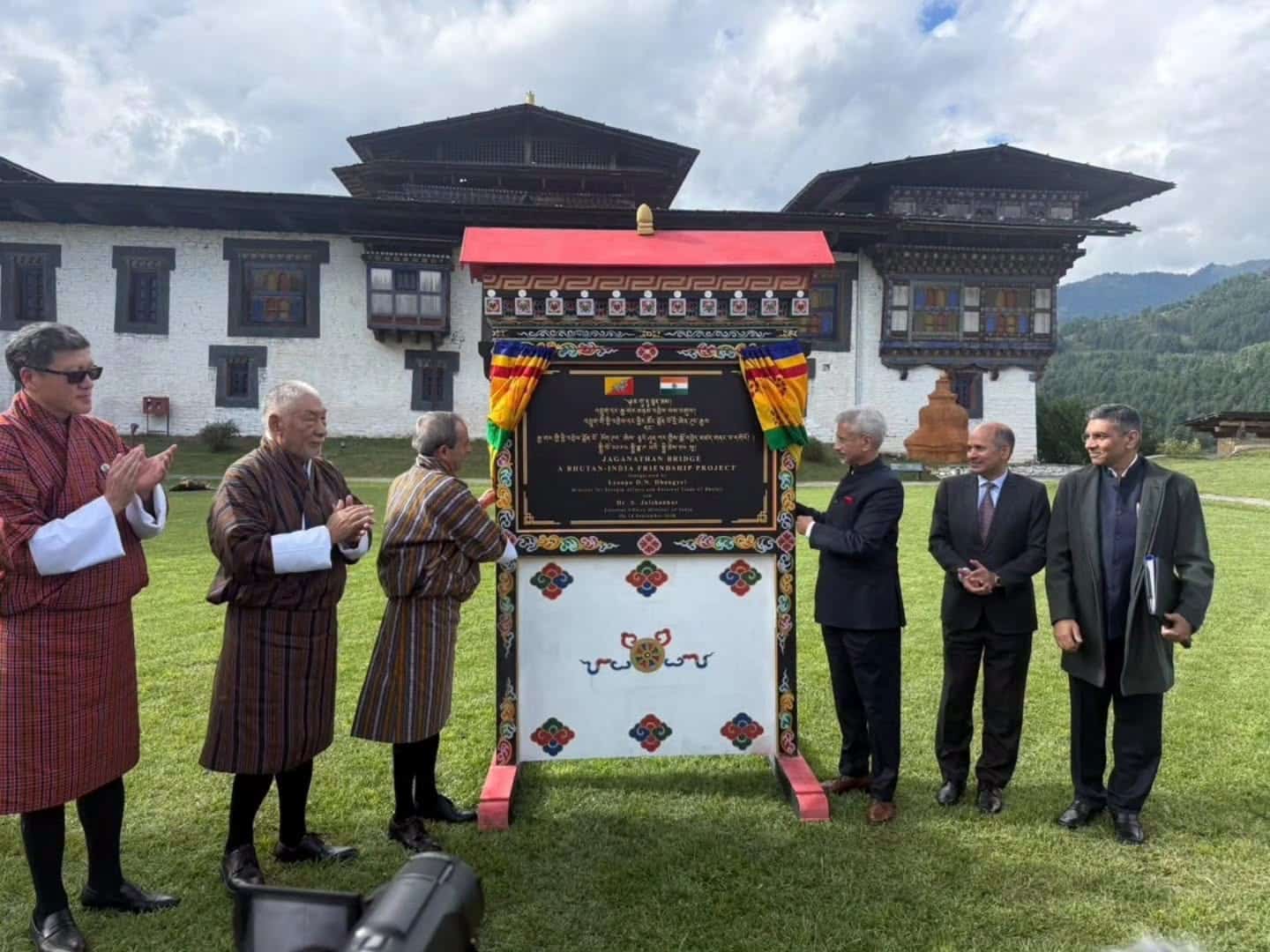
The two sides jointly inaugurated the 65-bedded Gyaltsuen Jetsun Pema Mother and Child Hospital in Mongar and the Jaganathan Bridge on the Samdrup Jongkhar-Trashigang Highway.
The projects add to cooperation in healthcare and infrastructure, with the bridge strengthening connectivity in eastern Bhutan.
Education also featured prominently. Bhutan and India renewed the Nehru-Wangchuck Scholarship Scheme for Bhutanese students pursuing higher education in India.
The two countries also agreed to increase Bhutanese seats under the Indian Council for Cultural Relations scholarship programme from 30 to 60, while seats under the Nalanda University Scholarship Scheme will increase from 30 to 55.
The expansion provides additional opportunities for Bhutanese students while reinforcing education and human-capital development as important components of the bilateral relationship.
The outcomes of Jaishankar’s visit demonstrate the increasingly diverse nature of Bhutan-India cooperation.
While hydropower and trade remain important pillars, the partnership now encompasses digital payments, electric mobility, healthcare, livestock development, education, cross-border railways, immigration infrastructure and the emerging opportunities around GMC.
For Bhutan, stronger connectivity and easier movement with India are particularly important as the country seeks to diversify its economy and create new avenues for investment, trade and employment.
The visit also reinforced the importance of high-level engagement. Jaishankar’s audience with His Majesty The King and meetings with the Prime Minister and Foreign Minister provided an opportunity to review both established areas of cooperation and emerging priorities.
The three-day visit concluded with both sides reviewing cooperation in development, energy, trade, connectivity, education, culture and people-to-people exchanges, while also discussing regional and international issues of mutual importance.
From a new energy financing arrangement and major infrastructure projects to scholarships, electric vehicles and the ability of Bhutanese travellers to pay digitally in India, the outcomes of the visit span both strategic national priorities and everyday needs.
More significantly, the developments show a bilateral partnership expanding into new areas while building on its longstanding foundations.
Nidup Lhamo, Thimphu