

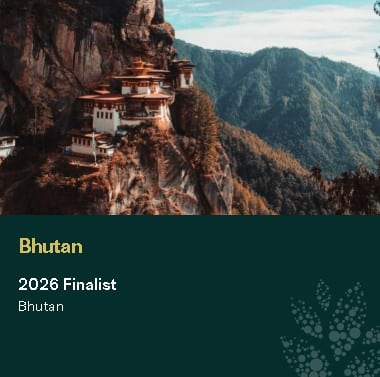
The country’s long-standing commitment to protecting its forests and restoring degraded landscapes has earned global recognition, with the country selected as one of 15 finalists for the 2026 Earthshot Prize.
Bhutan has been shortlisted in the Protect & Restore Nature category, alongside initiatives from around the world seeking to address some of the planet’s most pressing environmental challenges. The five winners will be announced at The Earthshot Prize Awards in Mumbai on November 17, with each receiving £1 million to scale their work.
While nearly 70 percent of the country remains under forest cover—well above the constitutional requirement to maintain at least 60 percent—the country is facing growing pressure from climate change, wildfires, water stress and land degradation.
The significance of Bhutan’s Earthshot recognition extends beyond its forest cover. It reflects an evolving conservation approach—from protecting forests and biodiversity to actively restoring landscapes that have already been degraded.
Bhutan’s forests form part of the wider Himalayan ecosystem and provide benefits far beyond the country’s borders. They regulate water systems, store carbon, reduce erosion and provide habitat for biodiversity, while the Himalayan watersheds support freshwater systems serving communities across South Asia.
But maintaining forest cover does not necessarily mean that every landscape is healthy or resilient.
Climate change is increasingly affecting Bhutan’s forests. Conservation International reported that more than 28,320 hectares were lost to forest fires between 2020 and 2024, with drier winters contributing to increasing wildfire risks.
Water security is also emerging as a serious concern, with thousands of water sources supporting communities across the country facing varying degrees of pressure.
It is against this backdrop that Restore Bhutan assumes importance.
The national restoration initiative seeks to restore up to 50,000 hectares of degraded land over the next decade, covering degraded forests, fire-affected areas and dryland agricultural landscapes. The initiative is being advanced through a partnership involving the Royal Government of Bhutan, Conservation International, the Bhutan Trust Fund for Environmental Conservation and the Bhutan Ecological Society.
The programme marks an important evolution in Bhutan’s conservation strategy.
For decades, conservation efforts have focused heavily on protecting existing forests, establishing protected areas and maintaining biological corridors. Restore Bhutan adds another dimension by identifying damaged or degraded landscapes and seeking to restore their ecological functions.
The approach extends beyond forests. It includes degraded agricultural land and other landscapes where restoration can strengthen ecosystems, improve resilience and support communities.
Conservation International said geospatial analysis helped identify restoration needs and establish an initial scope for the 50,000-hectare target. The analysis was subsequently refined using nationally available and ground-validated data.
Restoration cannot be measured simply by the number of seedlings planted. Success will depend on selecting appropriate species, ensuring that plantations survive, restoring soil and water systems, preventing recurring fires and monitoring ecological recovery over many years.
It will also depend on communities.
Degraded forests, fallow agricultural land and changing rural settlement patterns are closely connected to livelihoods, food production and migration. Restoration therefore needs to deliver ecological as well as social and economic benefits.
Bhutan has traditionally relied substantially on international support for conservation. As the country’s development financing landscape changes, long-term restoration will require innovative sources of finance, including nature-based and blended financing mechanisms.
The Earthshot platform could provide an additional avenue for such partnerships.
The 2026 finalists were selected from nearly 7,000 nominations across 169 countries, through a process involving more than 363 official nominators and an Expert Advisory Panel of more than 150 specialists.
Each finalist will receive dedicated mentorship, resources and technical support, as well as access to The Earthshot Prize’s global network of businesses, investors and environmental experts.
For Bhutan, the recognition also provides an opportunity to place its conservation experience before a global audience.
The country’s environmental policy has long been shaped by the philosophy of Gross National Happiness, which places environmental conservation alongside economic development, cultural preservation and social wellbeing.
That philosophy is increasingly being tested by a changing climate.
The Earthshot Prize, founded by Prince William in 2020, focuses on five environmental challenges: Protect & Restore Nature, Clean Our Air, Revive Our Oceans, Build a Waste-Free World and Fix Our Climate. The 2026 cohort is the sixth group of finalists recognised by the Prize.
Nidup Lhamo, Thimphu