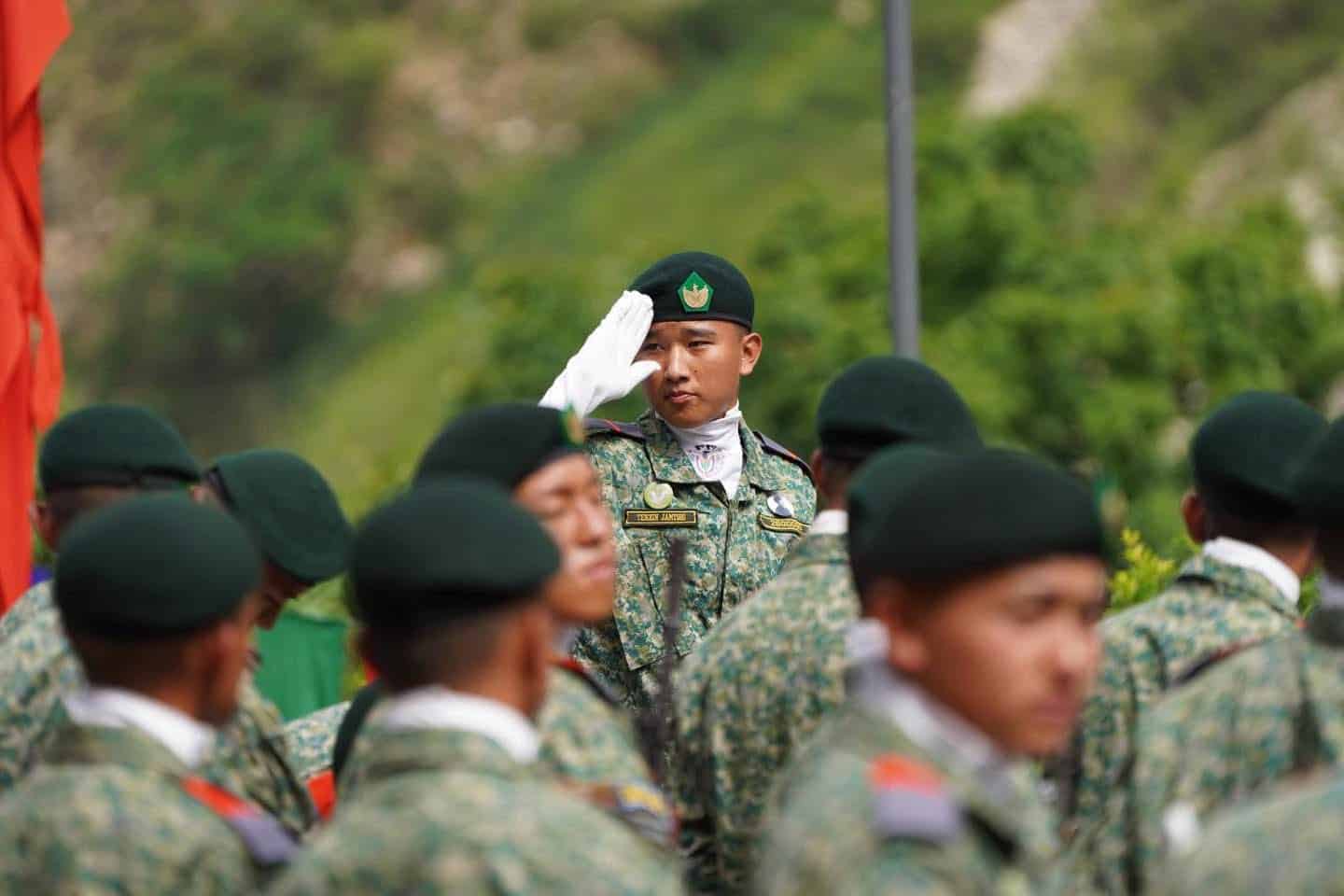
The Gyalsung training aspires to produce Bhutanese youth who are disciplined, skilled, and ready to serve in multiple roles, from contributing to economic development to responding in times of national emergency. While this remains its most visible and immediate outcome, the programme has also set in motion something less measurable but deeply transformative: a quiet revival of national consciousness within families, communities, and citizens themselves.
Across Bhutan, parents and guardians describe Gyalsung not only as a training programme for youth, but as a mirror reflecting back their own sense of responsibility. It has reawakened an emotional and civic awareness that had gradually softened under the pressures of modern life, work, urban migration, and the steady narrowing of family interactions into routines of survival and achievement.
For some, Gyalsung has changed how they see their children entirely.
Ugyen Tshering, a parent, recalls how his expectations once settled into something modest and practical. “Due to development, the change in time, work pressure and other factors, I had reached a position where I thought it was enough for my son to just graduate, find a job and fill his stomach,” he says. “It was not that I thought my child was insignificant. But I thought it was just fine if he could secure a living for himself.”
That perception, he says, shifted with the emergence of Gyalsung and the deeper national conversation it triggered. As the programme took shape under the vision of His Majesty The King, who has repeatedly emphasised the importance of every young Bhutanese as a citizen of purpose rather than circumstance, Ugyen found himself reassessing what he expected from his son and from himself as a parent.
“The way I looked at him, the way I perceived his future transformed,” he says. “I began to do something special for him every time I could. And today, as he becomes a Gyalsup, I am shedding tears of joy, not just for the transformation he would have undergone, but for the change it has brought within me.”
For others, Gyalsung has expanded the very definition of parenthood.
Sangay Dorji, who says he feels “unfortunate” that his daughter is too old to participate as a Gyalsup, expresses a similar shift in perception. “It dawned on me that when His Majesty is taking this extra initiative, we as citizens should also do so,” he says.
For Sangay, Gyalsung has blurred the boundaries between individual families and the nation at large. “It has instilled in me the feeling that I am a parent of all Bhutanese youth,” he reflects. “It may sound like an exaggeration, but I have developed this feeling. I now find myself trying to guide every young person I meet, though sometimes my wife cautions me that others may not always appreciate it.”
If Gyalsung has reshaped paternal instincts for some, it has also deepened civic awareness among mothers like Tenzin, who sees the programme as part of a broader philosophical shift in Bhutan’s social fabric.
She describes Gyalsung as an expression of what His Majesty has called the “Hive,” a collective national consciousness where every individual contributes to the strength of the whole. “A Hive would be further strengthened if every Bhutanese becomes part of it,” she says. “Through Gyalsung, we adults also become part of the Hive, because we become more conscious of our responsibilities.”
For Tenzin, this consciousness is not abstract. It is rooted in daily life, in how parents speak to their children, how citizens perceive responsibility, and how communities define success. “We can only become more conscious if we understand our roles and responsibilities as citizens of the nation, just like a Gyalsup,” she says.
She pauses before adding a thought that captures the depth of the transformation many are trying to articulate. “It is impossible to gauge or measure His Majesty’s vision,” she says. “Perhaps, His Majesty knew that this would be an outcome.”
What emerges from these reflections is a picture of Gyalsung that extends far beyond its institutional design. On paper, it is a structured national service programme aimed at building skills, discipline, and readiness among youth. In practice, it is also becoming a catalyst for emotional renewal, reconnecting parents with their children, and citizens with a renewed sense of collective purpose.
In a rapidly changing Bhutan, where urbanisation, economic pressure, and modern aspirations have sometimes diluted traditional bonds of community responsibility, Gyalsung appears to be restoring an older idea in a new form: that citizenship is not passive, but participatory; not individual, but shared.
It is this dual impact, both practical and philosophical, that is increasingly defining the programme. On one level, it prepares young Bhutanese for the demands of work, service, and crisis response. On another, it quietly reshapes how society understands itself: not as a collection of households striving independently, but as a coordinated whole, bound by responsibility across generations.
In that sense, Gyalsung is not only producing Gyalsups. It is, perhaps more profoundly, producing a renewed awareness among parents, guardians, and citizens that nation-building is not a distant policy objective, but a lived, shared responsibility.
Ugyen Tenzin, Thimphu