

Food prices eased from May, but households continue to face significantly higher costs than a year ago
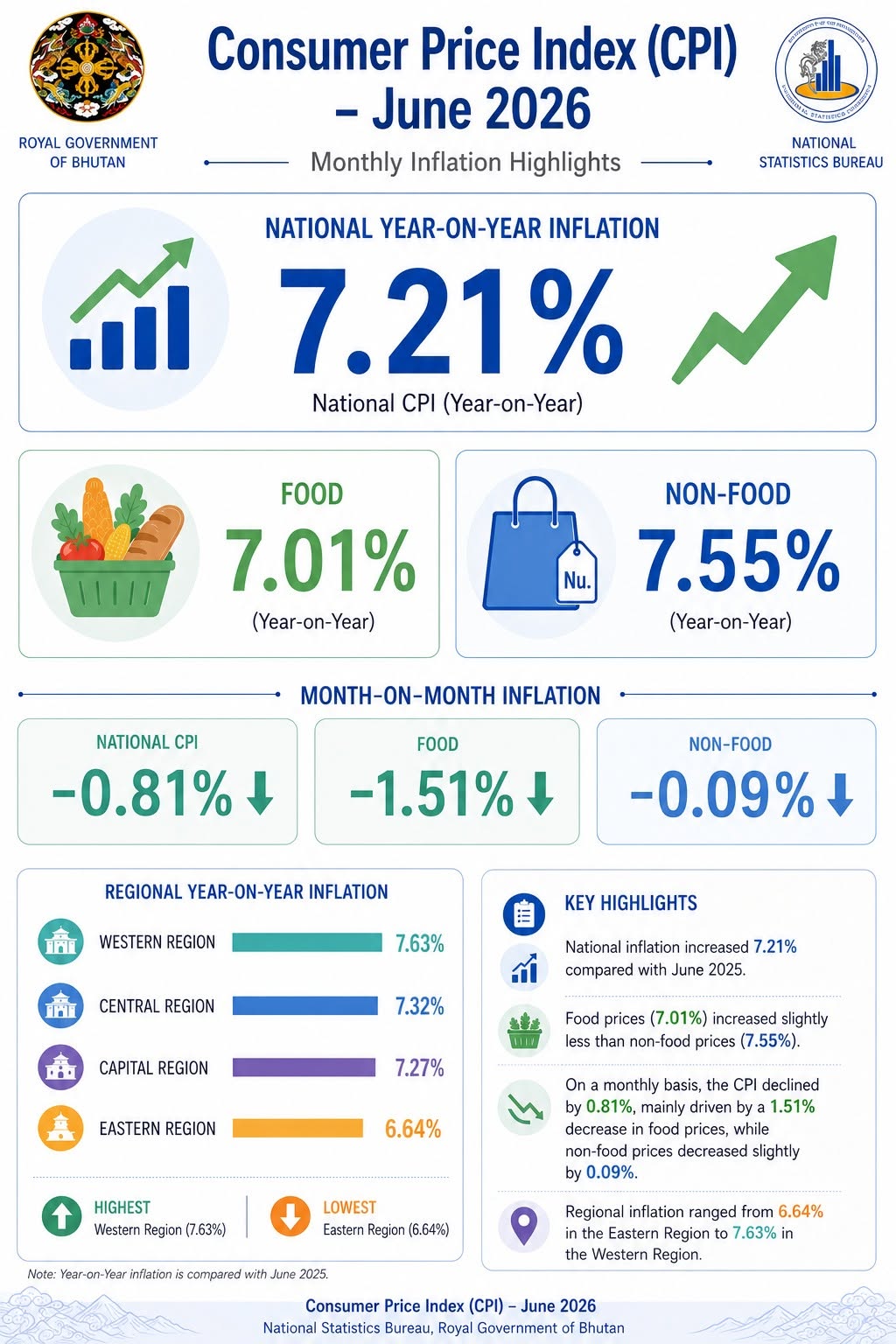
Bhutan’s cost of living remained under sustained pressure in June, with annual inflation rising to 7.21 percent, underscoring that households continue to pay significantly more for everyday goods and services than they did a year ago, even as prices moderated on a monthly basis.
The latest Consumer Price Index (CPI) report released by the National Statistics Bureau (NSB) presents a mixed picture of the economy. While consumers experienced a modest decline in prices compared to May, the year-on-year data show that inflation remains firmly elevated, eroding household purchasing power and increasing the cost of doing business.
The June figures illustrate an important distinction between annual and monthly inflation. On a year-on-year basis, which compares prices with the same month last year, overall consumer prices were 7.21 percent higher than in June 2025. However, compared with May this year, the national CPI declined by 0.81 percent, indicating that prices eased during the month.
The monthly decline was driven primarily by food prices, which fell 1.51 percent from May. Non-food prices also edged lower, declining by 0.09 percent. Although this provided some short-term relief for consumers, it does not reverse the broader inflationary trend that has built up over the past year.
The report suggests that inflationary pressures are becoming increasingly broad-based. Food prices rose 7.01 percent over the past year, while non-food inflation reached 7.55 percent, making non-food items the largest contributor to overall inflation.
This shift is particularly significant because non-food inflation tends to be more persistent than food inflation, which is often influenced by seasonal supply conditions. Rising non-food prices reflect increases across a wide range of household expenditures, including housing, transport, clothing, healthcare, education, communication and other essential services. Unlike seasonal fluctuations in food prices, increases in these categories can remain embedded in the economy for longer periods, placing sustained pressure on household budgets.
Food inflation, meanwhile, continues to weigh heavily on families. Food accounts for a substantial share of household expenditure in Bhutan, particularly among lower-income families, meaning even moderate increases in food prices can significantly affect living standards. Although food prices declined from May, they remain considerably higher than they were a year earlier.
The June data therefore point to a moderation in the pace of price increases rather than a reversal of inflation. Consumers may have paid slightly less for certain food items than in the previous month, but the cumulative increase in prices over the past twelve months means that the overall cost of living remains substantially higher.
Regional data reveal that inflationary pressures continue to be widespread across the country.
The Western Region recorded the highest annual inflation at 7.63 percent, followed by the Central Region at 7.32 percent. The Capital Region registered 7.27 percent, while the Eastern Region recorded the lowest inflation at 6.64 percent.
Although there were differences across regions, every part of the country experienced inflation exceeding six percent, indicating that rising prices are not confined to any single market or locality. Variations in transport costs, supply chains, local demand and the availability of essential commodities are likely to have contributed to the regional differences.
The persistence of inflation has broader implications for the economy. For households, higher prices reduce purchasing power, forcing families to spend a larger share of their income on essential goods and services while leaving less for savings or discretionary spending. This impact is particularly pronounced for lower-income households, where necessities account for a greater proportion of total expenditure.
Businesses also face mounting cost pressures. Rising prices for transport, utilities, raw materials and other operating expenses can squeeze profit margins, especially for small and medium-sized enterprises. In many cases, businesses may pass higher costs on to consumers, creating the risk of prolonged inflationary pressures.
The latest CPI data also carry implications for economic policy. While the month-on-month decline is encouraging, policymakers are likely to focus more closely on the annual trend, which remains well above levels consistent with stable prices. Sustained inflation can influence consumer confidence, investment decisions and long-term economic planning.
The June report therefore presents two contrasting narratives. On one hand, falling prices compared with May offer evidence that some inflationary pressures—particularly in food—have begun to ease. On the other, annual inflation above seven percent indicates that the cumulative rise in prices continues to place significant strain on households and businesses.
Whether June marks the beginning of a broader moderation in inflation or merely reflects temporary seasonal movements in food prices will become clearer in the coming months. Future CPI releases will be closely watched for signs of whether easing food prices are followed by moderation in non-food inflation, which has emerged as the stronger and potentially more persistent driver of Bhutan’s rising cost of living.
For now, the figures suggest that while consumers may have experienced some short-term relief in June, the broader challenge of high inflation remains. Until annual price growth slows more decisively, households are likely to continue feeling the squeeze from higher living costs, and businesses will remain under pressure to balance rising expenses with affordability in an increasingly cost-conscious economy.
Sherab Dorji, Thimphu