


As digital technologies rapidly reshape economies and societies across the Asia-Pacific, countries in the region are pushing for stronger cooperation to expand connectivity while confronting growing challenges around online safety, data protection, cybersecurity and digital inclusion.
These concerns dominated the 26th Asia-Pacific Telecommunity Policy and Regulatory Forum (PRF-26), where policymakers, regulators and industry representatives explored how countries can accelerate digital transformation without leaving vulnerable communities behind or allowing technological innovation to outpace the safeguards needed to protect users.
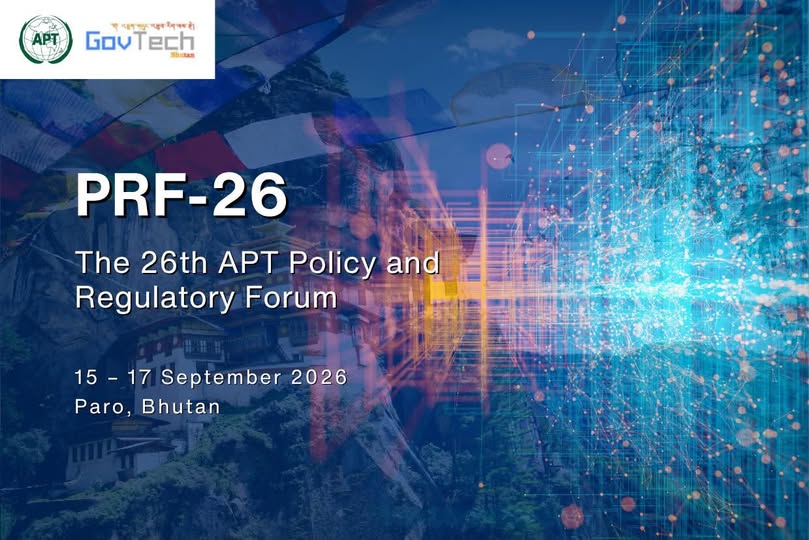
Held in Paro from September 15 to 17, the three-day regional forum placed particular emphasis on finding a balance between innovation and regulation, strengthening digital infrastructure and ensuring that the benefits of technology reach underserved communities.
An official from GovTech said the discussions reflected the growing pressure on countries to modernise their digital systems while managing the risks created by increasing dependence on digital platforms and technologies. “The forum’s thematic sessions covered six areas: digital infrastructure, digital transformation, connectivity for all, inclusiveness and digital empowerment, online safety and data protection, and cybersecurity workforce development,” the official said.
The six themes reflect some of the most pressing challenges confronting the region as governments, businesses and citizens increasingly depend on digital services for communication, commerce, financial transactions and public services.
One of the central discussions was how governments can regulate emerging technologies without stifling innovation.
A Regulators’ Roundtable brought together heads of regulatory authorities to exchange views on emerging policy and regulatory challenges. The discussions focused on approaches that could create sufficient space for innovation while maintaining safeguards for consumers, businesses and the wider digital ecosystem.
The forum also brought the private sector into the discussion through a Business Dialogue on building a sustainable telecommunications and ICT sector and promoting digital innovation.
Industry representatives shared their experiences and perspectives on the policies required to encourage continued investment, innovation and long-term sustainability in the rapidly evolving ICT sector.
The discussions underscored that digital transformation cannot be driven by governments alone. As businesses increasingly develop and deliver digital services, cooperation between regulators, industry and other stakeholders is becoming essential to ensure that technological development is commercially viable while also meeting broader public-interest objectives.
At the policy level, senior officials examined the implementation of the Tokyo Statement 2025, which provides a framework for regional cooperation and digital transformation.
A High-Level Dialogue considered how the statement could move beyond being a policy document and become a dynamic framework for strengthening cooperation among countries and accelerating digital transformation.
The discussions also recognised that digital development requires more than infrastructure.
Greater connectivity must be accompanied by the ability of people to use digital services safely and meaningfully. This brought inclusiveness and digital empowerment into the centre of the discussion, particularly in relation to communities that remain underserved by digital infrastructure and services.
For countries across the Asia-Pacific, the challenge is increasingly twofold: extending the digital network to those who remain disconnected while ensuring that those already online are adequately protected.
The forum also highlighted the growing shortage and importance of skilled professionals capable of protecting digital systems.
Cybersecurity workforce development was one of the six thematic areas, reflecting the expanding need for specialised skills as governments, financial institutions, businesses and citizens become increasingly dependent on interconnected digital systems.
Online safety and data protection were similarly identified as essential to building trust.
As more personal and commercial information moves online, participants discussed the importance of protecting data and creating a digital environment in which people can use online services with confidence.
The forum also provided countries and organisations with an opportunity to share national experiences, practices and approaches to common digital challenges and identify areas where regional cooperation could provide practical benefits.
PRF is one of APT’s flagship forums, providing a platform for policymakers, regulators and industry leaders to exchange views on policy and regulatory developments affecting the ICT sector.
PRF-26 was conducted over two and a half days and comprised a High-Level Dialogue, Regulators’ Roundtable, Business Dialogue and six thematic sessions.
The forum concluded with renewed emphasis on regional cooperation, knowledge sharing and the development of policies and capabilities needed to support a more inclusive, sustainable and resilient digital future.
Sherab Dorji, Thimphu