

Bhutan’s hospitality sector is making a significant shift towards digital transformation, with half of the country’s assessed three-star hotels now reaching an advanced level of digital readiness. However, major gaps remain, particularly in direct online booking, digital asset ownership and the ability of hotels to independently manage their online presence.
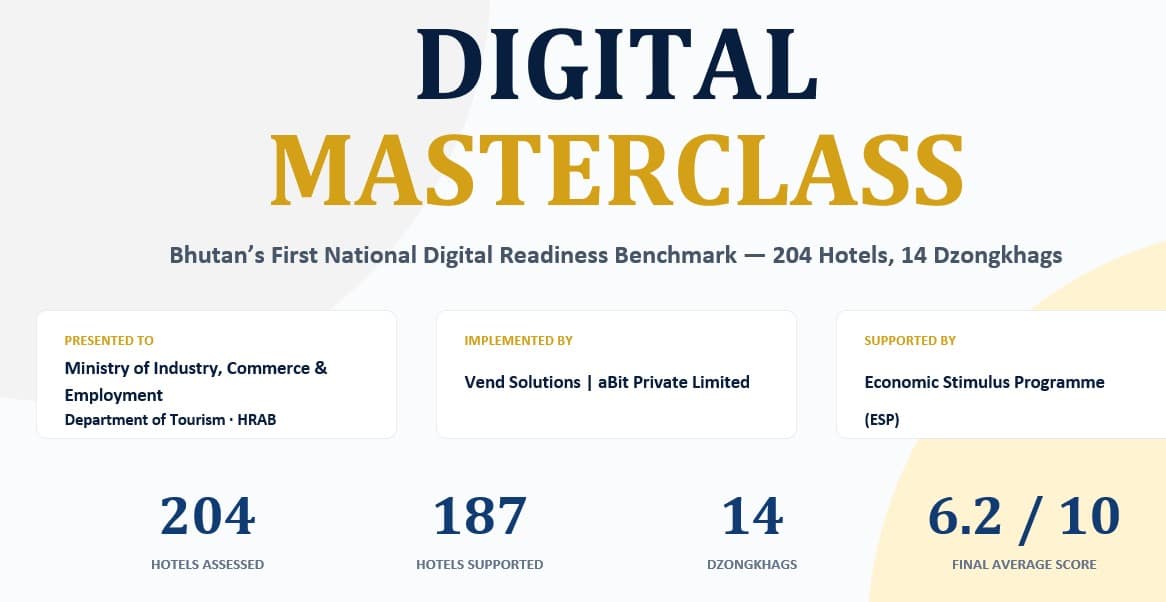
The findings come from Bhutan’s first National Digital Readiness Benchmark for the Hospitality Sector, developed through a comprehensive assessment of 204 three-star hotels across 14 dzongkhags. The benchmark provides the first national baseline on how prepared Bhutan’s hotels are to compete in an increasingly digital global tourism market.
The assessment, carried out to strengthen the competitiveness and sustainability of the hotel sector, focused on improving online visibility, branding, participation in online travel agencies (OTAs), direct booking capability and digital skills among hotel employees.
Of the 204 hotels assessed, 187 received on-site support, while 253 hotel staff were trained to manage digital platforms and sustain improvements independently.
The assessment recorded an average digital readiness score of 6.2 out of 10, establishing a national benchmark for measuring the sector’s digital preparedness.
One of the most encouraging outcomes was the rapid growth in the number of hotels classified as digitally advanced. Before the intervention, only 18.6 percent of assessed hotels were in the advanced category. Following the programme, the proportion increased to 50 percent, reflecting significant improvement in digital adoption among participating hotels.
The assessment also found improvements in basic digital visibility. Around 164 hotels now have accurate information displayed on Google, while 163 hotels have their own websites. However, about one-fifth of hotels still operate without a dedicated website, limiting their ability to attract and engage potential guests directly.
Similarly, 107 hotels have claimed and actively manage their TripAdvisor pages, enabling them to respond to guest feedback, manage online reputation and improve customer engagement.
Despite these gains, the biggest challenge facing the sector remains the absence of direct online booking systems.
None of the 204 hotels assessed currently operate their own direct booking platform, meaning they continue to rely entirely on commission-based OTAs for reservations. While OTAs provide valuable market access, excessive dependence on third-party platforms can reduce profitability, limit customer ownership and weaken hotels’ ability to build direct relationships with guests.
The benchmark identified several structural weaknesses preventing hotels from fully benefiting from digital transformation.
A common challenge was poor management of digital assets. Many hotels registered online accounts using personal email addresses or employees’ phone numbers, creating difficulties when staff members leave. Others had duplicate online listings, outsourced OTA management without retaining account credentials, inactive websites, inconsistent branding and no designated personnel responsible for digital operations.
The assessment also found that limited digital skills among owners and employees remain a significant barrier. In several establishments, digital accounts were controlled exclusively by owners, preventing managers and staff from updating information, responding to reviews or maintaining online platforms effectively.
According to the report, the root issue behind many of these challenges is the lack of ownership and proper management of digital assets.
To address these gaps, the report recommends two key interventions.
The first is the introduction of a Digital Asset Ownership Protocol, requiring hotels to maintain proper records of digital accounts, credentials and access rights, while ensuring smooth transfer of ownership whenever staff changes occur.
The second recommendation is the establishment of a Hospitality Revenue Manager Training Programme to equip hotel personnel with skills in managing OTA platforms, online sales channels, social media marketing and digital revenue strategies.
The benchmark also highlights practices followed by better-performing hotels. These include using official hotel email accounts for digital platforms, actively managing Google Business and TripAdvisor profiles, maintaining presence across multiple OTA platforms, ensuring consistent branding, operating mobile-friendly websites with direct booking options and assigning dedicated staff for digital management.
In contrast, hotels with weaker digital performance were commonly found to have inactive social media accounts, limited OTA visibility, poor branding, outsourced digital management without control over accounts and inadequate marketing capabilities.
The findings come at a critical time as Bhutan’s tourism industry seeks to enhance quality, increase visitor spending and improve competitiveness in the global market. As travellers increasingly rely on online platforms to discover, compare and book destinations, digital readiness has become a key factor influencing tourism success.
While acknowledging that many hotels still need to strengthen their digital capabilities, the benchmark concludes that Bhutan’s hospitality sector has demonstrated a strong willingness to embrace digital transformation when provided with practical and locally relevant support.
The study establishes the country’s first comprehensive picture of hotel digital readiness and provides a roadmap for future interventions to build a more competitive, technology-enabled tourism industry.
The assessment was conducted by Vend Solutions and aBit Private Limited, with support from the Department of Tourism under the Ministry of Industry, Commerce and Employment (MoICE) through the Economic Stimulus Programme (ESP), in collaboration with the Hotel and Restaurant Association of Bhutan (HRAB).
Sangay Rabten, Thimphu