

In Bhutan’s mountain farming communities, water can be close to a field yet remain out of reach.
A spring or stream may lie below farmland, separated by steep terrain that makes conventional irrigation difficult and costly. For farmers, the result can be dependence on rainfall, shorter cultivation periods or land left unused during dry spells. A climate adaptation project is now exploring a simple alternative: using the sun to lift water uphill.
Under the Integrated Climate Adaptation Solutions for the Hindu Kush Himalaya Region (HI-CAS) project, solar-powered lift irrigation systems are being proposed for Tili village in Shaba Gewog, Paro, and Yebisa in Punakha.
The principle is straightforward. Solar energy powers pumps that draw water from a source and lift it to agricultural land where gravity-fed irrigation cannot reach.
But turning that idea into a working irrigation system requires technical assessments, community participation and regulatory clearances.
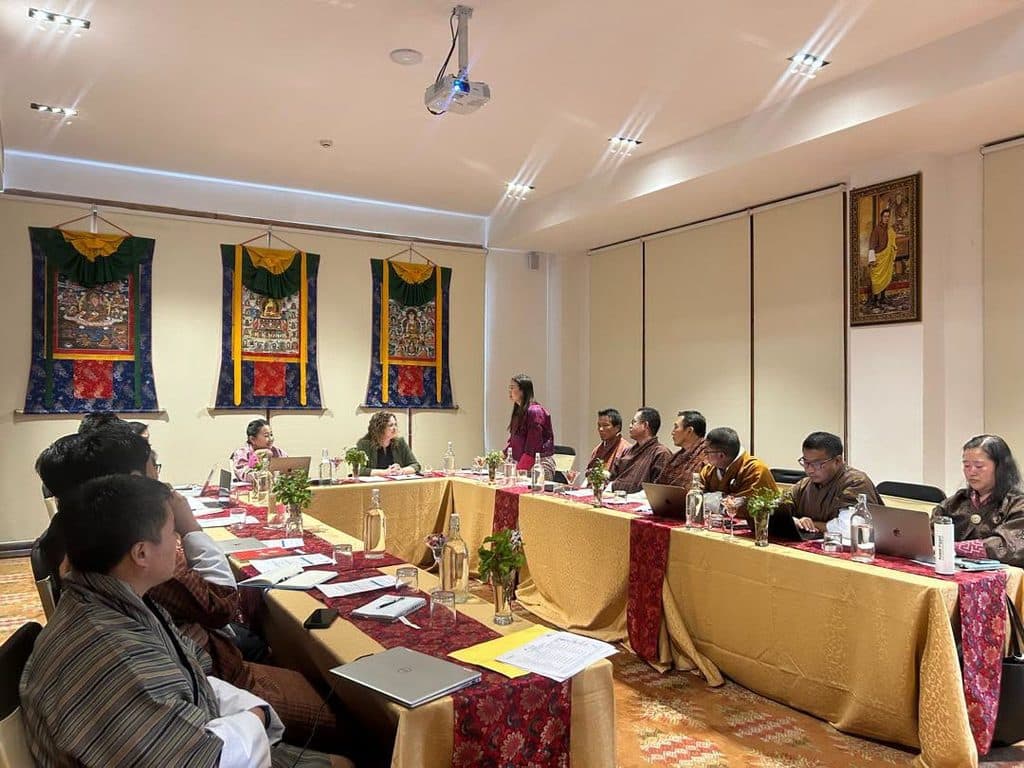
The issue was discussed during the second Project Country Advisory Committee meeting of the HI-CAS project held in Thimphu in September, where participating agencies reviewed progress and the next steps for the proposed interventions.
HI-CAS brings together water management, renewable energy and agricultural biodiversity to help mountain communities respond to climate-related challenges. In Bhutan, the Tarayana Foundation is implementing the project in partnership with the International Centre for Integrated Mountain Development (ICIMOD), with funding from Global Affairs Canada.
Earlier this year, project teams visited Tili and Yebisa to assess conditions on the ground. Community consultations and participatory mapping identified water sources, intake and distribution points, agricultural land, cropping patterns and areas experiencing water shortages.
Technical assessments examined terrain, elevation, land use and cropping cycles. According to the Tarayana Foundation, the findings indicate that the proposed solar lift irrigation systems are technically viable in both locations.
For farmers, the significance could extend beyond simply introducing a new irrigation technology. More reliable access to water can affect what crops can be grown, when land can be cultivated and how much agricultural land can be brought into production.
The project is also placing emphasis on community ownership and participation. Women, persons with disabilities and other community members are expected to be represented in decisions concerning the interventions.
The proposed systems reflect a broader shift in how renewable energy can be used in Bhutan—not only to generate electricity, but also to address practical challenges facing rural communities.
Bhutan already has experience with solar-powered irrigation. In August, the Department of Energy and ICIMOD inaugurated solar-powered lift irrigation systems at Humpathang and Tempakha in Punakha under the Women Empowerment through Renewable Energy-powered Lift Irrigation Systems project.
One system is privately owned, while the other is community-managed, with responsibility for operation handed over to local users.
The HI-CAS project takes a broader approach. Its interventions in Paro and Punakha are expected to benefit about 8,250 people and include solar irrigation, springshed management and agrobiodiversity activities designed to strengthen local resilience.
The work also fits into Bhutan’s wider effort to prepare the water sector for a changing climate.
Meanwhile, Bhutan’s Climate Adaptation Investment Plan for the Water Sector, launched this year, identifies 11 strategic investment packages requiring about USD 847 million over the next 15 to 20 years. The plan covers water-resource management, flood risks, watershed management, agriculture, climate services and early warning systems.
At the community level, projects such as HI-CAS provide a way to translate those broad adaptation ambitions into practical solutions.
The next step, however, depends on obtaining the necessary clearances and maintaining technical support. The Department of Infrastructure Development and Department of Energy are expected to remain involved, while the National Centre for Hydrology and Meteorology has supported the project through rain-gauge equipment and technical assistance.
A policy dialogue exchange is planned in Bhutan in late November, with lessons from the project expected to contribute to wider discussions on climate adaptation. The third Project Country Advisory Committee meeting is scheduled for February next year.
For farmers, however, the success of the project will ultimately be measured differently.
It will be measured by whether water reaches fields that were once difficult to irrigate—and whether the sun can help turn those fields into productive land.
In two mountain communities, that possibility now rests on the next round of clearances and implementation.
Sherab Dorji, Thimphu