

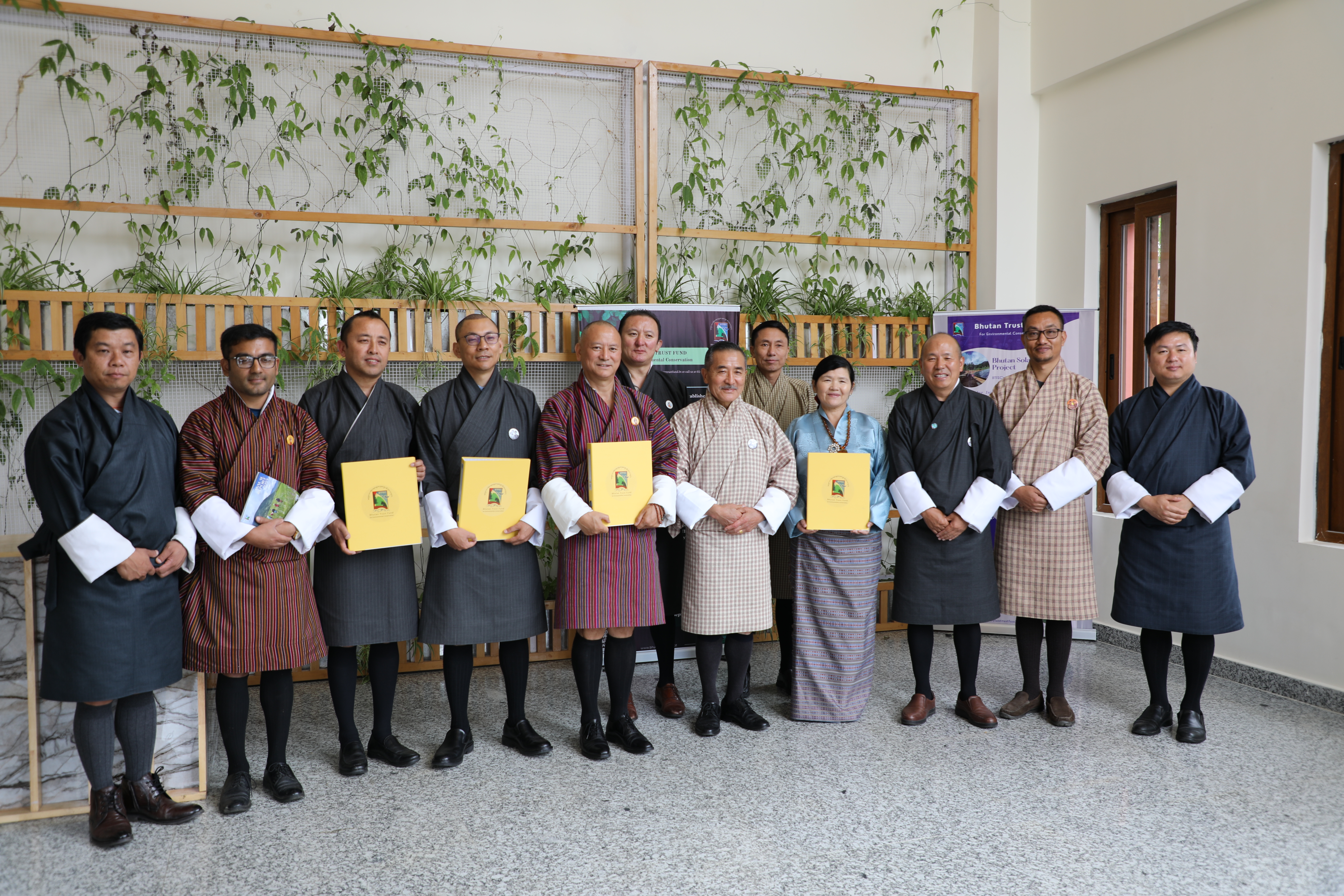
The Bhutan Trust Fund For Environmental Conservation (BTFEC) has announced an investment of Nu 17.8 million for three innovative and sustainable projects aimed at enhancing biodiversity conservation, addressing pollution, and promoting recycling on 12 July 2024.
75th Board convened on 4th July 2024 endorsed three Projects; two Large Grant Projects, and one Project Related Investment (PRI) project.
The first project, “Integrating Sustainable Infrastructure for Enhanced Ranger Efficiency: A Pathway to Biodiversity Conservation in Phibsoo Wildlife Sanctuary,” has been allocated Nu 3.95 million. This initiative aims to bolster biodiversity conservation efforts by improving ranger efficiency through sustainable infrastructure development in the Phibsoo Wildlife Sanctuary.
The second project, “Civil Engineering Laboratory Development to Assess Pollution Associated with Automobile Waste,” will receive Nu 1.85 million. This project focuses on creating a state-of-the-art laboratory to evaluate and address pollution caused by automobile waste, contributing to environmental protection and public health improvement.
Integrating Sustainable Infrastructure for Enhanced Ranger Efficiency and Civil Engineering Laboratory Development to Assess Pollution Associated with Automobile Waste are large grant projects.
The largest allocation of Nu 12 million has been dedicated to the “Green Papers” project. This innovative initiative aims to recycle waste paper, giving it a second life and reducing environmental impact. By transforming discarded paper into usable products, Green Papers will help mitigate waste and promote sustainable practices. This is a Project Related Investment (PRI) project.
These investments reflect Bhutan’s commitment to sustainable development, environmental conservation, and innovative solutions to contemporary challenges.
The grant agreement was signed between the BTF and representatives of the grantees.
Meanwhile, the BTFEC was established in 1992 with the primary objective of conserving Bhutan’s environment, which is rich in biodiversity and natural resources.
The BTFEC was established as a collaborative effort between the Royal Government of Bhutan, the United Nations Development Programme (UNDP), and the World Wildlife Fund (WWF). Its creation was driven by Bhutan’s commitment to sustainable development and environmental conservation.
The fund’s mission is to provide financial resources for environmental conservation activities in Bhutan. This includes supporting projects related to biodiversity conservation, sustainable natural resource management, community-based conservation initiatives, and environmental education.
The BTFEC initially received contributions from various international donors, including governments, multilateral organizations, and non-governmental organizations (NGOs). These funds are managed to ensure long-term sustainability of Bhutan’s natural environment.
Over the years, the BTFEC has funded numerous projects across Bhutan. These projects range from protecting endangered species and habitats to promoting sustainable agriculture practices and mitigating climate change impacts. The fund prioritizes projects that involve local communities and encourage their participation in conservation efforts.
The BTFEC has played a crucial role in conserving Bhutan’s environment, which is essential not only for biodiversity but also for the well-being of Bhutanese communities who depend on natural resources for their livelihoods. The fund’s approach emphasizes sustainable development that balances conservation goals with socio-economic needs.
The fund is governed by a Board of Trustees composed of representatives from the government, civil society, and international organizations. This ensures transparency, accountability, and effective management of resources.
Overall, the Bhutan Trust Fund for Environmental Conservation stands as a testament to Bhutan’s commitment to environmental stewardship and sustainable development, serving as a model for integrated conservation efforts globally.
By Sangay Rabten, Thimphu