For thousands of Bhutanese travelling to India, paying for a meal, buying medicines, shopping or settling a taxi fare could soon be as simple as taking out a phone and scanning a QR code.
Bhutanese travellers can now make digital payments in India through participating Bhutanese banking applications, using their local bank accounts to pay merchants accepting the Unified Payments Interface (UPI).
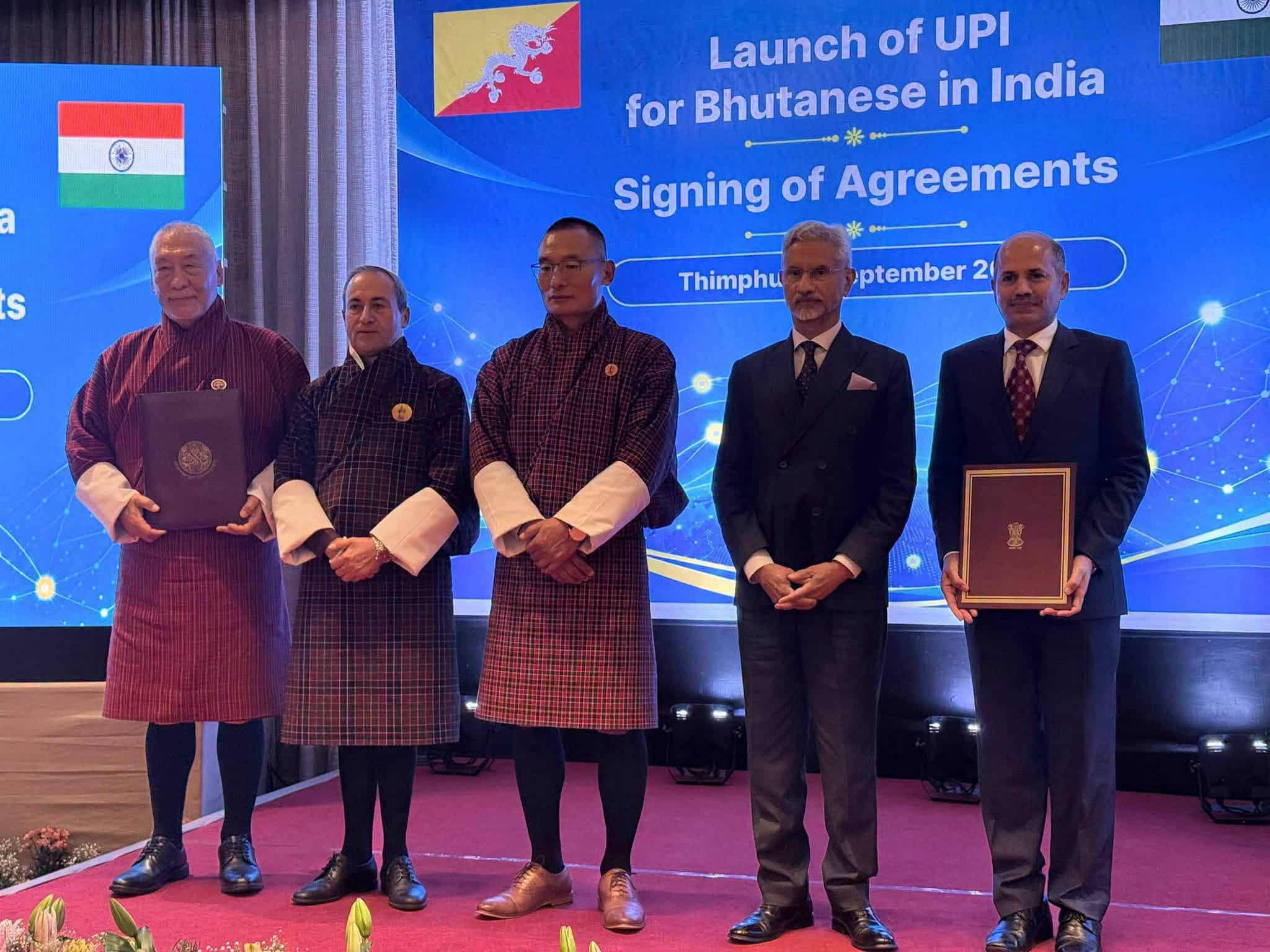
Prime Minister Dasho Tshering Tobgay and India’s External Affairs Minister Dr S. Jaishankar launched the second phase of the UPI payment service in Thimphu, significantly expanding digital payment connectivity between the two countries.
The development makes cross-border UPI payments two-way. The first phase allowed Indian visitors to make digital payments at participating merchants in Bhutan through UPI-enabled applications. The new phase enables Bhutanese visitors to India to make payments using supported Bhutanese mobile banking applications.
For ordinary travellers, the immediate benefit is convenience.
Instead of relying entirely on cash or carrying large amounts of Indian currency, eligible users can scan a compatible UPI QR code displayed by a participating merchant and pay directly through their enabled Bhutanese banking application.
This could be particularly useful for Bhutanese students, families accompanying patients for medical treatment, business travellers and tourists. For those spending weeks or months in India for education or healthcare, the ability to make smaller everyday payments directly from a Bhutanese bank account could make managing expenses considerably easier.
The facility does not eliminate the need for cash or other payment methods. UPI acceptance will depend on the merchant, while access from Bhutan will depend on participating banks and supported applications.
The development is the latest step in a broader evolution of financial connectivity between Bhutan and India.
Bhutan’s digital payment relationship with India began with RuPay, introduced in Bhutan in 2019. In 2020, Bhutanese cardholders gained the ability to withdraw Indian rupees from ATMs and make point-of-sale payments in India.
UPI connectivity followed in 2021, when BHIM UPI was launched in Bhutan, allowing Indian visitors to make cashless payments at participating Bhutanese merchants.
The latest phase takes that relationship further by allowing Bhutanese travellers to use local banking applications for payments in India. It therefore represents more than a new payment facility; it marks greater interoperability between the financial systems of the two countries.
The potential is significant given the volume of movement between Bhutan and India for education, healthcare, business, trade, tourism and family visits.
The existing system has already seen rapid growth. Royal Monetary Authority data shows that India-Bhutan iUPI transactions increased from about 1,550 in 2024 to 125,870 in 2025, while transaction value rose from Nu 6.59 million to Nu 220.44 million.
The new two-way facility could broaden that growth by bringing Bhutanese consumers into the cross-border digital payment ecosystem.
However, travellers should understand that the service is not necessarily available to every Bhutanese bank account or at every UPI merchant in India. Users should check with their banks before travelling to confirm whether their mobile banking application is enabled and to understand applicable transaction limits, foreign-exchange conversion arrangements, fees and other conditions.
The cross-border nature of the service means that QR-code convenience does not remove the underlying requirements governing currency conversion, settlement and transaction limits.
It should therefore be viewed as an additional payment option, rather than a complete replacement for cash, cards or other established methods.
Its wider significance, however, goes beyond convenience.
As people and businesses move increasingly between Bhutan and India, seamless financial connectivity can reduce friction in everyday transactions and support greater economic interaction. It also complements Bhutan’s broader transition towards a more digital and cash-lite economy.
The first phase brought India’s UPI ecosystem into Bhutan. The second brings that convenience back across the border for Bhutanese travellers.
For the ordinary traveller, the change may ultimately be very simple: cross the border, open the banking app, scan the QR code and pay.
A small change in how people transact could make movement between the two countries considerably more seamless.
Sherab Dorji, Thimphu