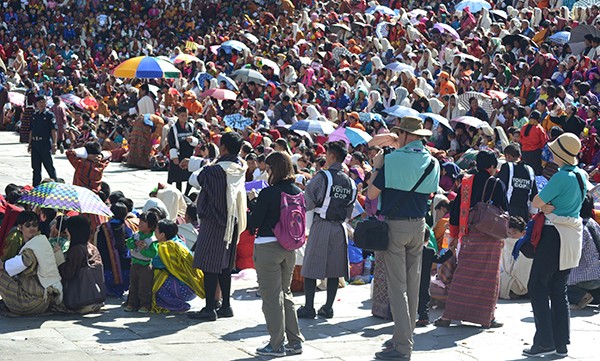
The tourism sector maintained strong momentum in June 2026, welcoming 25,195 international visitors, with Indian tourists continuing to dominate arrivals while visitors from countries other than India (COTI) also maintained a healthy presence. Tourist arrivals more than doubled compared to 11,524 visitors recorded in June 2025, representing an increase of 13,671 tourists, or approximately 118.6 percent year-on-year.
Indian tourists remained the largest source of visitors in June, accounting for 17,814 arrivals, or nearly 71 percent of total tourist arrivals during the month. Visitors from COTI numbered 7,381, making up the remaining 29 percent.
The figures indicate that while Bhutan continues to receive a significant share of visitors from neighboring India, it is also maintaining a stable flow of long-haul international tourists, supporting the government’s objective of achieving balanced market diversification.
Visitors stayed in the country for an average of 5.76 days during June, reflecting the continued popularity of multi-day cultural, trekking and nature-based itineraries.
Tourist Arrivals Maintain Upward Trend
Monthly arrival data shows that Bhutan has sustained healthy visitor numbers throughout the first half of 2026. Tourist arrivals stood at 20,251 in January, rising to 28,037 in February, before recording 24,412 in March, 21,137 in April, 17,742 in May, and 25,195 in June. These figures remain substantially higher than those recorded during the corresponding months in 2025, demonstrating continued recovery across the sector.
India Dominates Source Markets
India remained Bhutan’s largest tourism market by a wide margin, with 21,007 Indian visitors recorded during June. Thailand emerged as the second-largest overseas market with 749 visitors, followed by the United States (577), Singapore (516), Bangladesh (477), China (393), the Republic of China (148), Nepal (127), Australia (115) and Japan (114).
Maharashtra Tops Indian Source States
Among Indian visitors, Maharashtra remained the leading source state with 3,948 tourists, followed by West Bengal (2,237) and Gujarat (2,056). Other significant markets included Karnataka (1,182), Rajasthan (897), Uttar Pradesh (853), Madhya Pradesh (656), Bihar (552), Jharkhand (356) and Punjab (334).
Paro Airport Remains the Main Gateway
Paro International Airport continued to serve as Bhutan’s principal entry point for international visitors. Data maintained with the Department of Tourism (DoT) shows that 16,135 tourists entered Bhutan through Paro International Airport, while 6,979 visitors crossed through Phuentsholing. Other entry points included Samdrup Jongkhar (1,838), Samtse (132) and Gelephu (111).
Tourism Services Continue to Expand
The steady increase in tourist arrivals has been accompanied by growth in tourism service providers. As of June this year, Bhutan had 3,449 licensed tour guides, including 2,436 cultural and trekking guides, 530 cultural guides, 405 female cultural and trekking guides, 43 senior guides and 35 tour leaders. During June alone, 35 new tour guides were registered.
The number of licensed tour operators also continued to grow, with 1,697 registered tour operators and 50 new operators joining the industry during the month.
Accommodation Capacity Keeps Pace
To support the growing tourism industry, Bhutan’s accommodation sector continues to expand. The DoT reported 459 certified accommodation establishments nationwide, offering 6,403 rooms and 9,879 beds. These include 21 five-star hotels, 22 four-star hotels, 181 three-star hotels, 29 two-star hotels, seven one-star hotels, and 199 village homestays.
Thimphu remains the country’s largest accommodation hub with 93 certified establishments, followed by Paro (81), Punakha (55), Wangdue Phodrang (55) and Bumthang (44).
Positive Outlook
“The June tourism figures reinforce the sector’s steady recovery and demonstrate Bhutan’s growing attractiveness across both regional and international markets,” said an official from the Department.
The substantial year-on-year increase in arrivals, expanding tourism services and continued investment in accommodation capacity indicate that the country is well positioned to sustain tourism growth while maintaining its commitment to a high-value, sustainable tourism model.
“The tourism sector appears set to remain an important driver of economic activity, employment and foreign exchange earnings throughout 2026,” another official maintained.
Tashi Namgyal, Thimphu