

When the ballots were counted in Korphu, history did not arrive with celebration.
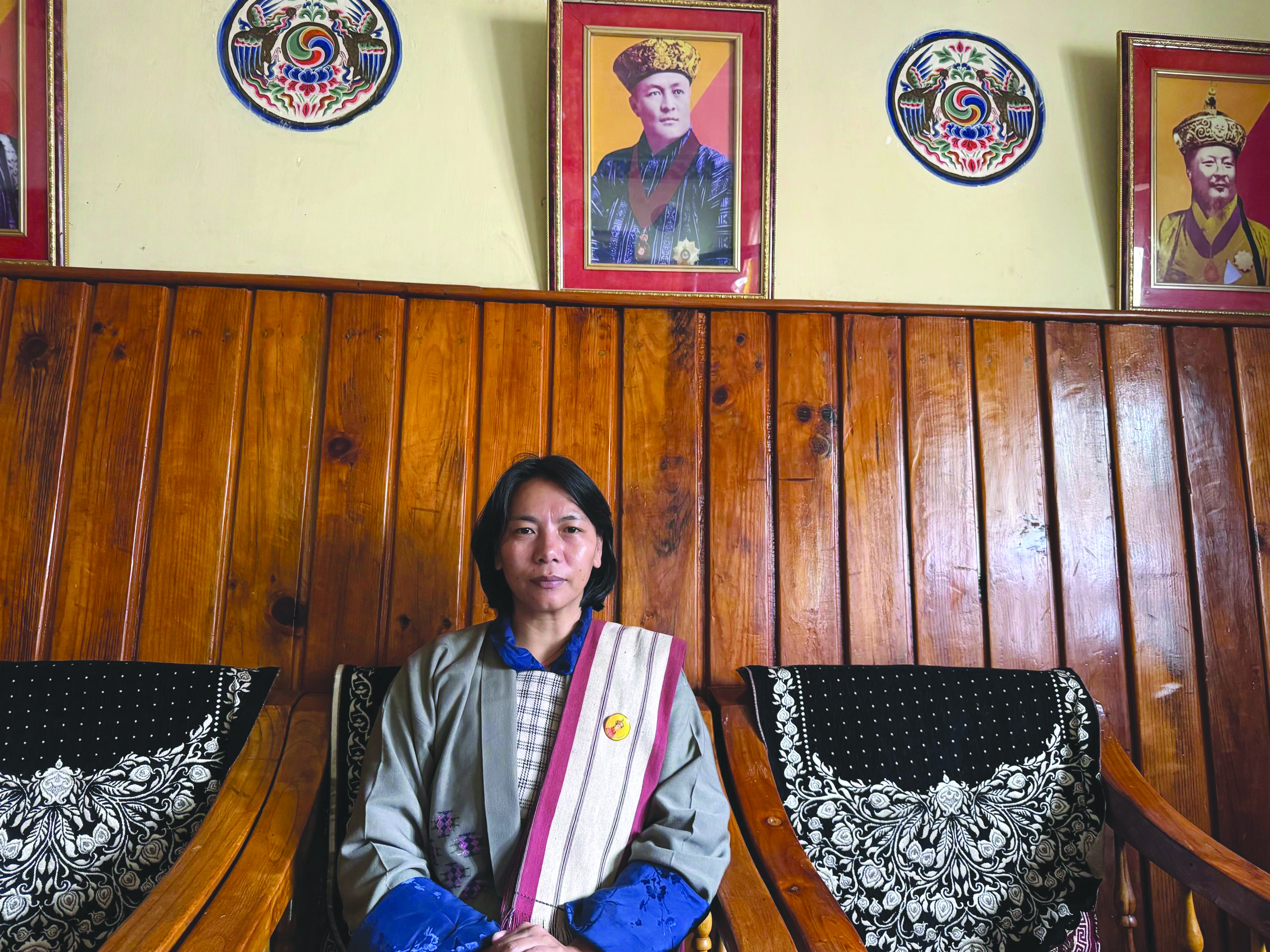
It arrived quietly with a 33-year-old mother of two becoming one of only nine women leading Bhutan’s 205 gewogs.
In that moment, Kuenzang Choden did more than win an election. She stepped into a space
where women have long been absent and began to reshape what leadership looks like from within.
In a system where less than five percent of Gups are women, her victory reflects both progress and a persistent gap.
“I participated before but couldn’t win. But I got another opportunity, and this time I won,” she said. “I thank all the communities of the five chiwogs under Korphu for placing their hope and faith in me.”
Her first attempt at the Gup seat ended in defeat. But she carries that experience not as failure, but as preparation.
Each vote she earned represented more than personal support, it quietly challenged long standing norms in a community where leadership, even at the chiwog level, has traditionally been dominated by men.
“For many, politics is seen as public and masculine, while women are expected to take care of household duties and look after children,” she said.
Her interest in leadership did not begin with ambition, but observation. Watching female parliamentarians, particularly Lhaki Dolma of Punakha, who speak with clarity and confidence left a lasting impression.
“Whenever she raised concerns or questions, she did it fluently without any hesitation. From there, I felt women could shoulder responsibility equally,” Kuenzang Choden recalled.
At home, her leadership is supported by shared responsibility. She credits her husband’s role in caring for their children as critical to her ability to serve.
“Balancing family responsibilities with the workplace is not an issue as long as you have supportive family members. My husband always makes sure he takes responsibility for our sons when I take up duties at the office. Husband support means a lot.”
But such support is not universal.
Women in Bhutan continue to shoulder a disproportionate share of unpaid care work, limiting their participation in both the workforce and public life. For many, entering politics is not just a professional decision, it is a negotiation with deeply embedded social expectations.
“Sometimes I felt people might have supported me out of curiosity, to see how differently a woman leader might lead,” she said. “Stepping out to represent the community comes with challenges, but it is our responsibility to navigate obstacles.”
Determined to lead through action rather than rhetoric, one of her first responsibilities was overseeing the renovation of Nebee Lhakhang, ensuring continuity with existing development plans.
Her approach, measured, consultative, and accessible is already reshaping how governance feels in Korphu.
“Since the beginning of democracy, leadership has mostly been in men’s hands. There was some fear: what if we fail?” said Khandro Wangmo, a local resident of Nebee chiwog. “But seeing a woman lead has changed that. Now I feel more confident.”
Others describe a shift in participation. Tshogpa Kinley Tenzin said Kuenzang Choden is approachable and engages actively with the community, even if she takes time to make quick decisions.
Another local resident like Dema Lhamo notes that women are speaking more openly in meetings, especially on issues affecting households and families.
Another 65-years-old resident, Changala said he was initially unsure how a woman would manage the demands of the role, but that perception has shifted. “At first, we wondered if it would be difficult. But now we see that leadership depends on commitment, not gender,” he said.
“With a woman Gup, community members seem more at ease asking questions and sharing their opinions,” said Changala, adding that the change reflects greater accessibility rather than a critique of past leadership.
For younger women in the gewog, the impact is already becoming evident. Pema Choden, a recent high school graduate, shared that public office had never felt like a realistic aspiration for her.
“Now, seeing a woman Gup, I feel it is something we can also pursue in the future,” she said. She noted that while women make up nearly half the population, leadership positions have long remained overwhelmingly male-dominated.
“I never imagined that a woman from my own village would step forward to lead five chiwogs,” she added. “But today, she is not only leading, but she is also doing so with strength, confidence, and purpose.”
Kuenzang’s story, however, is not just local, but it reflects a national reality.
Women make up nearly 47 percent of Bhutan’s population and around 40 percent of the civil service. Yet their representation declines sharply at decision-making levels.
Women hold only about 23 percent of executive civil service positions and just five of the 72 seats in Parliament.
According to the United Nations Development Programme, women in Bhutan continue to face multiple structural and social barriers to political participation from the disproportionate burden of unpaid care work to persistent stereotypes about women’s leadership abilities.
Limited access to networks, fewer campaign resources, and lower exposure to leadership opportunities further restrict their entry into public office.
“Strengthening women’s skills alone is not enough,” UNDP notes, emphasizing that these challenges must be addressed alongside deeper structural inequalities and social norms.
To help bridge this gap, UNDP is working with institutions such as the National Commission for Women and Children and the Bhutan Centre for Media and Democracy to identify and prepare women candidates, build support networks, and promote more inclusive participation in upcoming local government elections.
The agency also supports broader reforms from workplace protections to leadership development, aimed at creating an environment where more women can enter and remain in positions of power.
Sustainable progress, UNDP emphasizes, depends not only on empowering women individually, but also on changing the systems and expectations that shape who is allowed to lead.
Back in Korphu, that shift is already beginning to take form.
“There is no right to force the public to support women,” Kuenzang Choden said. “But awareness programs and policies, if sustained, can address deep-rooted socio-cultural and structural barriers.”
For her, leadership is not defined by position alone, but by inclusion. “My hope is to ensure the voices of all, including women and marginalized members of my gewog, are included and raised during meetings,” she said.
At 33, she sees herself as standing between generations.
“I am at an age where I am neither too young nor too old, and I hope to serve as an example for both.” Her motivation remains clear.
“When I first contested for Gup, my motive was to inspire youth and give women a voice. I hope my role encourages upcoming female candidates to participate in leadership.”
Nine women out of 205 Gups is still a small number.
But in Korphu, change has already begun, not through slogans or symbolism, but through the quiet authority of a woman doing the job.
And in a country still negotiating who gets to lead, that is how transformation often starts—not loudly, but one seat at a time.
This story is supported by the Bhutan Centre for Media and Democracy (BCMD) with funding from the Canada fund for local initiative
Nidup Lhamo, Korphu, Trongsa