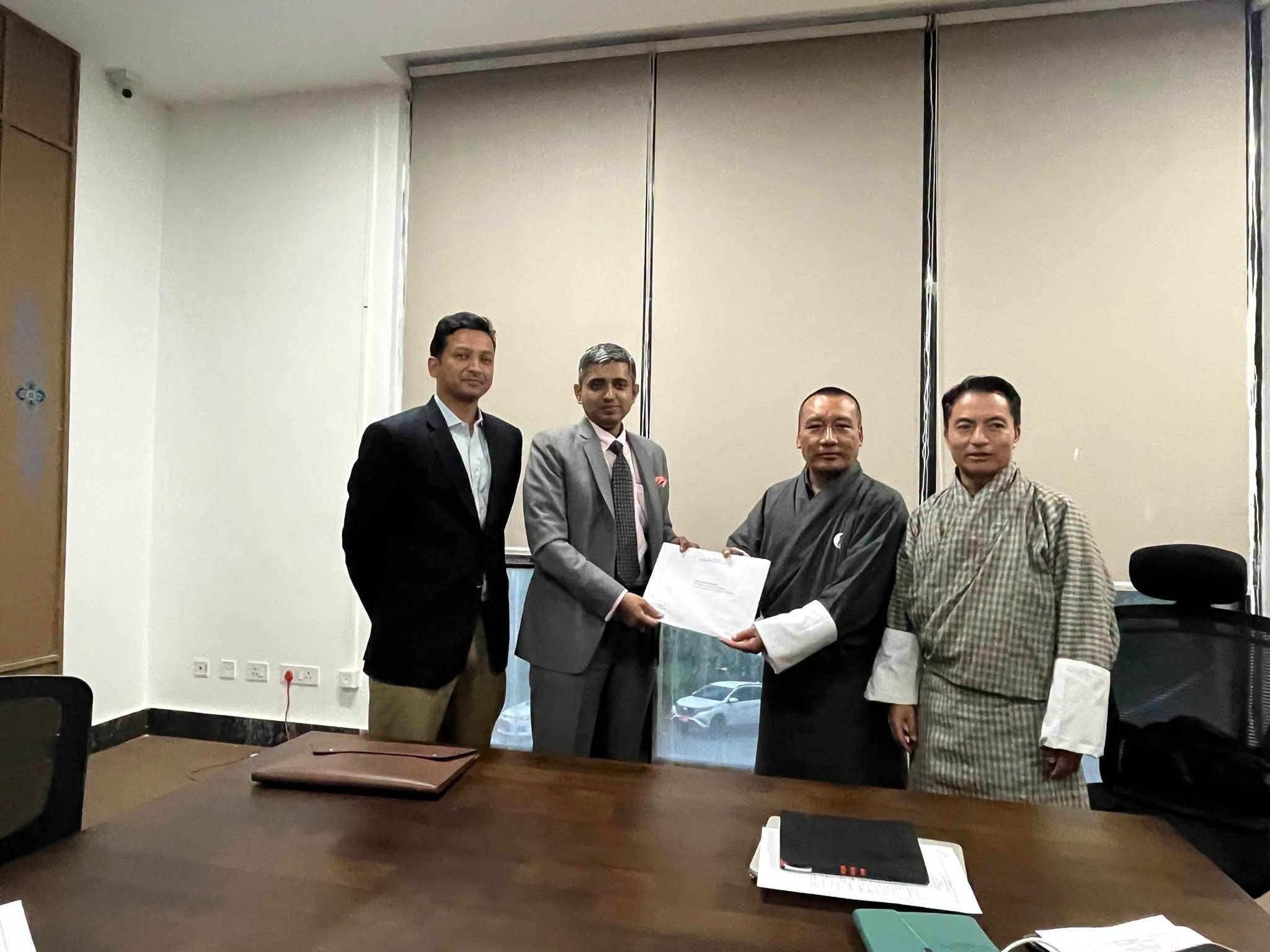
The Japan Alumni Association of Bhutan (JAAB) awarded its latest mini-grant on 5 September, 2025, recognizing innovative projects by Bhutanese professionals trained in Japan. This year, Nityam Nepal, senior geologist at the Department of Geology and Mines (DGM), Ministry of Energy and Natural Resources, received the grant for his project titled “Enhancing Sustainability and Operational Reliability of Seismic Monitoring and Infrastructure.”
Bhutan lies in the seismically active Himalayan region, making earthquake preparedness critical, despite the infrequency of large events. As the sole agency responsible for real-time seismic monitoring and response, the DGM operates a network of intensity meters across Dzongkhags and Gewogs. This network, supported by the World Bank and the Japanese government, provides crucial data on earthquake impacts.
However, the system faces persistent challenges, including aging equipment, lightning-related damage – especially in southern Bhutan – and difficulties in procuring spare parts. Drawing from JICA training on system redundancy and local-level maintenance, Nityam Nepal proposed a project aimed at strengthening monitoring capabilities and reducing downtime.
The project objectives include procuring spare Raspberry Pi CPUs and screens, training district ICT and disaster management officials, and developing a strategic equipment distribution plan prioritizing high-risk or critical stations. Activities under the grant will involve: procuring high-quality, compatible hardware from reputable vendors, conducting a comprehensive survey of existing stations to identify high-risk locations, establishing regional stockpiles of spare parts for rapid deployment and maintenance and deploying equipment based on risk and operational importance. The others are providing hands-on training for district officials in fault detection, component replacement, and basic maintenance and monitoring and evaluating equipment performance, downtime, and response times to optimize future strategies.
Once implemented, the project is expected to enhance the reliability and resilience of Bhutan’s earthquake intensity monitoring network, reduce downtime, and accelerate restoration of services after equipment failures. Moreover, it will strengthen technical capacity and responsiveness among local ICT and disaster management personnel, while ensuring strategic and cost-effective use of resources.
“The success of this project will also demonstrate the tangible benefits of the Global Seismological Observation training I received in Japan,” said Nepal, adding that it may inspire other professionals to pursue similar training. The DGM proposed a tentative budget of Nu 248,000, comfortably within JAAB’s Nu 250,000 grant ceiling.
JAAB’s mini-grants are awarded to members who have completed short-term or long-term training in Japan under MEXT or JDS scholarship programs. Projects are selected based on relevance to the applicant’s training, potential community impact, contribution to Bhutan-Japan relations, and environmental sustainability.
Founded by alumni of JICA training programs and long-term MEXT/JDS scholars, JAAB has grown into a vibrant civil society organization that operates independently while maintaining strong ties and financial support from JICA. Its mission is to harness the knowledge, skills, and international exposure gained by its members to address pressing national challenges and contribute to Bhutan’s sustainable development. By awarding grants such as the one received by Nityam Nepal, JAAB not only enhances critical infrastructure like Bhutan’s seismic monitoring network but also demonstrates how international training programs translate into tangible, local impact.
The project is a striking example of the multiplier effect of global knowledge transfer – how skills, insights, and exposure gained through international training can be transformed into tangible solutions that address pressing national challenges. By applying lessons learned abroad, Bhutan is not merely importing ideas; it is crafting locally relevant strategies that strengthen the country’s disaster preparedness, enhance technical capacity among professionals, and ultimately safeguard communities against potential hazards. Beyond technical gains, the initiative highlights the power of collaboration: when international expertise is thoughtfully integrated into local systems, it elevates institutions, improves operational efficiency, and builds resilient frameworks that endure over time. In this way, projects like this demonstrate that knowledge is not static; it multiplies, rippling outward to create lasting benefits for people, organizations, and the nation as a whole.
Sangay Rabten from Thimphu