

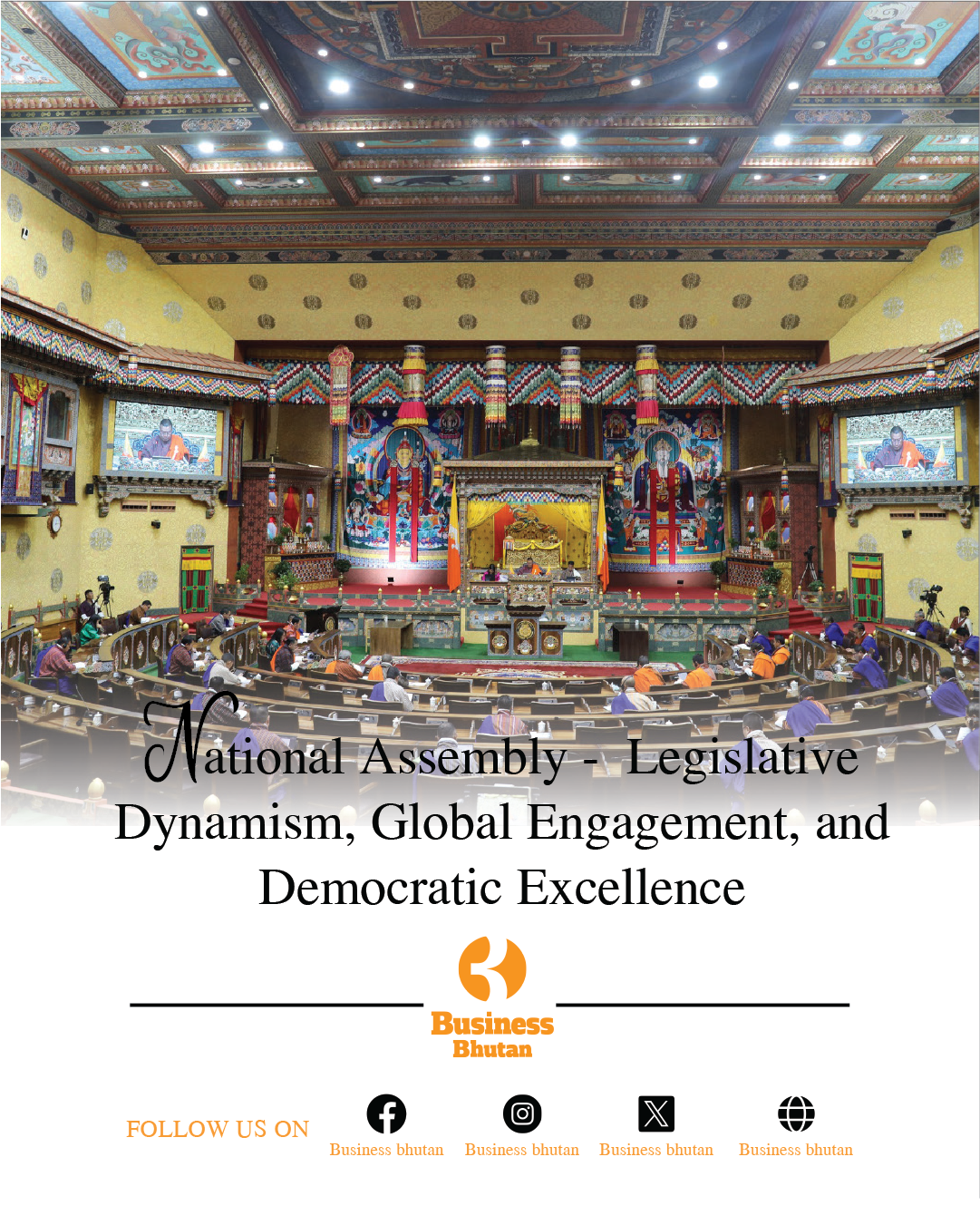
2025 has been a defining year for Bhutan’s National Assembly, marked by robust legislative activity, strengthened oversight, strategic international engagement, and dynamic parliamentary diplomacy. Guided by His Majesty The King’s vision and democratic principles, the Assembly advanced reforms in economic policy, governance, social justice, and institutional capacity, reinforcing its role as the cornerstone of Bhutanese democracy.
The year began with a strong reaffirmation of parliamentary oversight. On January 3, the Royal Audit Authority (RAA) presented its Annual Audit Report 2023–2024 to the Public Accounts Committee (PAC), highlighting top findings related to fraud, non-compliance, and systemic lapses. This set the tone for a year focused on accountability and transparency. By July 2, Parliament had endorsed the PAC’s recommendations on Audit Review Reports for both FY 2023–2024 and FY 2010–2023, demonstrating follow-through on critical accountability mechanisms and cementing the Assembly’s oversight role.
Early in the year, from January 10 to 11, the National Assembly conducted its first-ever Reflective Workshop on His Majesty’s 117th National Day Address in Paro. This landmark initiative aimed to align legislative, oversight, and representative functions with His Majesty’s vision of economic transformation, meritocracy, governance reform, and people-centric democracy, ensuring Bhutan’s Parliament remains a forward-looking institution attuned to national priorities.
Bhutanese Members of Parliament were actively engaged on regional and international fronts. Between January 29 and 30, they participated in the India–Bhutan Bilateral Meeting with parliamentarians and the National Malaria Programme in Guwahati, reviewing cross-border malaria resurgence and reinforcing parliamentary support for elimination efforts. On February 4, the Assembly engaged in a World Bank Group consultation on Bhutan’s Country Partnership Framework for FY 2025–2029, highlighting priorities such as foreign direct investment legislation, digital economy development, carbon trading initiatives, and enhanced legislative scrutiny.
The Assembly also strengthened Bhutan’s international relations through high-level diplomatic engagement. On February 3, Swiss National Council Member Thomas Aeschi visited, reaffirming Switzerland’s support for Bhutan’s education, livestock development, human resource enhancement, and infrastructure initiatives. The Hon’ble Speaker led the Bhutanese delegation to the 15th Asian Parliamentary Assembly in Baku from February 17 to 21, signaling Bhutan’s commitment to regional unity and sustainable development. Further outreach included discussions with U.S. Senator Gary Peters on democratic processes, participation in the 6th World Conference of Speakers of Parliament in Geneva, attendance at the HKH Parliamentarians’ Meet in Kathmandu, and the BIMSTEC Young Leaders Summit in Guwahati, underscoring Bhutan’s growing profile in regional and global parliamentary diplomacy.
The Assembly’s committees remained highly active throughout the year. In February, the Good Governance Committee consulted with GovTech and the Prime Minister’s Secretariat to improve grassroots service delivery under the 13th Five Year Plan, while the Economic and Finance Committee engaged JICA officials during a macroeconomic review mission. In March, Members met with UNFPA leadership to discuss women’s rights and population development, and conducted consultations on the Economic Stimulus Programme. The Special Committee, chaired by the Leader of the Opposition, addressed land-related public concerns, while multiple consultations on the National Assembly (Amendment) Bill 2024 and the Alternative Dispute Resolution (Amendment) Bill 2024, including public hearings on ESP implementation, ensured that legislative processes remained inclusive and participatory.
The Third Session of the Fourth Parliament, opened by His Majesty on May 23, marked a productive legislative period. Key bills passed included the Goods and Services Tax (Amendment) Bill 2025, the Income Tax Bill of Bhutan 2025, the Alternative Dispute Resolution (Amendment) Bill 2024, the Marriage (Amendment) Bill 2024, and the Financial Services (Amendment) Bill 2025. The National Budget for FY 2025–26 was presented on May 26 by the Finance Minister, followed by the Prime Minister’s State of the Nation Report to the Joint Sitting on July 3, reflecting a robust dialogue between the legislature and executive on national priorities.
Capacity building and media engagement were a major focus in 2025. Workshops on media engagement and digital tools in April, AI and media training for research assistants in July, a media symposium on journalism in Bhutanese democracy in August, and legislative drafting training at the Lok Sabha in New Delhi in October all strengthened institutional capabilities and modernized parliamentary processes, ensuring that the Assembly could interact effectively with citizens and the press.
The Assembly also held the Fifth Plenary Session on March 25, addressing constituency concerns, followed by a Post-Session Review Meeting on July 16 to chart future priorities. His Majesty graced the opening of the Fourth Session of the Fourth Parliament on November 27, reaffirming the monarchy’s enduring guidance in Bhutan’s democratic journey.
In 2025, the National Assembly of Bhutan demonstrated an active, responsive, and forward-looking Parliament. Through impactful legislation, strengthened oversight, inclusive consultations, and dynamic parliamentary diplomacy, the Assembly reinforced its commitment to good governance, democratic values, and the well-being of the Bhutanese people. The year stands as a testament to Bhutan’s mature democracy, where legislative excellence, international engagement, and public accountability converge to ensure the nation’s continued prosperity and resilience.
Sangay Rabten
Ftom Thimphu