

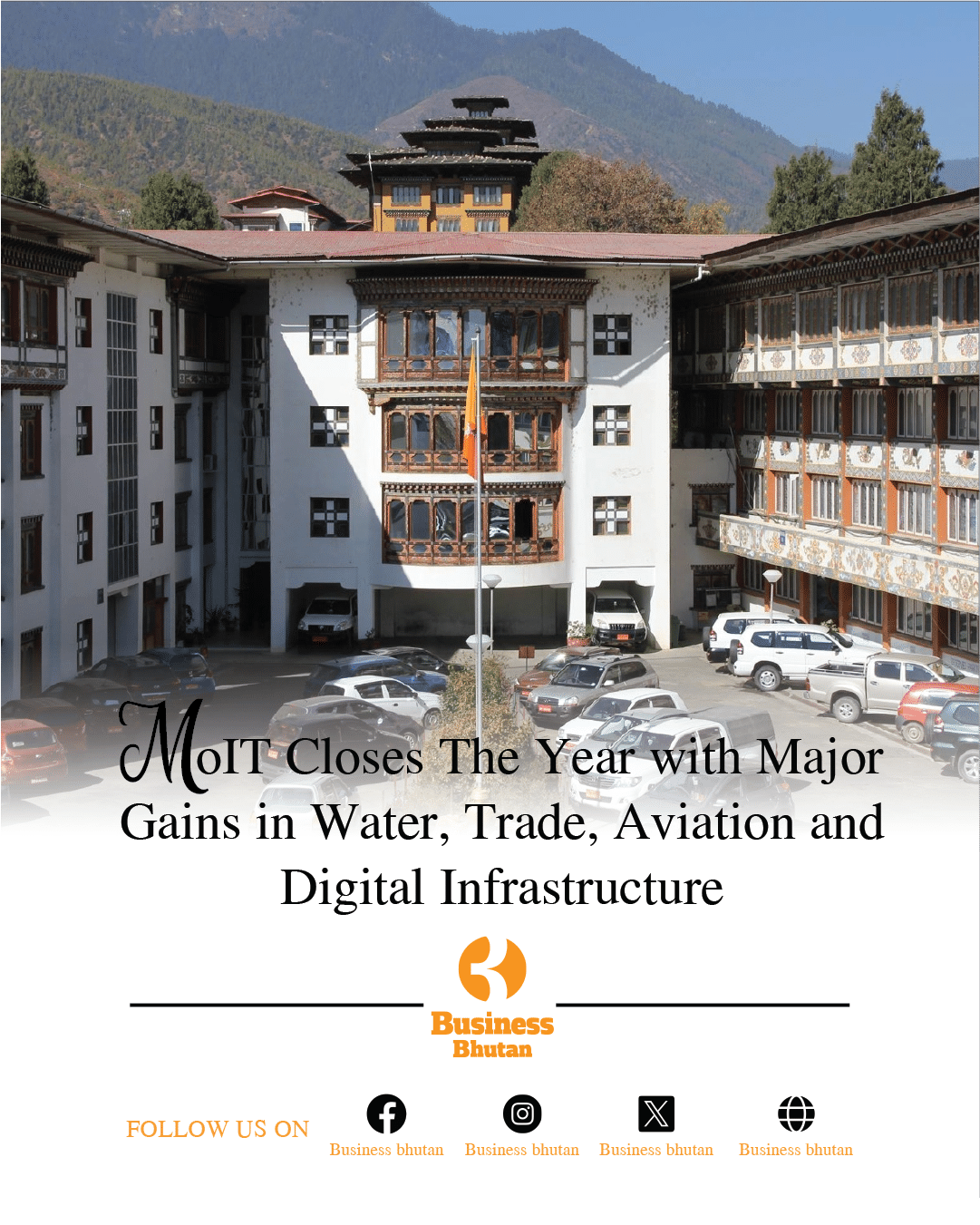
The Ministry of Infrastructure and Transport (MoIT) concluded 2025 with remarkable strides across water supply, digital governance, aviation, trade connectivity, and climate-resilient infrastructure, reinforcing its role as a key driver of Bhutan’s modernization and regional integration.
A standout achievement was the inauguration of the Jungzhina–Pamtsho Water Supply System, completed at a cost of Nu 123.45 million with support from the Asian Development Bank (ADB) and the Royal Government. The system features a 1.4 million litre-per-day treatment plant, a 23-kilometre distribution network, 260 automated water meters, and an advanced SCADA system, delivering safe drinking water to 1,378 households. Officials hailed the project as a model of climate-resilient, efficient, and transparent urban water infrastructure.
Digital transformation remained a core focus. MoIT launched four new digital platforms: the Zhichar Building Database for urban planning, the Electronic Correspondence Archival and Management System (E-CAMS) for administrative transparency, the Spatial Plan Inventory System (SPIS), and the Emergency Shelter Preparedness Dashboard (ESPD) to strengthen disaster readiness. In parallel, the Construction Manager Software (CMS) replaced paper-based measurement books, enhancing workflow efficiency, accountability, and transparency in public infrastructure projects.
Bhutan expanded its aviation and transport diplomacy. A historic Air Services Agreement (ASA) with Vietnam was signed on August 19, attended by His Majesty the King and Vietnamese President Luong Cuong, marking a milestone in regional air connectivity. Minister Lyonpo Chandra Bdr. Gurung also represented Bhutan at the ICAO Facilitation Conference 2025 in Doha, reaffirming the nation’s commitment to sustainable aviation growth, airport modernization, and improved passenger facilitation while preserving environmental and cultural values.
2025 also saw Bhutan’s first structured step into drone technology. On April 28, MoIT and JICA signed a Record of Discussions for the Drone Usage Environment Project, a 27-month initiative to update the national drone strategy, conduct trials, strengthen safety regulations, and establish foundational services for disaster management, surveying, agriculture, and logistics.
Bhutan demonstrated commitment to safe and sustainable mobility at the 4th Global Ministerial Conference on Road Safety in Marrakech, Morocco, highlighting progress under the Global Road Safety Master Plan 2021–2030, including reductions in fatalities, infrastructure upgrades, and public awareness initiatives. The minister pledged amendments to the Road Safety and Transport Act by 2027 to align with the Safe System approach.
Regional trade connectivity advanced with the Jogighopa Inland Waterways Terminal in Assam, India, inaugurated with Bhutan’s Minister for Industry, Commerce and Employment Namgyal Dorji and India’s Union Minister Sarbananda Sonowal. Located 91 kilometres from Gelephu, the terminal enhances access to the Indo-Bangladesh Protocol Route, reduces logistics costs, and strengthens Bhutan’s bilateral trade. MoIT now oversees inland waterways transport, further facilitating regional commerce.
Progress also continued on the Bhutan-India Rail Links Project, with the first steering committee meeting advancing rail connections between Kokrajhar–Gelephu and Banarhat–Samtse. The JICA Technical Cooperation Project on human resource development strengthened skills and professional standards within Bhutan’s construction sector.
Urban planning and climate resilience were emphasized, including proposals for a climate-resilient Thimphu–Paro strategy and connectivity enhancements such as the Gelephu–Tareythang road under the ACCESS initiative.
As 2025 closes, MoIT’s achievements reflect a year of steady progress and institutional strengthening, laying the foundation for resilient infrastructure, improved public services, and deeper regional integration in the years ahead.
Nidup Lhamo
From Thimphu