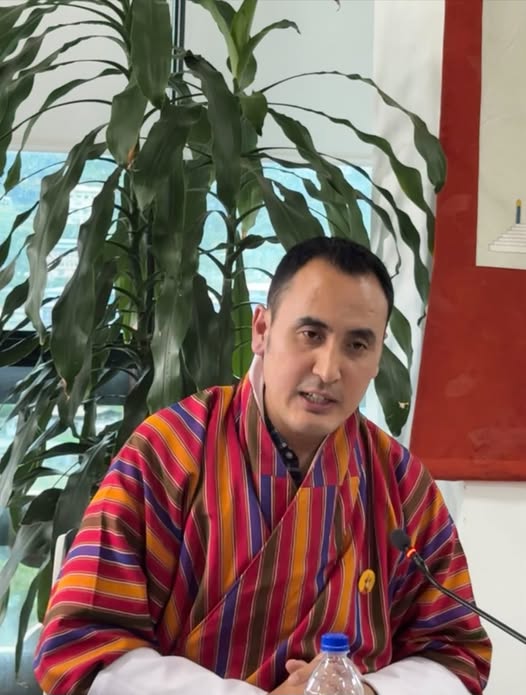
Bhutan’s economic transformation cannot be achieved through government reforms alone. The private sector must change, take greater responsibility, invest, innovate and compete if the country is to build a stronger and more dynamic economy, Industry, Commerce and Employment Minister Namgyal Dorji said.
Speaking at the 31st Meet-the-Press following the Government’s nationwide tour to identify bottlenecks constraining businesses and private-sector growth, the minister said the exercise was not simply about identifying what Government should fix. It was also about asking what businesses themselves must do differently.
The Government, he said, has a responsibility to simplify regulations, remove unnecessary barriers and create a business environment that is predictable, efficient and conducive to investment. But businesses must respond by becoming more professional, productive and accountable.
“But reform cannot be one-sided. If businesses want fewer regulations, there must also be greater professionalism, compliance and accountability,” Lyonpo Namgyal Dorji said.
The message comes as Bhutan seeks to accelerate economic transformation, attract investment and create more employment opportunities, while confronting the limitations of a small domestic market and a private sector that remains heavily dependent on domestic demand.
The minister said Bhutanese entrepreneurs could no longer afford to simply replicate existing business models.
“In a small domestic market, we cannot keep replicating the same businesses. Our entrepreneurs must innovate, improve productivity, invest in technology and skills, take calculated risks and increasingly look beyond Bhutan for markets,” he said.
For businesses, this means moving beyond an approach centred primarily on seeking government support and instead taking greater ownership of investment, innovation and growth.
The minister said the private sector must be prepared to invest, compete and create jobs, while the Government focuses on removing structural barriers and creating the conditions for businesses to succeed.
“The government can create the enabling environment, but ultimately businesses must invest, compete and create jobs,” he said.
He also stressed that the relationship between Government and businesses must be built on mutual trust, which lies at the heart of His Majesty’s vision of a Trust Economy.
The Government must have confidence that businesses will operate responsibly and comply with the rules, while businesses must have confidence that the Government will be fair, predictable and efficient in its dealings with them.
Trust, however, cannot be built by Government alone.
The minister said greater professionalism, accountability and compliance from businesses would be essential to building the confidence needed for Government to reduce unnecessary regulatory burdens.
“We also need greater ambition,” he said.
That ambition, he suggested, must be reflected not only in the number of businesses established but also in their ability to grow, innovate and compete beyond Bhutan.
The nationwide tour was undertaken to hear directly from businesses about the barriers affecting their operations, including regulatory and administrative bottlenecks. The Government is expected to use the findings to inform reforms aimed at making it easier to start, operate and expand businesses.
But removing bottlenecks will only address one side of the challenge.
For Bhutanese businesses to become engines of economic transformation, they will need to strengthen management practices, invest in people and technology, improve productivity and develop products and services that can compete in larger markets.
This will also require a greater willingness to take calculated risks. In a small economy, limited domestic demand means that businesses seeking significant growth will increasingly need to look beyond Bhutan.
The minister said stronger cooperation between Government and the private sector would therefore be critical.
“If government reforms and the private sector steps up, trust itself can become a competitive advantage for Bhutan,” he said.
The message from the Government is consequently not simply that it must do more for business. It is also a challenge to businesses to do more for themselves.
As Bhutan seeks to diversify its economy and create meaningful employment for its growing workforce, the private sector will have to move from being a beneficiary of reforms to becoming an active driver of transformation.
The Government can open doors, remove obstacles and create the conditions for growth. But ultimately, investment, innovation, productivity, jobs and competitiveness must come from businesses themselves.
Sherab Dorji, Thimphu