

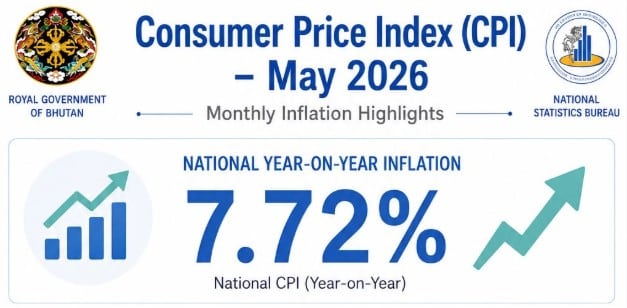
The annual inflation accelerated to 7.72 percent in May 2026, driven by sustained increases in both food and non-food prices compared to the same period last year, according to the latest Consumer Price Index (CPI) released by the National Statistics Bureau (NSB).
While the year-on-year figures indicate continued inflationary pressures across the economy, consumer prices eased on a monthly basis as food prices declined sharply, providing some short-term relief to households.
The latest data show that national inflation rose from May 2025 levels, with food inflation reaching 7.88 percent and non-food inflation standing at 7.70 percent, suggesting that rising living costs continue to affect households across the country.
Food prices increased slightly faster than non-food prices over the year, highlighting persistent cost pressures on essential commodities that account for a significant share of household expenditure.
Inflation, measured through the CPI, tracks changes in the average prices paid by consumers for a basket of goods and services. A higher inflation rate generally translates into reduced purchasing power, particularly for low- and middle-income households whose spending is concentrated on food and basic necessities.
Despite the annual rise, the monthly inflation trend paints a different picture. The national CPI declined by 0.64 percent between April and May, mainly due to falling food prices. Food prices recorded a 1.42 percent month-on-month decline, offsetting a modest 0.18 percent increase in non-food prices.
The decline suggests that seasonal factors and improved supplies have contributed to easing food prices during the month, although broader inflationary pressures remain elevated when compared to a year earlier.
Economists note that month-on-month inflation often reflects short-term fluctuations, whereas year-on-year inflation provides a clearer indication of underlying price trends in the economy.
Regional inflation figures reveal noticeable differences in price movements across the country.
The Western Region recorded the highest annual inflation at 8.16 percent, closely followed by the Central Region at 8.13 percent. Inflation in the Capital City stood at 7.85 percent, while the Eastern Region recorded the lowest inflation rate at 6.93 percent.
The disparity suggests that regional variations in transportation costs, supply chains, market access and consumption patterns continue to influence price levels across Bhutan.
The higher inflation recorded in the western and central regions may reflect stronger consumer demand, higher transportation costs and greater concentration of commercial activities, while relatively lower inflation in the eastern region indicates comparatively moderate price increases.
The latest figures indicate that inflation remains broad-based, affecting both essential food items and non-food goods and services.
Food inflation continues to be closely watched because it has a direct impact on household welfare. Rising prices of food items disproportionately affect lower-income families, which spend a larger share of their income on basic necessities.
Meanwhile, non-food inflation reflects higher costs across categories such as housing, clothing, transport, education, healthcare and other consumer goods and services, increasing the overall cost of living.
Although the slight monthly decline offers temporary relief, the annual inflation rate remains significantly above levels generally associated with stable prices.
Persistent inflation can influence household consumption patterns, business operating costs and investment decisions, while also affecting broader economic growth. Businesses may continue to face higher input costs for raw materials, transportation and logistics, which can eventually be passed on to consumers through higher retail prices.
At the same time, sustained inflation places pressure on household budgets by reducing real purchasing power and increasing expenditure on everyday necessities, while inflation remains an important economic indicator as it influences fiscal planning, wage expectations and broader macroeconomic management for policymakers.
The NSB noted that the annual inflation rate compares consumer prices in May 2026 with those recorded in May 2025, while the monthly CPI measures price changes between April and May 2026.
The Bureau’s latest inflation highlights show that although consumer prices eased marginally during the month, annual price pressures remain elevated across most sectors of the economy.
The combination of strong food inflation, rising non-food costs and regional disparities suggests that inflation will continue to be closely monitored as Bhutan pursues economic recovery and growth under the 13th Five-Year Plan.
While the decline in monthly food prices provides some optimism, the latest CPI data indicate that inflationary pressures remain firmly embedded in the economy, underscoring the need for continued vigilance to safeguard household purchasing power and maintain overall price stability.
Tashi Namgyal, Thimphu