


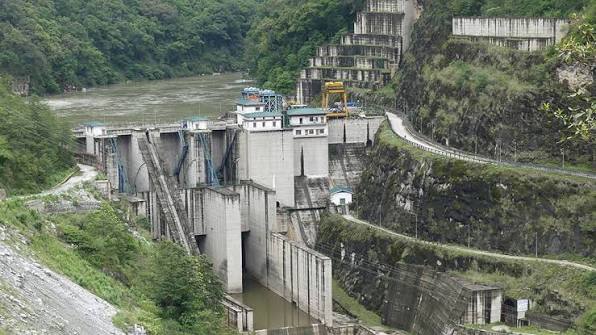
Bhutan’s hydropower generation rose sharply in the first seven months of 2026, with the country’s major power plants producing 7,964.1 million units of electricity, an increase of 9.3 percent from 7,286.8 million units generated during the same period last year.
The increase reflects stronger output from some of the country’s largest hydropower plants, particularly Punatsangchhu-II (PHPA-II), Tala, Mangdechhu, Chhukha and Basochhu.
According to the Royal Monetary Authority’s September statistical bulletin, generation was higher in January, March, April, May and July compared with the corresponding months of 2025. July recorded the highest output, with generation reaching 2,603.7 million units, compared with 2,253.8 million units in July last year.
Among the major plants, Tala recorded the largest increase in absolute generation. Its output rose by 14.6 percent to 2,395.2 million units in the first seven months, from 2,089.2 million units during the same period last year.
PHPA-II, meanwhile, generated 2,062.5 million units, up 14.5 percent from 1,800.6 million units in the first seven months of 2025.
Mangdechhu Hydropower Plant also recorded higher generation, increasing by 3.2 percent to 1,778.8 million units from 1,723.8 million units. Chhukha’s generation increased by about two percent to 905.7 million units.
Basochhu recorded the highest percentage growth among the major plants, with generation rising 16.4 percent to 153.1 million units from 131.5 million units.
Dagachhu Hydropower Project was the notable exception. Its generation declined by 40.4 percent to 108.3 million units from 181.8 million units during the corresponding period last year.
The stronger generation comes as Bhutan’s electricity sector continues to play a central role in the country’s economy, both as a major source of domestic energy and as an important source of export revenue.
While overall generation increased, domestic electricity sales recorded an even stronger growth during the seven-month period.
Combined domestic sales from the major hydropower plants reached Nu 10.21 billion between January and July, up 20.6 percent from Nu 8.47 billion during the same period last year.
The increase was largely driven by Mangdechhu, Tala and Chhukha.
Mangdechhu recorded the most significant increase in domestic sales, with the value more than doubling from Nu 1.50 billion in the first seven months of 2025 to Nu 3.58 billion this year.
Tala’s domestic sales increased from Nu 1.34 billion to Nu 1.90 billion, while Chhukha recorded a much sharper increase, from Nu 385.8 million to Nu 1.68 billion.
The increase in domestic sales also reflects growing electricity consumption within the country as economic activity expands and electricity demand rises across households, businesses and industries.
PHPA-II, however, recorded a substantial decline in domestic sales. Its sales fell from Nu 4.72 billion in January-July last year to Nu 2.29 billion during the same period this year.
Domestic electricity sales peaked in June at Nu 2.35 billion, compared with Nu 945.6 million in June 2025. In July, however, sales fell to Nu 779.4 million from Nu 1.14 billion a year earlier.
Despite the significant increase in electricity generation, export earnings from electricity declined during the first seven months.
Combined export sales stood at Nu 10.04 billion in January-July, down 14.4 percent from Nu 11.73 billion during the same period last year.
The decline was recorded in each of the first six months of the year, despite the overall increase in generation.
However, the trend changed dramatically in July. Export sales surged to Nu 8.08 billion, compared with Nu 5.13 billion in July 2025.
PHPA-II accounted for Nu 3.64 billion of the July export sales, while Tala contributed Nu 1.06 billion.
The divergence between generation and export earnings highlights an important shift in the electricity sector. Higher generation does not automatically translate into higher export revenue, as the amount available for export is also influenced by domestic consumption, plant-specific generation patterns and the timing and volume of electricity traded.
The sharp rise in July export earnings nevertheless points to the importance of seasonal electricity availability and export markets in determining the sector’s financial performance.
At the same time, Bhutan’s dependence on imported electricity during the first seven months of the year declined substantially.
The country imported 1,788.2 million units of electricity between January and July, compared with 2,585.9 million units during the same period last year—a reduction of about 31 percent.
February recorded the highest monthly electricity imports at 550.2 million units, followed by January at 521.3 million units.
Significantly, no electricity imports were recorded in June and July, coinciding with the period of stronger domestic hydropower generation.
The decline in imports, coupled with higher domestic generation, suggests an improvement in the availability of locally generated electricity during the summer months, when Bhutan’s hydropower plants generally benefit from higher water flows.
Meanwhile, electricity generated from solar sources is also beginning to feature more prominently in the country’s energy mix.
Solar electricity imports stood at 182 million units during the first four months of 2026, compared with only 29.5 million units during the corresponding period last year.
The sharp increase represents a significant expansion in solar electricity compared with the same period in 2025.
Bhutan’s electricity sector is therefore entering a period in which hydropower remains the dominant source of generation, while other renewable sources such as solar are beginning to contribute more significantly.
Sherab Dorji, Thimphu