

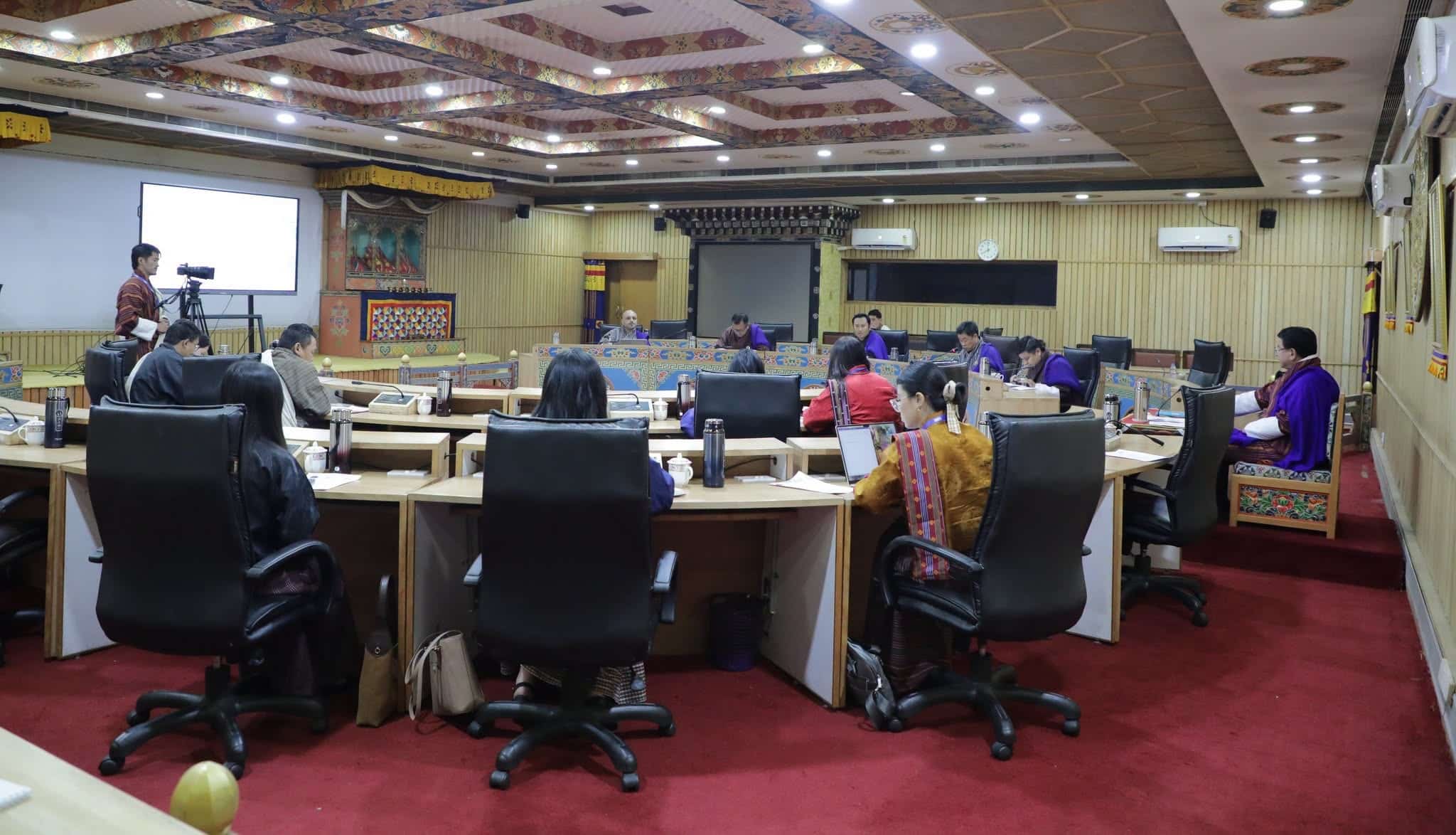
The government plans to initiate the preparation of Local Area Plans (LAPs) for 10 Yenlag Thromdes within 24 months, but boundary discrepancies, funding constraints and a shortage of qualified engineers remain major challenges. The plans are outlined in the government’s consolidated response to the National Council’s (NC) review report on Yenlag Thromdes, following recommendations made during the Council’s 37th Session.
The Department of Human Settlement under the Ministry of Infrastructure and Transport (MoIT), in collaboration with the Regional Offices for Infrastructure Development (RoIDs), will initiate the preparation of the plans within the stipulated period.
However, the government has identified boundary realignment as a prerequisite, stating that existing Thromde boundaries in some areas do not adequately reflect settlement patterns, emerging economic activities and development pressures. Major economic centres and new development activities have emerged outside existing municipal boundaries. Preparing LAPs without addressing these discrepancies could leave important growth areas outside the planning framework.
The government said boundaries should be reviewed and, where necessary, realigned to reflect settlement patterns, economic centres, infrastructure linkages and future development potential.
The 10 Yenlag Thromdes identified are Jyengkana in Haa, Beteykha in Paro, Kuenga Rabten in Trongsa, Chumey in Bumthang, Yadi in Mongar, Mendrelgang in Tsirang, Damji in Gasa, Gomtu in Samtse, Khasadrapchu in Thimphu and Lobesa in Punakha.
The NC had recommended completing and approving all 10 LAPs within 24 months, prioritising areas without existing plans. It also called for reviewing the 10 existing LAPs to ensure uniform planning standards. However, the government’s response commits only to initiating their preparation within 24 months, without explicitly guaranteeing their completion and approval.
Funding remains a concern, with no separate allocation earmarked for LAP preparation in the current financial year. The department will prioritise the exercise within MoIT’s 2026-27 budget and seek additional funding in the following financial year, subject to the Ministry of Finance’s budget ceiling.
The government has also indicated that a separate Yenlag Thromde Development Fund may not be necessary, rejecting the NC’s recommendation for a dedicated fund or national capital grant to reduce their dependence on parent Dzongkhags. Instead, development activities will continue to be financed through annual block grants allocated to Dzongkhags under the Resource Allocation Formula. Local governments are expected to prioritise essential investments within existing budgets, while major projects will be considered through the Five-Year Plan and annual budget process. Essential infrastructure, including water supply, sewerage and drainage, will also be funded through existing mechanisms.
As a result, Yenlag Thromdes will continue to depend largely on their parent Dzongkhags for development financing.
On the recommendation to introduce a legally binding Standard Operating Procedure (SOP) for rationalising Thromde boundaries, the National Land Commission Secretariat (NLCS) has reported progress. Preliminary discussions have been held with the Department of Human Settlement, while Boundary Anomalies Studies covering urban areas across the country have been completed and presented to NLCS management. A draft SOP for Thromde boundary delineation and rationalisation has been prepared and internally reviewed. It covers legal and institutional mandates, identification of boundary discrepancies, verification of urban plans, joint committee reviews, surveys, demarcation and updating of land records.
The draft will undergo further stakeholder consultations involving MoIT, the Department of Local Governance and Disaster Management, and the Election Commission of Bhutan. The SOP, however, has yet to be finalised or formally adopted.
Beyond planning and financing, the availability of qualified engineers remains a significant obstacle to developing Yenlag Thromdes. The Royal Civil Service Commission (RCSC) has supported the NC’s recommendation to facilitate the sharing of urban planning and municipal engineering personnel within Dzongkhag administrations.
Engineering services are organised across three levels: Dzongkhag administrations, RoIDs and the central ministry. Dzongkhag Engineering and Human Settlement sectors handle infrastructure and regulatory functions, while RoIDs provide technical support for local area planning, architectural and structural designs, and engineering works. MoIT oversees national human settlement policies, LAPs, building codes and engineering standards.
Under the 13th Five-Year Plan, projected staffing for engineering services was increased by more than 10 percent, with around 811 technical positions planned for Dzongkhags and RoIDs. Of the Nu 592 million allocated for civil service capacity development under the Government of India’s Project Tied Assistance for the 13th Plan, Nu 112.6 million, or 19 percent, has been allocated to MoIT.
However, the government acknowledged that attracting and retaining engineers in the civil service has become difficult due to growing private-sector demand and less competitive remuneration. Recruitment figures highlight the problem. Not a single candidate turned up for the 2026 campus recruitment at the College of Science and Technology. In 2025, only 18 of 42 advertised engineering positions were filled, while just 27 candidates applied for 54 positions advertised in 2026.
To address the shortage, the RCSC has undertaken campus recruitment, introduced substitute recruitment for engineers on extraordinary leave or long-term training, and reintroduced engineering scholarships from 2026. The RCSC and MoIT are also exploring alternative mechanisms to strengthen engineering services for Dzongkhags and local governments.
Nidup Lhamo, Thimphu