

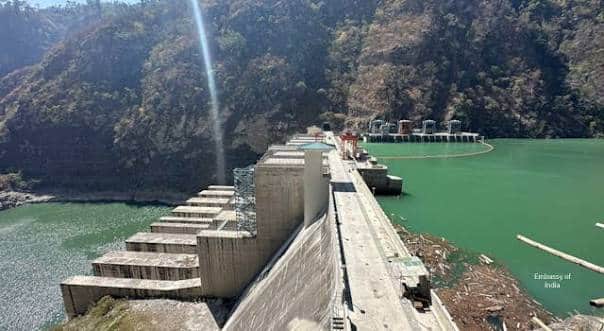
The country’s economy recorded one of its strongest expansions in recent years, growing by 8.52 percent in real terms in 2025, as increased electricity generation, a surge in investment and strong performances across key sectors propelled growth momentum. According to the National Accounts Statistics 2026 report, the acceleration was largely driven by the commissioning of the 1,020MW Punatsangchhu-II Hydroelectric Power Plant, which significantly boosted power generation and strengthened industrial activity, while rising capital investment and recovery across service sectors further supported economic expansion. The growth signals a major shift in the economic structure, with the energy and industrial sectors playing an increasingly important role in driving the next phase of development.
The growth marked an acceleration from the 7.84 percent expansion recorded in 2024, reflecting the economic impact of the commissioning of the 1,020MW Punatsangchhu-II Hydroelectric Power Plant and increased economic activity across industries.
The country’s nominal Gross Domestic Product (GDP) reached Nu 318.48 billion in 2025, while GDP per capita rose to Nu 406,204 (US$4,660.90).
The electricity sector emerged as the biggest driver of growth, expanding by 27.16 percent during the year. Electricity generation itself increased by 28.91 percent following the commissioning of Punatsangchhu-II, significantly boosting the industrial sector.
The broader industrial sector grew by 16.10 percent, increasing the share of the secondary sector in the economy by 3.01 percentage points. The secondary sector accounted for 35.39 percent of GDP, followed by the tertiary sector at 51.20 percent and the primary sector at 13.41 percent.
Construction remained another major contributor, growing by 13.21 percent and accounting for 11.69 percent of GDP, supported by continued infrastructure and development activities.
The financial sector also recorded strong growth, with finance and insurance expanding by 14.29 percent. Information and communication activities grew by 14.18 percent, supported by a 17.46 percent growth in telecommunications.
Tourism-related activities continued their recovery, with hotels and restaurants growing by 9.89 percent, while transport and storage expanded by 7.81 percent.
However, growth remained uneven across sectors. Agriculture recorded modest growth of 1.85 percent, with crop production increasing by 1.65 percent, livestock by 1.81 percent and forestry and logging by 2.42 percent.
Mining and quarrying contracted by 5.77 percent for the second consecutive year, while public administration and defence grew by 1.78 percent and wholesale and retail trade expanded by 2.76 percent.
Investment Emerges as a Major Growth Engine
The strong economic performance was accompanied by a significant rise in investment.
Gross capital formation increased by 42.57 percent in real terms to reach Nu 173.37 billion in 2025.
Investment in machinery and equipment surged by 73.02 percent to Nu 107.02 billion, while construction investment rose by 15.55 percent to Nu 61.81 billion.
The increase in investment contributed 19.61 percentage points to overall GDP growth, highlighting its critical role in driving economic expansion.
Private consumption also recovered strongly. Household and non-profit institution consumption grew by 9.52 percent, reversing the contraction recorded in 2024. Total final consumption expenditure increased by 7.73 percent.
Trade Deficit Widens Amid Higher Imports
Despite strong economic growth, Bhutan continued to face pressure from a widening trade deficit.
The trade deficit increased to Nu 97.18 billion in 2025, equivalent to 30.51 percent of GDP, as imports grew faster than exports.
Exports of goods and services increased by 35.46 percent to Nu 118.02 billion. However, imports rose sharply by 60.56 percent to Nu 215.20 billion.
The report attributed the increase in imports to higher investment and increased economic activity. Imports of services alone increased by 69.63 percent during the year.
Savings Rise, but Investment Gap Expands
National savings also improved, increasing by Nu 30.32 billion to Nu 100.79 billion.
Private savings accounted for Nu 78.48 billion, while government savings stood at Nu 22.31 billion. However, savings remained below investment requirements, with the saving-investment gap widening to Nu 47.30 billion.
Domestic savings financed around 58 percent of total investment.
Consumer prices also increased moderately, with annual inflation rising to 3.50 percent in 2025 from 2.82 percent in 2024. The GDP deflator, however, declined slightly to 4.52 percent from 4.78 percent.
The National Accounts Statistics report noted that Bhutan’s economic growth in 2025 reflected a structural shift towards the secondary sector, driven by higher electricity generation and investment.
The commissioning of Punatsangchhu-II marked a significant turning point by strengthening electricity output, supporting industrial growth and improving export capacity.
While the 8.52 percent growth rate signals strong economic momentum, the widening trade deficit, slower agricultural growth and continued dependence on imports remain key challenges as Bhutan works to sustain long-term economic transformation.
Sherab Dorji, Thimphu