For many highland communities in Bhutan, the annual cordyceps auction is more than a marketplace. It is the moment when months of hardship, endurance and uncertainty in the mountains are converted into much-needed income. But this year, the excitement has turned into disappointment for many collectors.
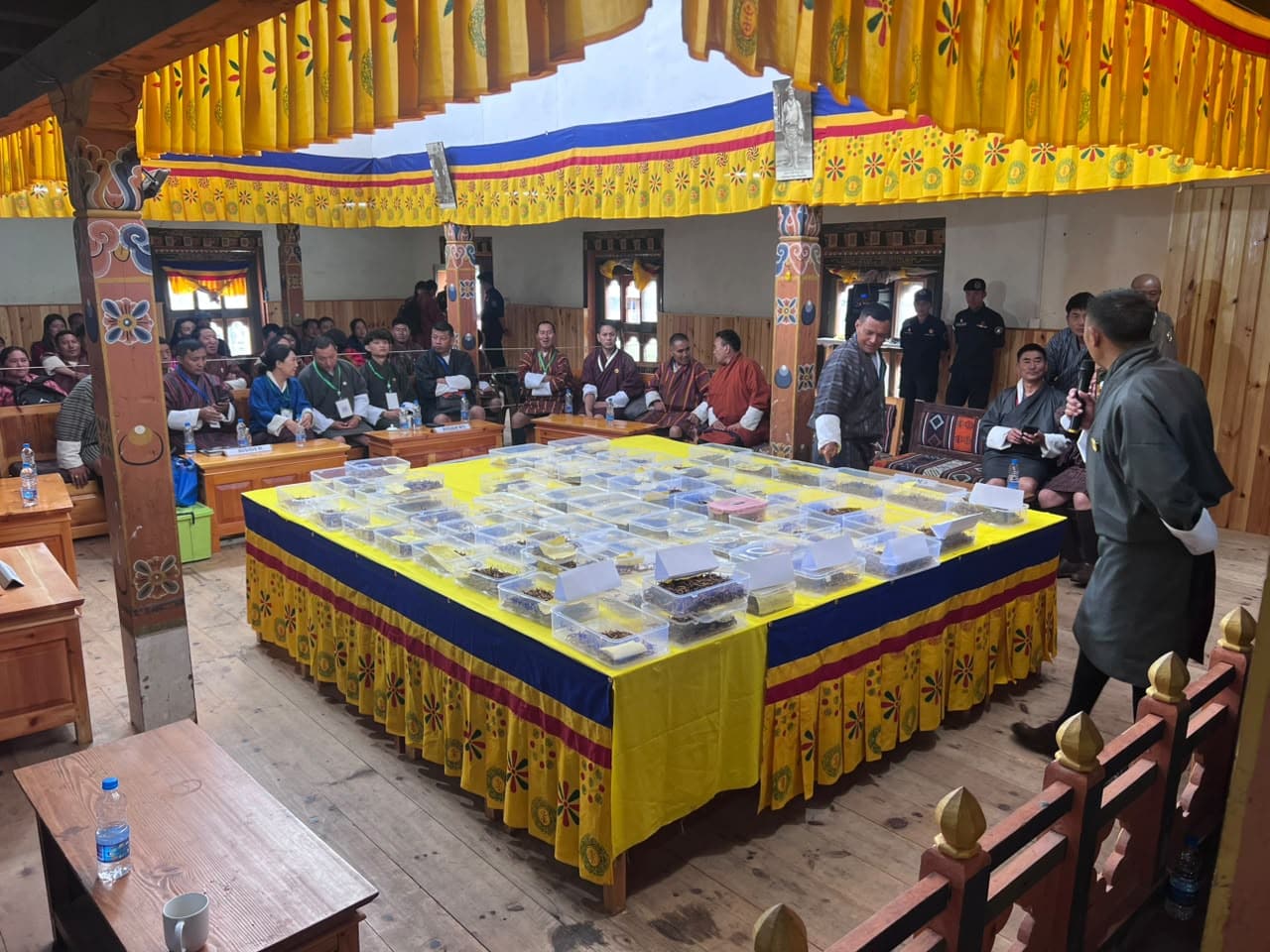
The annual cordyceps auction began in Bumthang on 10 July, but several collectors walked away without selling their prized harvest after bids fell below their expectations. Many chose to withdraw their premium-grade cordyceps, hoping that upcoming auctions in other dzongkhags, or waiting another year, may bring better returns.
At the auction held at the Chhoekhor Gewog Centre, collectors said the prices offered did not reflect the value of the rare medicinal fungus or the difficult conditions under which it is collected.
Cordyceps remains one of the most important sources of cash income for Bhutan’s highland communities. For months, collectors endure harsh weather, difficult terrain and physically demanding conditions in remote alpine areas to gather the highly valued fungus. The annual harvest often determines household earnings for the year.
However, collectors say declining auction prices are creating uncertainty for communities that depend heavily on cordyceps income.
Nima, a collector from Chhoekhor, sold only his lower-grade cordyceps while withdrawing his highest-quality A+++ grade harvest after bids failed to meet his expectations.
“I had to withdraw my best-grade cordyceps because I could not get the price I expected,” he said. “I am now considering taking it to the auction in Sephu or keeping it until next year in the hope of getting a better price.”
Another collector, Thinley Jamtsho from Chhoekhor Toe, said he registered for the auction but decided not to participate in the second round after seeing the bids.
Having already paid the required royalty, he is now exploring alternatives, including finding private buyers or traveling to Thimphu in search of better offers.
“The prices were lower than what we expected,” he said.
Jangchub Dema, also from Chhoekhor Toe, shared similar concerns, saying many collectors were reluctant to sell their best harvest at current prices.
Collectors believe one major reason behind the lower bids is the absence of major exporters at the auction yards.
“The main exporters are not coming to the auction. Instead, brokers are bidding, and I feel they are influencing the prices,” Thinley Jamtsho said. “It would be better if the actual exporters participated directly.”
He acknowledged that prices remain high compared to historical levels but said collectors naturally compare current returns with the exceptional prices achieved in recent years.
Cordyceps prices have seen significant fluctuations over the past decade. In 2013, a kilogram fetched around Nu. 685,000, almost half the price recorded in 2012. By 2021, the highest-quality cordyceps crossed Nu. 1.2 million per kilogram, while lower grades sold for slightly above Nu. 100,000.
The market reached extraordinary levels in recent years. At the Chhoekhor auction, premium cordyceps fetched a record Nu. 4.3 million per kilogram in 2023, before declining to Nu. 3.341 million per kilogram in 2024.
In 2022, the lowest successful bid was reported at Nu. 565,000 per kilogram, compared to Nu. 680,000 in 2023.
Last year, the highest bid for A+++ grade cordyceps reached Nu 2.7 million per kilogram. This year, the top price recorded at the Choekhor auction center was slightly lower, at Nu 2.5 million per kilogram for A++ grade.
Buyers attribute the decline largely to weakening international demand.
Ngawang Penjor, a cordyceps buyer from Bumthang, said the global market has slowed due to economic challenges in major export destinations.
“Because the global economy is not doing well, the price of cordyceps has gone down,” he said.
Bhutanese cordyceps is mainly exported to markets such as Taiwan, Hong Kong, Singapore and Vietnam, where buyers have reportedly become more cautious.
He also pointed to increasing competition from cultivated cordyceps produced in China.
“Bhutan’s wild-harvested cordyceps is still highly valued, but cultivated cordyceps from China is becoming a major competitor,” he said. “If this trend continues, prices may decline further in the future.”
Despite the short-term challenges, market outlooks suggest that global demand for cordyceps and other natural health products remains strong.
Industry projections indicate that the global cordyceps market is expected to expand in the coming years, driven by increasing interest in natural supplements, pharmaceuticals and functional foods.
However, for collectors in Bumthang, global growth projections offer little comfort when faced with immediate concerns at the auction yard.
For them, the question is not whether cordyceps will remain valuable globally, but whether the income generated from the harvest will continue to justify the difficult and risky journey into the mountains every year.
The decision by many collectors to hold back their best harvest reflects a growing tension in Bhutan’s cordyceps economy: a prized natural resource with strong international demand, but a market where the people at the beginning of the supply chain feel increasingly vulnerable.
For now, many collectors are choosing patience over selling at prices they believe undervalue their labour, hoping that future auctions will once again recognise the true worth of Bhutan’s golden fungus.
Sangay Rabten, Thimphu