From exporting construction minerals to supplying one of the world’s most strategic resources
Bhutan may have identified one of its most significant mineral opportunities in recent decades. The country’s first nationwide Airborne Geophysical Survey has detected potential occurrences of tungsten, copper and other base and precious metals, with the Department of Geology and Mines (DGM) now undertaking ground validation to verify the findings.
For a country whose mineral exports have traditionally been dominated by bulk commodities such as limestone, dolomite and stone aggregates—largely serving the neighbouring Indian market—the discovery could mark a significant turning point. While the identification of copper and other minerals is important, it is the potential presence of tungsten that is significant because of the metal’s extraordinary strategic importance in the modern economy.
If further exploration confirms commercially viable tungsten deposits, Bhutan’s role in global trade could be transformed. The country could move beyond being primarily a supplier of construction minerals and emerge as a potential strategic supplier of one of the world’s most sought-after critical minerals.
Such a transition could diversify Bhutan’s export base, create new economic opportunities and connect the country with advanced economies such as Japan, the United States, European nations and others that are actively seeking more secure and diversified sources of critical minerals amid growing concerns over China’s dominance of global supply chains.
The metal that powers modern civilization
Often described as the “metal behind modern civilization,” tungsten is regarded by many governments as a critical mineral. It is difficult to replace in many high-performance applications, making it essential to advanced manufacturing, defence, aerospace, technology industries and others.
Tungsten is unique.
It possesses the highest melting point of any pure metal at 3,422 degrees Celsius and remains exceptionally strong even under extreme temperatures. It is among the hardest industrial materials known and is highly resistant to wear, making it almost impossible to replace in many applications.
In many cases, tungsten is not part of the final product. Instead, it is the material that makes manufacturing the product possible. This is why economists often describe tungsten as a “force multiplier.” A relatively small quantity enables the production of goods worth thousands or even millions of times more.
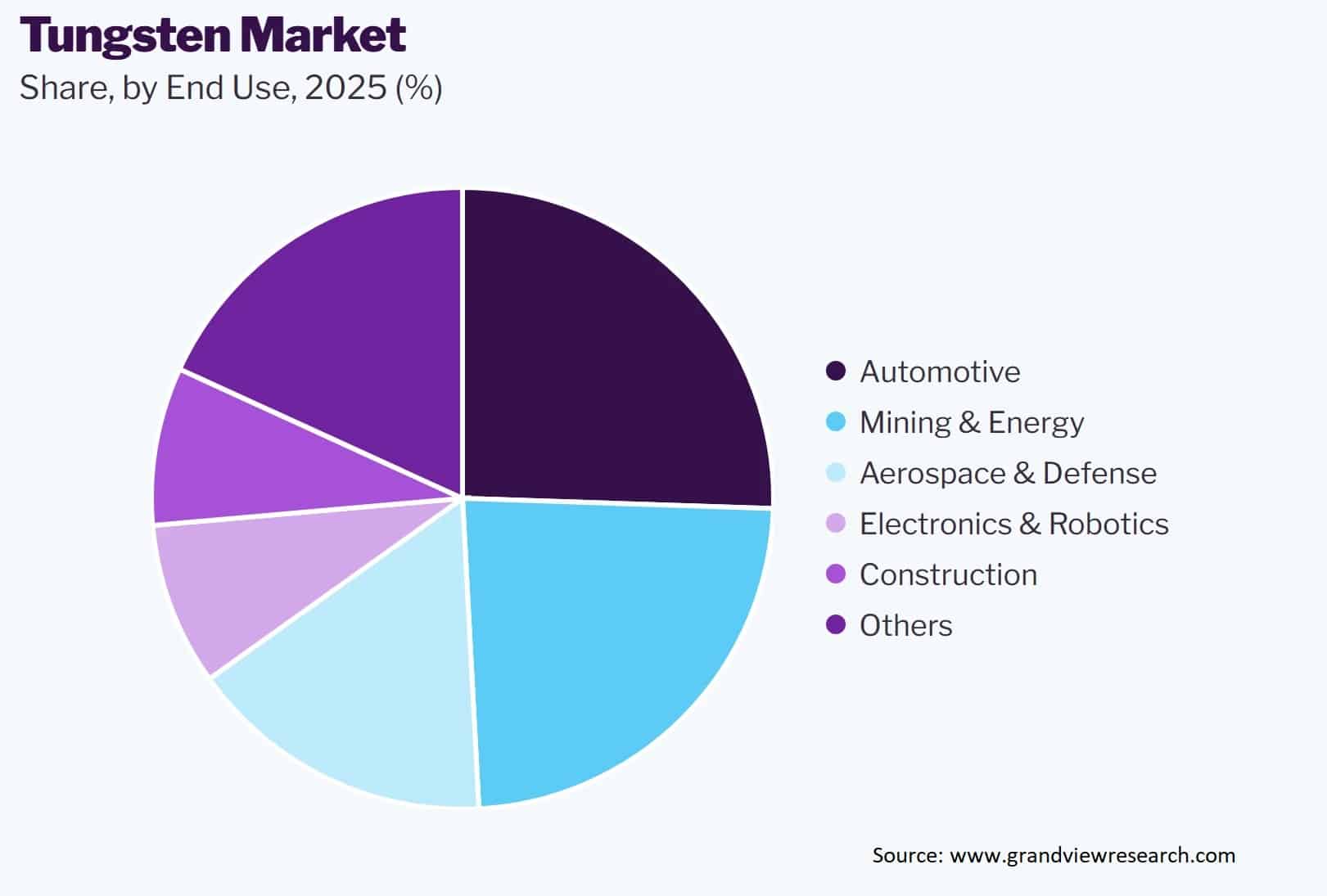
Its largest global use is in tungsten carbide, an ultra-hard material used to manufacture cutting and drilling tools. A vast range of modern products, including automobiles, aircraft, electronics and machinery, are manufactured using tools made from tungsten carbide.
Defence systems use tungsten in specialised applications such as penetrators, counterweights, radiation shielding and components requiring high density and heat resistance.
The aerospace industry uses tungsten in engines operating under extreme temperatures.
Semiconductor manufacturers depend on tungsten because it conducts electricity efficiently while remaining stable under intense heat.
Researchers developing nuclear fusion reactors consider tungsten among the most promising materials capable of withstanding extraordinary levels of heat and radiation.
The medical sector uses tungsten for radiation shielding and increasingly as an environmentally safer alternative to lead.
Even the global transition toward electric vehicles depends on tungsten because the precision tools required to manufacture batteries, motors and drivetrain components are themselves made using tungsten carbide.
Its value therefore lies not in its market price alone but in the enormous economic activity it enables.
Like lithium, cobalt and rare earth elements, tungsten contributes relatively little directly to global GDP. But industries dependent upon it collectively generate trillions of dollars annually.
A mineral with extraordinary strategic value
What make tungsten even more strategic is not only how it is used but where it comes from and where it goes to.
According to the United States Geological Survey (USGS), approximately 80 to 85 percent of the world’s mined tungsten originates from China. China also dominates refining, processing and the manufacture of tungsten-based products, giving it unprecedented influence over the global supply chain.
Vietnam is the second-largest producer, contributing only around four to five percent of global output, followed by Russia with approximately three to four percent. Other producing countries—including North Korea, Bolivia, Rwanda, Austria and Spain—account for relatively small shares.
The concentration is even more striking because China is also the world’s largest consumer of tungsten. Beyond China, the largest consumers include the European Union, the United States, Japan and South Korea.
These are among the world’s most technologically advanced economies. However, unlike China, most of them possess little or no domestic tungsten production and therefore depend overwhelmingly on imports.
This unusual combination—high strategic demand alongside highly concentrated production and consumption—has elevated tungsten into one of the world’s most geopolitically important minerals.
Japan illustrates the strategic challenge
Tungsten’s strategic importance in the modern world can be best illustrated by taking the example of Japan.
The USGS and Japan’s strategic minerals agency (JOGMEC), rank Japan among the world’s largest consumers of tungsten, despite having almost no domestic production. Industry estimates place its annual consumption at roughly 3,000 to 5,000 tonnes of contained tungsten. Trade data from Japan’s Ministry of Finance, UN Comtrade and the USGS indicate that Japan spends tens to hundreds of millions of US dollars annually importing tungsten ores, concentrates, tungsten powders, ammonium paratungstate (APT), tungsten carbide and other processed products essential to its industries.
This reflects Japan’s position as a global leader in automobiles, semiconductors, precision engineering, robotics, aerospace and advanced manufacturing.
Without any commercial tungsten mining, virtually all of Japan’s tungsten requirements are imported and its supplies come primarily from China, followed by Vietnam.
This dependence has become a strategic vulnerability. A prolonged suspension of Chinese exports would create significant pressure on Japan’s manufacturing supply chains.
The first impact would be felt by precision engineering.
Tungsten carbide tools are indispensable for machining high-performance components used in automobiles, aircraft, industrial machinery and electronics. Without them, production costs would rise sharply while manufacturing efficiency would decline.
Japan’s semiconductor industry would also come under pressure.
Tungsten plays a critical role in chip fabrication and semiconductor manufacturing equipment. A prolonged shortage would ripple across global electronics supply chains.
The automobile industry—one of Japan’s economic pillars—would also suffer because tungsten-based tools are essential for machining engines, transmissions and precision vehicle components, including those used in electric vehicles.
The defence and aerospace sectors would face similar challenges because few materials can match tungsten’s combination of density, hardness and resistance to extreme temperatures.
Japan has therefore spent years diversifying supply sources, increasing strategic stockpiles and supporting recycling initiatives.
But replacing Chinese supply entirely remains extremely difficult because China dominates not only mining but also processing and downstream manufacturing.
Similar challenges confront the United States and European economies, both of which classify tungsten as a critical mineral vital to national security and economic resilience.
A strategic opportunity for Bhutan
For Bhutan, the implications are profound.
Should the ongoing ground verification confirm commercially viable deposits, the country would not simply discover another export commodity. It would acquire a resource that sits at the heart of twenty-first century industrial competition.
Rather than exporting only minerals used in construction, Bhutan could potentially supply a critical input required by the world’s most advanced economies.
Countries seeking secure and diversified sources of tungsten—including Japan, South Korea, the European Union and the United States—could eventually look to Bhutan as a trusted supplier.
Such a development would diversify Bhutan’s economy beyond hydropower, expand export destinations, attract high-quality foreign investment, strengthen strategic partnerships and integrate the country into global critical mineral value chains.
The discovery remains at an early stage, and commercial viability has yet to be established. Ground validation, resource estimation, environmental assessment and economic feasibility studies will ultimately determine whether mining is practical.
Nevertheless, the survey findings have already revealed something significant. For a nation long known for hydropower and environmental stewardship, Bhutan may also possess one of the world’s strategically important critical minerals.
If confirmed and responsibly developed, tungsten could become far more than another export. It could transform Bhutan from a traditional commodity exporter into a strategic mineral partner at a time when the world’s advanced economies are urgently searching for secure and reliable critical mineral supply chains.
Ugyen Tenzin, Thimphu