

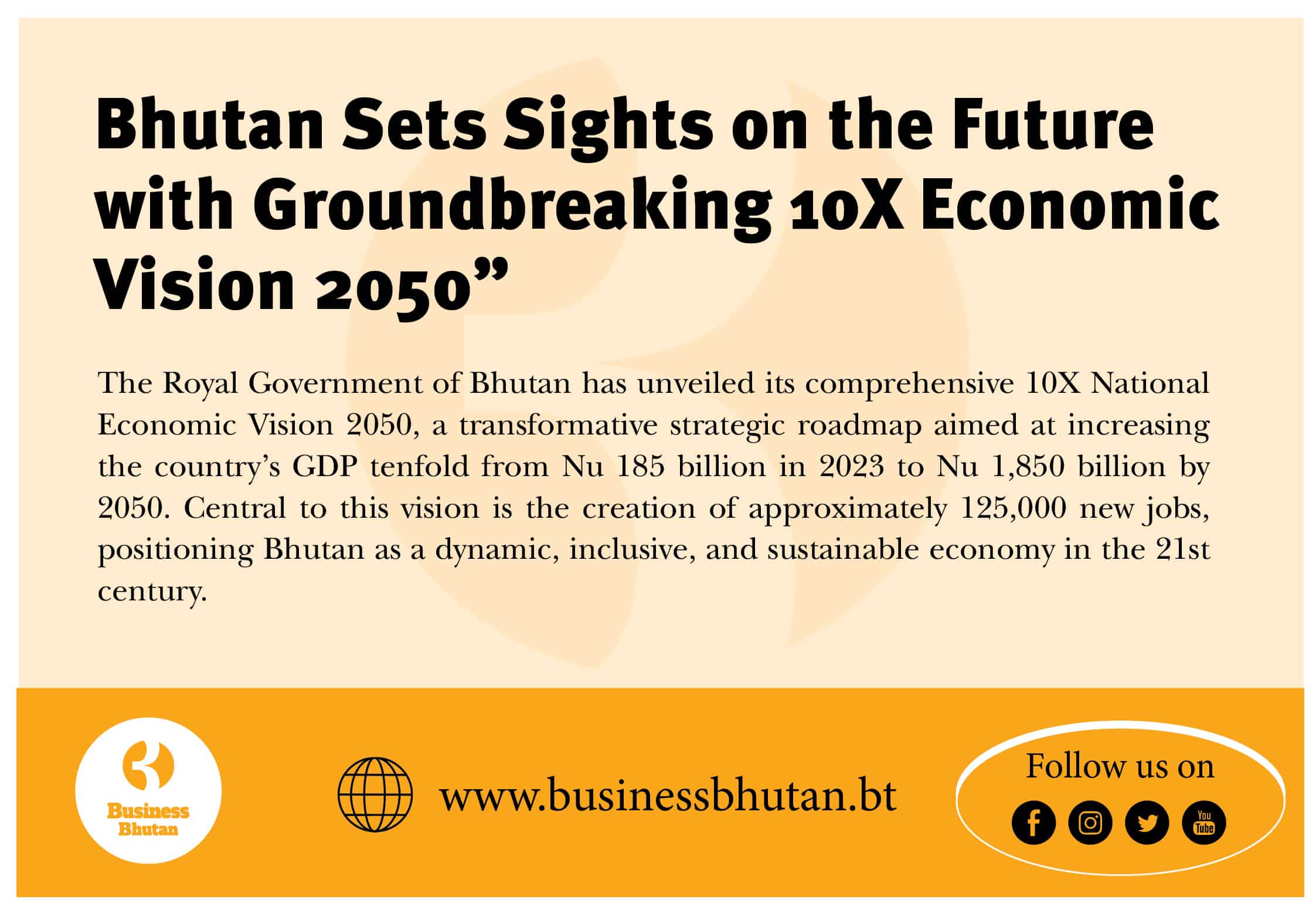
The Royal Government of Bhutan has unveiled its comprehensive 10X National Economic Vision 2050, a transformative strategic roadmap aimed at increasing the country’s GDP tenfold from Nu 185 billion in 2023 to Nu 1,850 billion by 2050. Central to this vision is the creation of approximately 125,000 new jobs, positioning Bhutan as a dynamic, inclusive, and sustainable economy in the 21st century.
By 2050, Bhutan envisions achieving developed nation status, characterized by full employment, high standards of living, and a resilient, diversified economy. This aspiration is grounded in the nation’s long-term commitment to inclusive growth, sustainability, and innovation.
As part of this vision, the government anticipates the creation of 45,000 jobs in the hydropower sector, capitalizing on Bhutan’s abundant renewable energy potential and its strategic role in regional energy cooperation. In parallel, the tourism sector is expected to generate 80,000 jobs, driven by a shift toward high-value, low-volume tourism that promotes cultural preservation, environmental conservation, and premium visitor experiences.
Beyond these traditional strengths, Bhutan aims to catalyze growth in emerging industries through strategic investments and innovation. Institutions such as Druk Holding and Investments (DHI) and an increasingly vibrant private sector are expected to play a central role in driving diversification across key sectors—including digital technology, sustainable agriculture, financial services, and creative industries.
This multi-sectoral approach is designed to reduce economic dependency, enhance national competitiveness, and provide meaningful employment opportunities for Bhutan’s growing and increasingly skilled workforce.
The 10X National Economic Vision 2050 is firmly anchored in Bhutan’s foundational philosophy of Gross National Happiness (GNH), which places equal emphasis on sustainable development, environmental conservation, cultural preservation, and the holistic wellbeing of its people. Unlike conventional development models that prioritize economic growth alone, Bhutan’s approach integrates material progress with spiritual, social, and ecological dimensions to ensure that development remains both inclusive and meaningful.
This forward-looking strategy draws profound inspiration from His Majesty The King’s address during the 112th National Day celebrations, where His Majesty emphasized the critical need for foresight, innovation, and proactive adaptation in an increasingly complex and fast-evolving global environment. His Majesty’s visionary call urged the nation to prepare not only for emerging opportunities but also for the disruptive challenges posed by rapid technological advancements, climate change, shifting demographics, and geopolitical uncertainties.
In line with this guidance, Vision 2050 outlines a transformative pathway that seeks to future-proof Bhutan’s economy while safeguarding its unique identity and values. It calls upon all sectors of society—government, private enterprises, civil society, and individuals—to take collective ownership of the nation’s economic destiny by embracing innovation, nurturing resilience, and staying true to Bhutan’s deeply rooted commitment to human and environmental wellbeing.
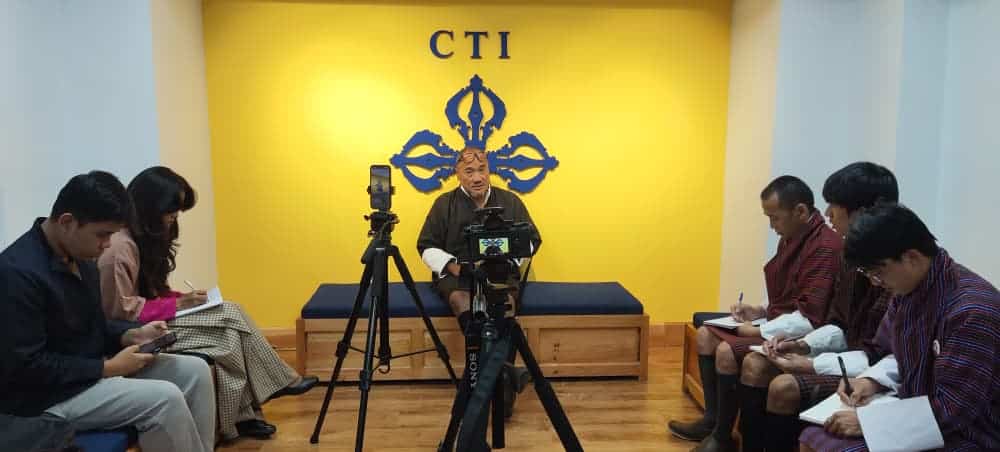
Prime Minister Tshering Tobgay stated that the Prime Minister’s Office will not only lead the implementation of the roadmap but will also establish a dedicated Implementation Monitoring Unit. “This initiative is not about producing strategic documents for the sake of documentation. We will publicly report progress on an annual basis to ensure transparency and accountability,” he said.
The Prime Minister further underscored the critical importance of micro-level planning as a cornerstone of effective implementation. He noted that such targeted, granular planning processes are already in progress across key sectors and institutions. “Through detailed and localized planning, we will ensure greater operational efficiency, optimize the allocation of resources, and systematically identify gaps or areas where performance can be improved,” he stated. This approach reflects a shift from broad policy pronouncements to actionable strategies with measurable outcomes at the ground level.
In addition, the Prime Minister acknowledged the complex and rapidly evolving global landscape marked by technological disruption, demographic transitions, geopolitical instability, and escalating climate challenges. These external forces, he emphasized, require Bhutan to adopt a proactive and adaptive posture in its development planning.
Despite these uncertainties, the Prime Minister reaffirmed Bhutan’s unwavering commitment to its core national values, grounded in the philosophy of Gross National Happiness. “We will respond to global change not by compromising our principles, but by leveraging our strengths—our unity, our vision, and our unique development model—to build a future that is both resilient and sustainable,” he said.
The 10X Economic Vision 2050 is more than a long-term plan—it is a national call to action. It urges the active participation of all sectors of society, including government, businesses, civil society, and individuals, to take ownership of Bhutan’s economic destiny. The strategy sets a bold vision for transforming Bhutan into a knowledge and innovation-driven economy, with a strong emphasis on:
- Renewable energy
- Tourism and sustainable travel
- Agriculture and food security
- Digital technology
- Financial services
These sectors are envisioned as key drivers of economic transformation, enabling wealth creation, job growth, and global competitiveness.
A notable element of the roadmap is its alignment with the Royal vision for Gelephu Mindfulness City, a landmark project that exemplifies Bhutan’s commitment to sustainability, innovation, and holistic wellbeing.
To realize these aspirations, the strategy prioritizes two foundational imperatives:
- Fostering competitiveness in high-growth sectors, particularly through innovation.
- Strengthening key enablers, including policy frameworks, infrastructure development, education and skill-building, financing access, and national innovation capacity.
“The 10X Economic Vision 2050 is a collective mission,” said the Prime Minister. “Every Bhutanese has a role to play. Through unity, strategic foresight, and innovation, I am confident that we can build an economy that not only supports our people but also serves as a model for the world.”
In addition, the 10X Economic Roadmap introduces a forward-looking branding strategy designed to position Bhutan as a globally recognized and trusted economic identity. This strategy is rooted in three core concepts: the brand economy, which leverages Bhutan’s unique values and global reputation to create competitive advantage; the trust economy, which emphasizes transparency, accountability, and institutional integrity; and the strength economy, which focuses on building resilience through innovation, human capital, and robust infrastructure.
By integrating these principles, the roadmap seeks to elevate Bhutan’s international profile as a country that not only upholds ethical and sustainable practices but also delivers value through strategic investments, sound governance, and long-term vision. This approach aims to attract quality investments, foster global partnerships, and establish Bhutan as a credible and forward-thinking economic player on the world stage.
The government further stresses that the next decade will be a defining period for Bhutan’s economic future. With rapid global shifts and increasing competition, the urgency for decisive and coordinated action has never been greater. The roadmap calls for the alignment of national policies across sectors, efficient resource mobilization, and the creation of an enabling ecosystem that supports entrepreneurship, innovation, and sustainable development. Only through such concerted efforts can Bhutan realize its long-term vision of a prosperous, inclusive, and resilient economy.
Sherab Dorji from Thimphu