Bhutan’s primary sector—comprising agriculture, livestock, and forestry—remains the backbone of the rural economy and plays a crucial role in ensuring food security. In the remote villages of Wangringmo under Ramjar Gewog and Bephusoth under Yalang Gewog, this vision of food self-sufficiency is already becoming a reality.
Farmers in these communities import very few food items—mostly just salt, oil, and meat. Almost all other food is grown locally. While farming has been practiced for generations, the recent surge in vegetable and cereal production has been largely supported by the Commercial Agriculture and Resilient Livelihoods Enhancement Programme (CARLEP), which has significantly boosted both yields and rural livelihoods.
This transformation is not only improving the quality of life in rural communities but is also helping meet the growing food demand in urban centres. According to Yalang Gup Sonam, Bephusoth has notably reduced its dependence on imported food. He credits a bold strategy focused on increasing domestic production through better-quality local seeds and improved farming practices.
“Boosting domestic production of essential commodities to reduce reliance on imports is not just an economic strategy—it is a critical step toward achieving our Gewog’s food self-sufficiency,” said the Gup. He added that, together with the Gewog Agriculture Extension Officer and Tshogpa, efforts are being made to put Wangringmo firmly on the path toward economic independence.
Gup Sonam acknowledged that while community dedication played a vital role, CARLEP’s support introduced modern agricultural techniques—from production and processing to marketing—which helped strengthen food systems and ensured continuity in supply.
Residents proudly shared their stories. “We rarely buy imported rice—just once in a while for a change in taste,” said Jigme Thinley from Phungyang village. “Our livelihoods have improved with increased income. I only buy salt, oil, and meat now. Everything else we grow ourselves.”
Sonam Choden from Bephusoth expressed similar sentiments. “There’s no need for us to buy imported vegetables or cereals anymore,” she said. “In fact, many villagers are now selling their produce. After CARLEP provided farming equipment and training, our crop yields have improved significantly.”
She added, “Had we relied solely on traditional farming methods, our harvests would never have reached this volume. CARLEP’s support made a real difference.”
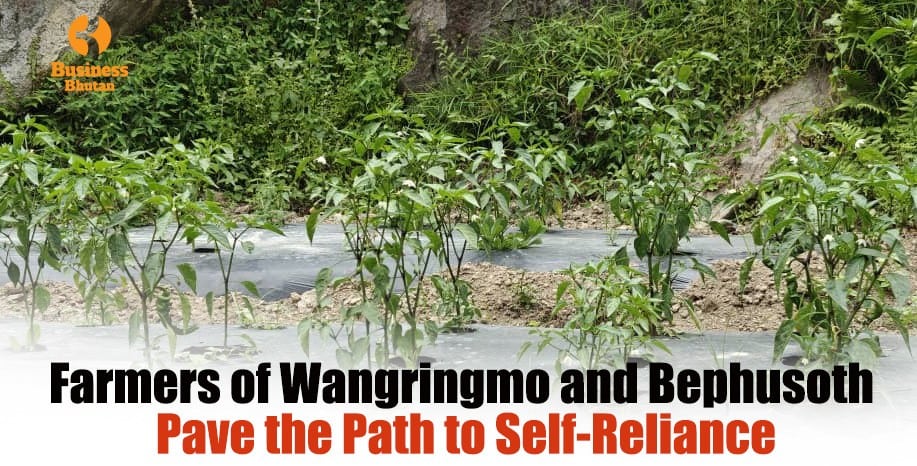
The farmers in these villages grow rice and maize during the summer, with wheat and a variety of vegetables cultivated during the winter. Beans, potatoes, brinjals, tomatoes, garlic, cabbage, and coriander are commonly grown. Notably, Wangringmo and Bephusoth are known for producing Bhutan’s early-season chilies, which have become a major source of income.
“During the early chili season, I earn about Nu 50,000,” shared Sonam Choden with a smile.
Dorji Lhendup, Agriculture Extension Officer of Yalang Gewog, said that farmland in these villages is kept under cultivation year-round. “On average, each household produces 300–400 kg of chilies during the early harvest and around 100 kg in the second harvest,” he said. “Farmers earn approximately Nu 300,000 from chili production alone. The yield has increased significantly after CARLEP introduced mulching practices.”
CARLEP also supported the construction and renovation of irrigation canals. Norbu,Component Manager for Livestock, CARLEP, the Agriculture Research and Development Centre in Wengkhar, Mongar, noted that improved irrigation systems—such as sprinklers, pipes, and mulching plastic—have played a vital role in boosting productivity and income. “With better irrigation, food self-sufficiency has received a major boost,” he said.
Despite their success, farmers still face significant challenges, including poor market access and persistent human-wildlife conflict. Extension Officer Dorji Lhendup also pointed out that while progress is visible, some farmers remain hesitant to adopt newer technologies.
This story is supported by the Commercial Agriculture and Resilient Livelihoods Enhancement Programme (CARLEP), under the Ministry of Agriculture and Livestock, and funded by the International Fund for Agricultural Development (IFAD).
Sangay Rabten from Trashiyangtse