

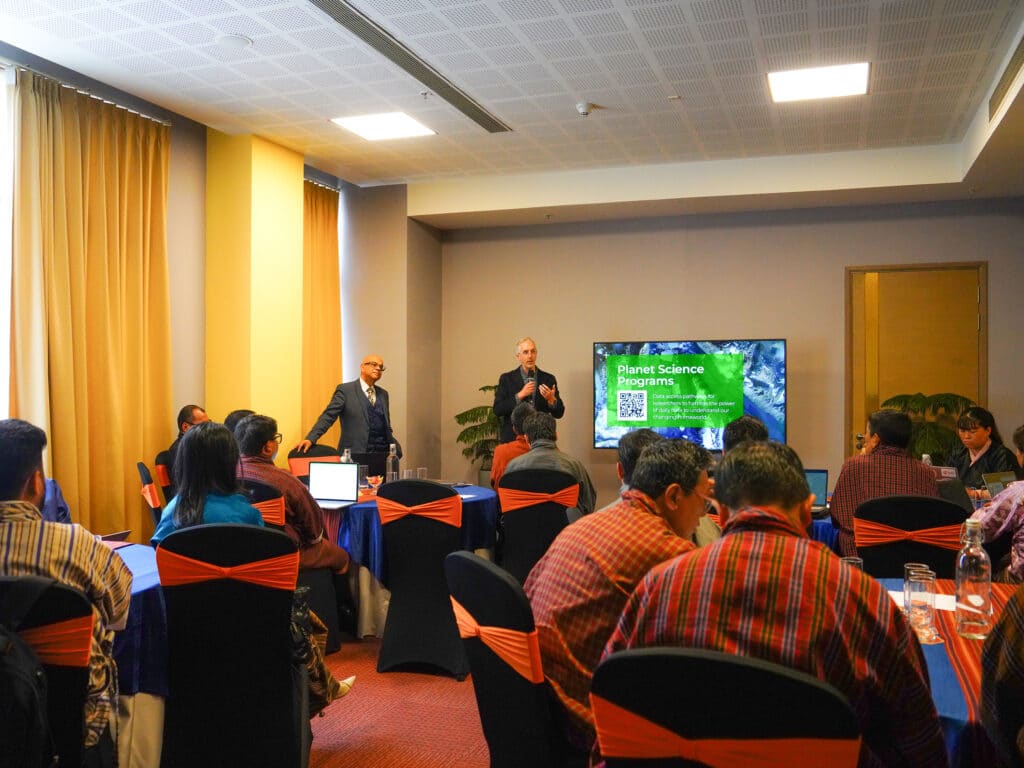
Bhutan is exploring the use of high-resolution satellite imagery and near-daily earth observation data to improve environmental monitoring, strengthen agricultural planning, and enhance disaster preparedness across the country.
Scientists from Planet Labs say Bhutan stands to benefit significantly from near-daily satellite imagery and monthly mosaics for conservation, agriculture, and disaster-risk management.
Planet Labs is a global satellite data company founded by former NASA scientists. The company provides frequent satellite images that show changes on the ground almost in real time.
According to Giles D’Souza, dense historical satellite archives, averaging around 3,000 images per location globally, can help Bhutan analyze long-term environmental changes, including shifts in vegetation patterns, seasonal crop cycles, and pasture conditions across gewogs.
“Machine learning applied to these time series can detect patterns and flag anomalous early senescence or drought,” he said. “This can allow targeted advisories for smallholder farmers and pastoralists.”
He said modern satellite constellations can now provide near-daily observations and monthly cloud-minimized mosaics, with resolutions reaching approximately five to 5.5 meters in many areas. The system combines cloud-free pixels collected over days or weeks to generate clearer imagery in regions frequently affected by cloud cover.
For Bhutan’s mountainous terrain, where clouds, haze, and snow often obstruct observations, he said pixel-level classifications and cloud, haze, and snow masks are particularly important.
“These products provide detailed scientific data that can help measure vegetation health and environmental changes, while also creating simpler visual maps that are easier for planners and non-technical users to understand,” he said.
The satellite products could also support monitoring of mowing and grazing windows, seasonal protections for ground-nesting birds, small-scale forest degradation, illegal clearing, and community forest management activities.
Hydrology and glacial lake outburst flood monitoring are also emerging as major areas where satellite monitoring could be applied.
Satellite analytics can also detect forest degradation, new road construction, crop stress, and land-use change by comparing imagery collected over time. Machine-learning systems can generate vector outputs such as building footprints and road networks while identifying areas of potential environmental disturbance.
However, scientists cautioned that satellite imagery alone cannot replace ground verification.
Bhutan’s steep slopes, monsoon cloud cover, and snow conditions continue to present major technical challenges for remote sensing. Christopher Anderson said local validation through Renewable Natural Resources (RNR) stations, community forest plots, and dzongkhag-level records will be essential to ensure accuracy and usability.
“Tailored processing is necessary to address steep terrain and monsoon clouds in Bhutan,” he said.
The country director of the Bhutan Foundation, Norbu Dema, said Bhutan currently relies largely on costly commercial imagery or freely available open-source satellite data that often lack the resolution required for detailed monitoring.
“With satellite images, precision data can inform interventions on the ground, including enhancing agricultural productivity, biodiversity mapping, monitoring forest carbon stock, and improving land-use management,” she said.
She added that satellite-derived information could help Bhutan respond more effectively to environmental pressures and disaster risks while improving conservation planning and environmental governance.
Despite the opportunities, Bhutan still faces technical and institutional capacity gaps in advanced geospatial analysis. Many agencies currently lack access to high-resolution imagery, analytical tools, and specialized training required to fully utilize satellite-derived products.
To address these challenges, Bhutan is discussing collaboration under Planet’s “Project Centinela” initiative, a global digital grant program that provides selected partners with access to satellite imagery, analytics, and technical support.
The initiative aims to support agricultural productivity, biodiversity mapping, forest carbon monitoring, and land-use management at a time when Bhutan is experiencing increasing environmental pressures from climate change, infrastructure expansion, and ecosystem degradation.
“To address this gap, discussions are underway under Planet’s global digital grant initiative, Project Centinela, which could provide free access to high-resolution imagery, analytics, and technical support for selected conservation sites,” she said.
Under the proposed collaboration, Bhutan could receive high-resolution monitoring support for priority landscapes totaling up to 15 square kilometers, including near-daily satellite observations, analytical products, satellite tasking capabilities, and capacity-building support for Bhutanese technical agencies.
Nidup Lhamo, Thimphu