

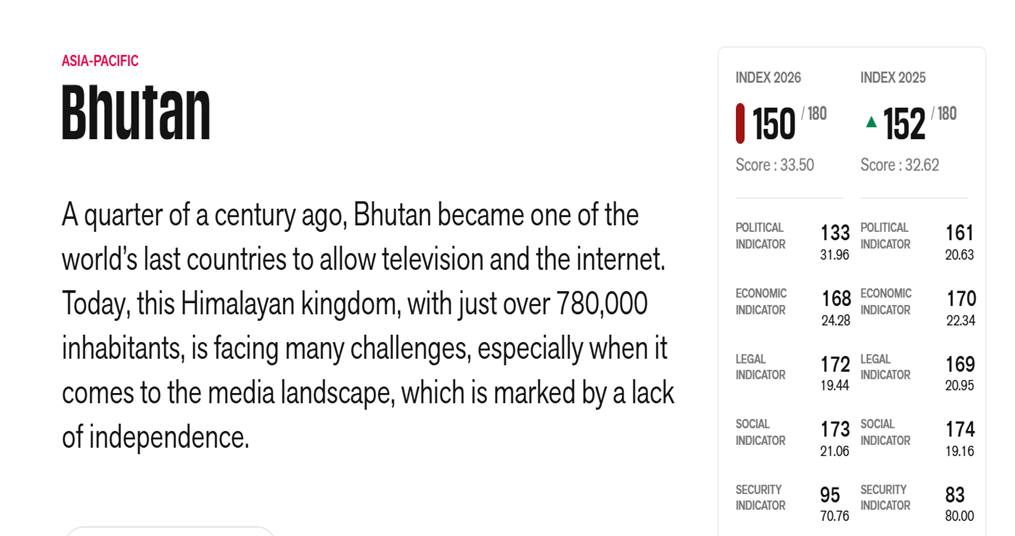
Bhutan has climbed two places in the 2026 World Press Freedom Index, reflecting a modest improvement in its media environment. The latest index, released on April 30 by Reporters Without Borders (RSF), ranks Bhutan 150th out of 180 countries, up from 152nd in 2025. Despite this slight gain, Bhutan remains among the lower-ranked countries globally and far below its 2022 position of 33rd, marking one of the steepest declines in South Asia over recent years.
The report point to Bhutan’s evolving media landscape, shaped by its democratic transition since the mid-2000s. It highlights the early growth of privately owned media outlets alongside public institutions, as well as an expanding digital ecosystem in which blogs and social media increasingly influence how information is produced and consumed.
However, the marginal improvement in ranking comes against persistent structural constraints. Economic pressures remain the most significant challenge, with independent media outlets struggling to remain financially viable in a small advertising market. Political and institutional factors also continue to weigh on the sector, particularly regarding access to information, editorial independence, and a prevailing culture of self-censorship.
Bhutan’s strongest performance is in the safety category, where journalists face relatively low levels of physical risk compared to those in conflict-affected or highly repressive environments. Analysts note that this provides a critical foundation for further strengthening press freedom.
Media professionals, however, say against reading too much into incremental gains in ranking. Neten Dorji, a senior reporter with Kuensel, said Bhutan must aim higher to build a media environment that genuinely serves the public interest.
“We should not be content with a slight rise in the press freedom ranking, especially when fundamental challenges in accessing information still persist,” he said.
He added that many experienced journalists leave the profession not due to lack of interest, but because of limited access to information, low salaries, and the routine classification of information as sensitive. These factors, he said, also contribute to high attrition among young journalists.
Questions have also been raised in media circles about RSF’s data collection process and sampling methods. Some journalists note that in previous years, including the 2024 ranking, there were claims that mainstream private media practitioners in Bhutan were not consulted, raising concerns about how fully the survey reflects on-the-ground realities.
Despite these concerns, stakeholders—including the government—have continued efforts to improve media conditions. The Prime Minister’s Office maintains its monthly “Meet the Press” sessions, while government agencies have designated media focal persons to facilitate information sharing.
The challenges on the economic front come mainly due to the shrinking advertisement market. While the state remains the main source of advertisement, a major chuck of this goes to the state owned print media outlet, which has always been a hotly debated topic within Bhutan’s mainstream media landscape. As the market remains redundant, private media outlets face daunting challenges getting advertisements. This has become a serious issue in the aftermath of the Covid Pandemic, with Bhutan’s private sector too, cutting down on advertisement revenue.
The growth of social media has added to the challenges that the print media face.
Regionally, Bhutan ranks behind Nepal, the Maldives, and Sri Lanka, but ahead of Bangladesh, India, Pakistan, and Afghanistan. While this provides comparative context, it contrasts with Bhutan’s earlier standing as one of the stronger performers in South Asia.
Observers say Bhutan’s modest rise should be viewed as progress rather than a destination. Strengthening editorial independence, improving access to information, and ensuring the financial sustainability of media organisations remain key priorities for building a more resilient and diverse media ecosystem.
Globally, the index presents a concerning picture. RSF reports that more than half of the countries assessed now fall into the “difficult” or “very serious” categories for press freedom—a first in the index’s history. The global average score has also fallen to its lowest level in 25 years, reflecting increasing legal pressures and the growing criminalisation of journalism worldwide.
Sangay Rabten, Thimphu