

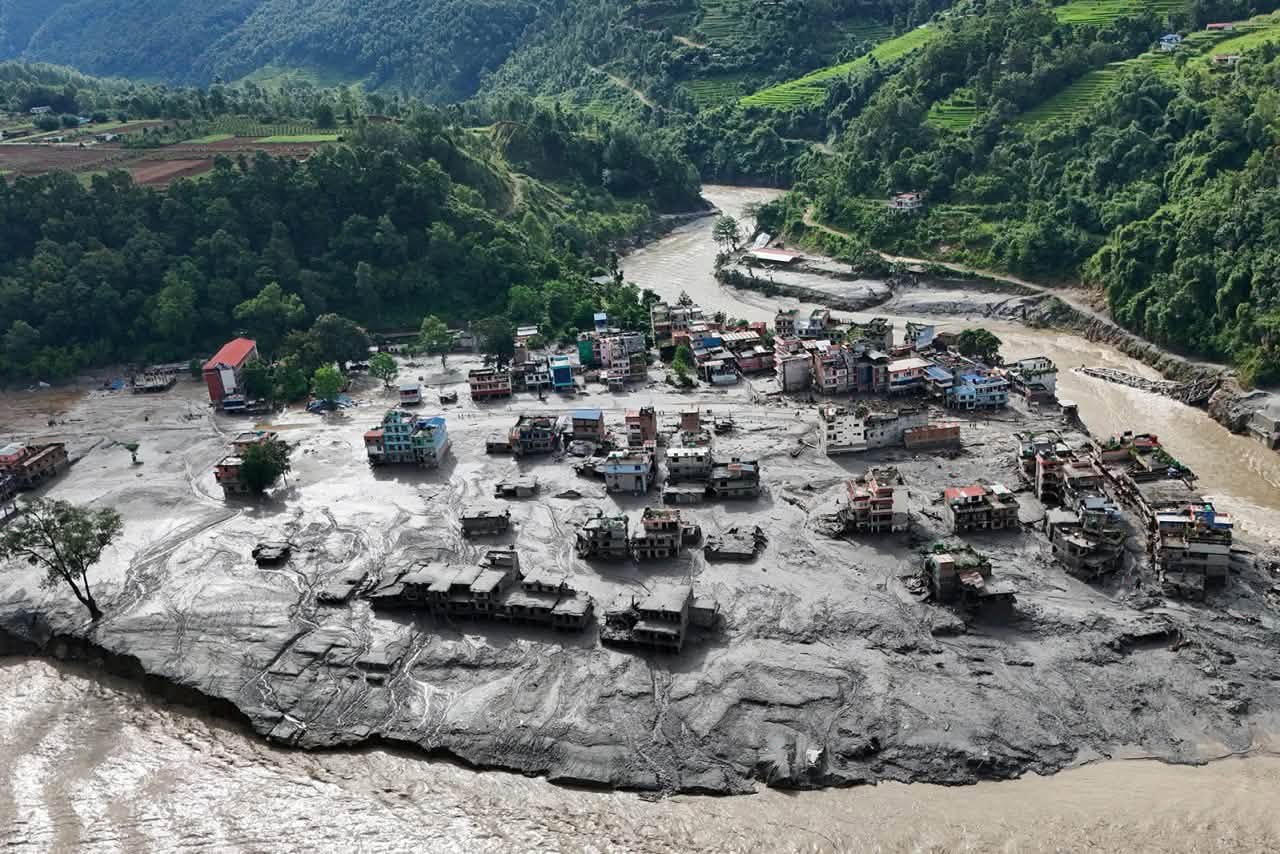
Nepal floods rekindle Bhutan’s GLOF concerns as Himalayan disaster risks intensify
The catastrophic flooding along the Nepal–Tibet border this week has brought renewed attention to a risk Bhutan has confronted for decades: the growing threat posed by an increasingly unstable Himalayan cryosphere.
The disaster, which swept through Nepal’s Rasuwa district and China’s Gyirong County on August 26, was initially reported as a flash flood and was at first linked to possible seismic activity. Subsequent analysis by the US Geological Survey indicated that the event was triggered by a glacial collapse, which sent a massive flow of ice, rock, mud and water into the river system.
The scale of the destruction has been severe. At least 400 people have been confirmed dead across Nepal and Tibet, while more than a thousand remain missing. Roads, bridges, homes and infrastructure have been swept away, and the strategic Gyirong border crossing between Nepal and China has also been badly affected.
For Bhutan, the disaster is more than a tragedy unfolding in a neighbouring Himalayan country. It is a reminder that glacial hazards can rapidly translate into downstream disasters, threatening communities, economic infrastructure and critical river systems far from the source.
Bhutan has its own painful history with glacial flooding. The 1994 Lugge Tsho Glacial Lake Outburst Flood (GLOF) remains one of the country’s most significant natural disasters. The flood travelled down the Pho Chhu valley and caused extensive damage in Punakha, including severe inundation around Punakha Dzong.
The lesson from Punakha was clear: a hazard originating high in the mountains can become a major economic and human disaster hundreds of kilometres downstream. That vulnerability remains relevant today. Bhutan’s mountainous terrain, rapidly changing glaciers and extensive network of glacial lakes create a complex combination of hazards. The country has thousands of glacial lakes, and previous assessments have identified a number of potentially dangerous lakes requiring monitoring and mitigation.
More recent research makes the concern even more pressing. A comprehensive 2026 assessment by researchers at Newcastle University identified previously unrecognised high-risk glacial lakes and downstream communities exposed to GLOF hazards, suggesting that conventional assessments may not fully capture the country’s current risk landscape.
The latest Nepal disaster therefore raises an important policy question for Bhutan: is the country doing enough to anticipate cascading mountain hazards rather than responding after they occur?
Bhutan has already invested significantly in GLOF monitoring, early-warning systems, hazard assessment and risk reduction, particularly in vulnerable valleys such as Punakha-Wangdue and Chamkhar. A UNDP-supported climate adaptation programme, for instance, specifically focuses on reducing climate-change-induced GLOF risks in the Punakha-Wangdue and Chamkhar valleys.
But the nature of Himalayan hazards is changing. The Nepal event is particularly instructive because it was not a conventional GLOF. A collapse of glacial ice and rock generated a massive debris flow and flood, demonstrating that dangerous downstream flooding can occur through several interconnected processes.
This distinction matters for policy. Monitoring only known glacial lakes may not be sufficient. Risk assessments increasingly need to consider glacier collapse, rock and ice avalanches, landslides, river blockages, debris flows and cascading events as part of a single mountain-hazard system.
For Bhutan, this has major implications for infrastructure planning. Hydropower plants, roads, bridges, settlements and transmission lines are concentrated along river valleys—the same corridors through which GLOFs and other mountain floods can travel.
A recent study of GLOF risk in the Pho Chhu basin found that a future GLOF scenario could completely inundate areas around Punakha Dzong, with simulated flood depths exceeding 10 metres in some locations. This raises questions about whether existing infrastructure standards adequately account for extreme, low-probability but high-impact events.
Instead of assessing flood risk only at individual project sites, planners may need to examine entire river basins, mapping how a hazard originating in a remote glacier could affect hydropower facilities, roads, agricultural land, settlements and downstream economic centres. Such basin-wide assessments could also help determine where new infrastructure should—and should not—be located.
Early-warning systems remain one of the most important investments. However, warning systems are useful only if warnings reach people quickly and communities know how to respond.
For remote settlements, this means strengthening communication networks, evacuation routes, community preparedness and local disaster-response capacity alongside technical monitoring.
The Nepal disaster illustrates the consequences when roads, bridges, electricity and communications are simultaneously destroyed. Rescue teams faced major difficulties reaching affected areas, while the destruction of infrastructure compounded the humanitarian emergency.
Bhutan’s disaster preparedness therefore needs to assume that multiple systems could fail at the same time. The GLOF question can no longer be treated solely as an environmental or disaster-management issue. For Bhutan, it is increasingly an economic policy issue.
A major flood can damage hydropower assets, interrupt electricity generation, destroy roads and bridges, disrupt tourism and trade, damage agricultural land and impose significant reconstruction costs on the government.
The cost of prevention and preparedness may therefore be considerably lower than the cost of rebuilding after a major disaster. This makes investment in glacier monitoring, hazard mapping, early-warning systems and climate-resilient infrastructure not simply an environmental expenditure but a form of economic risk management.
The Nepal disaster offers Bhutan an opportunity to reassess its own risk framework before another major event occurs. The country has already learned this lesson from Punakha. The challenge now is to apply that experience to a changing Himalayan environment. Recent research indicates that Bhutan’s GLOF risk may be greater and more geographically extensive than previously recognised.
The policy response, therefore, should move beyond asking which glacial lake might burst next. The more important question is: what happens downstream if a glacier collapses, a lake breaches, a landslide blocks a river or several of these events occur together?
For Bhutan, where communities and economic infrastructure are concentrated along narrow river valleys, answering that question could be critical. The tragedy unfolding across the Nepal–Tibet border is a stark reminder that the Himalayas are not only changing at their peaks. The consequences of that change are travelling downstream—and Bhutan must ensure that its policies, infrastructure and communities are prepared before the next wave arrives.
Tashi Namgyal, Thimphu