

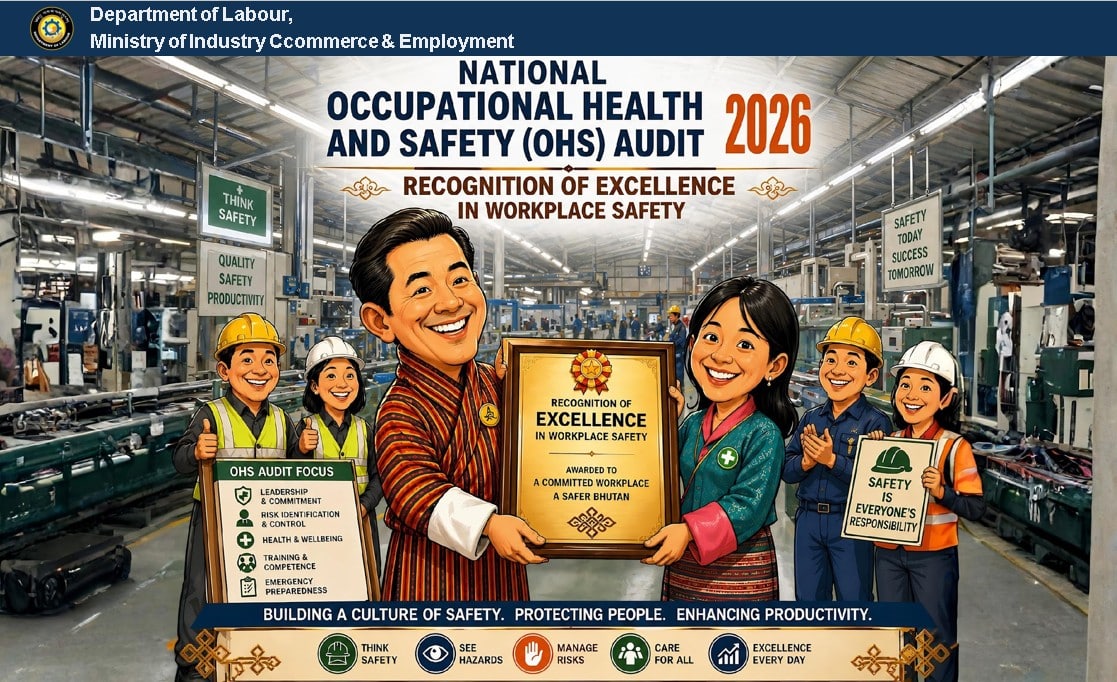
Bhutan’s occupational health and safety (OHS) standards remain in a “developing stage,” according to the National Occupational Health and Safety Audit 2026 conducted by the Department of Labour Bhutan under the Ministry of Industry Commerce and Employment Bhutan.
The nationwide audit assessed 87 workplaces across sectors including manufacturing, construction, services, hydropower, electricity and water supply, and telecommunications. Sonam Geley Dorjee, deputy executive engineer, said the exercise aimed to evaluate compliance with national OHS regulations, identify workplace risks, and promote a culture of prevention while recognizing high-performing organizations.
Findings indicate that while awareness of workplace safety is increasing among both workers and management, overall compliance remains moderate. Most companies fall within the mid-range of performance, with only a few achieving high standards.
“The OHS landscape in Bhutan is not yet mature,” the report states, calling for a shift in focus from simply forming OHS committees to ensuring their functionality and effectiveness.
Sector-wise, construction recorded slightly more top performers compared to others, although patterns across sectors remain largely similar, with limited high compliance and a concentration of firms in the middle range.
The audit highlights several positive trends, including growing safety awareness, adoption of basic protective measures, increased use of personal protective equipment (PPE), and the emergence of safety leadership in some organizations.
However, key areas requiring improvement include strengthening OHS management systems, enhancing training and awareness programmes, improving emergency preparedness, and ensuring consistent compliance. The report also points to the need for better worker safety behaviour and more effective use of health surveillance systems.
The audit emphasizes that workplace safety goes beyond compliance. “Safety is not compliance alone; it is commitment,” it notes, adding that strong leadership, active worker participation, and continuous improvement are essential to building safe and resilient workplaces.
It also reveals that manufacturing companies continue to lead in workplace safety compliance, while significant gaps persist across several sectors, particularly construction and mining.
According to the audit results, Tashi Beverages Limited in Chhukha topped the national ranking with a score of 82.21 percent, narrowly edging out HILD-Rigsar Consortium in Thimphu, which scored 82.19 percent. RSA Private Limited’s limestone and mining unit secured third place with 81.58 percent, highlighting a relatively strong performance even within higher-risk industries.
Of the top 10 performers, more than half are from the manufacturing sector, many located in Pasakha Industrial Estate in Chhukha, underscoring the impact of established industrial systems and compliance mechanisms in the area. Hydropower projects such as Basochu Hydropower Plant and Mangdechhu Hydropower also feature among the higher-ranking entities, reflecting steady adherence to safety standards in the energy sector.
However, the audit points to uneven performance across the board. While top companies scored above 80 percent, a large number of firms fall within the 50 to 70 percent range, indicating moderate compliance but significant room for improvement. Several companies, particularly in construction and smaller manufacturing units, recorded scores below 50 percent, with the lowest performer scoring just 22.88 percent.
The construction sector, despite having a few high-ranking firms, shows wide disparities in safety practices, with multiple companies appearing in both upper and lower tiers of the ranking. Similarly, mining operations display mixed results, suggesting inconsistent enforcement of occupational health and safety standards.
Geographically, industrial hubs such as Chhukha, Thimphu, and Samtse dominate the rankings, reflecting higher concentrations of audited firms. However, variations in scores within these regions indicate that location alone does not guarantee compliance.
The findings highlight the need for stronger monitoring, capacity building, and enforcement mechanisms to ensure safer workplaces nationwide. As Bhutan continues to industrialize, the audit underscores the importance of prioritizing occupational health and safety to protect workers and sustain economic growth.
Sangay Rabten, Thimphu