

Limited access to finance continues to be one of the biggest constraints to agribusiness development in Bhutan, with financial sector leaders and policymakers increasingly pointing to blended finance as a key solution to unlock investment and bridge long-standing funding gaps in the sector.
The issue took centre stage at the two-day Bhutan Agrifood Trade and Investment Forum (BATIF) 2.0, held in Thimphu from 21–22 May 2026, where officials from financial institutions, government agencies, and investment bodies explored new approaches to financing agriculture and agri-food enterprises.
A key theme was the need to move beyond traditional lending systems, which participants said have struggled to support Bhutan’s agriculture sector due to high risks, weak collateral systems, and limited project bankability.
Blended finance—combining public, private, and philanthropic capital to mobilise investment for socially and environmentally beneficial projects—was highlighted as a promising pathway for transforming Bhutan’s
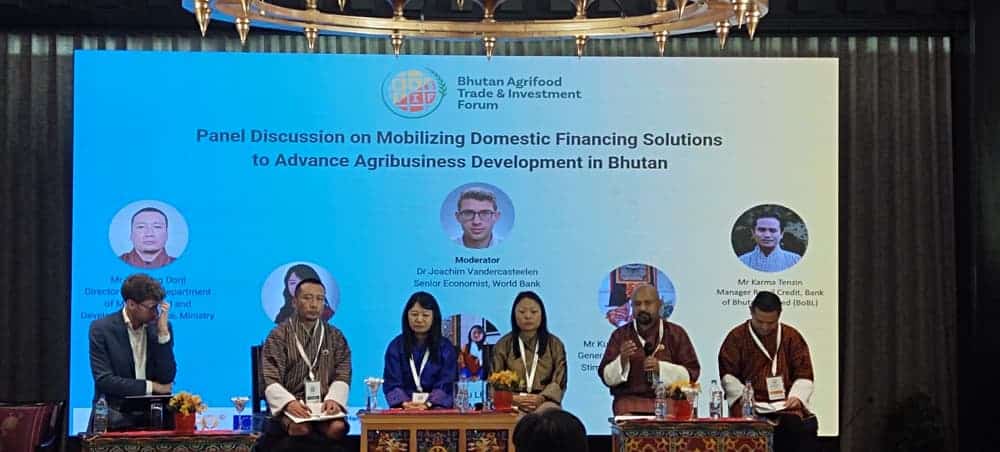
Speaking during a panel discussion on “Mobilising Domestic Financing Solutions to Advance Agribusiness Development in Bhutan,” Deputy Governor of the Royal Monetary Authority, Ugyen Choden, said Bhutan must move beyond conventional banking models if it aims to build a stronger and more resilient agribusiness ecosystem.
According to her, agriculture lending continues to carry elevated risks, which has contributed to non-performing loans in the sector. She also pointed to the limitations of the National Credit Guarantee Scheme, stating that it has not significantly improved access to finance for farmers and agribusinesses. Weak bookkeeping practices, difficulties in meeting equity requirements, and high investment risks continue to restrict access to formal credit.
Director General of the Department of Macro-Fiscal and Development Finance under the Ministry of Finance, Tshering Dorji, said financing for Bhutan’s agriculture sector has historically been fragmented and poorly coordinated. He suggested that pooled investment mechanisms, such as the Bhutan AgriSustain Fund (BAF), could serve as an effective blended finance model to address long-standing financing bottlenecks.
The Bhutan AgriSustain Fund is an USD 80 million initiative designed to provide long-term and sustainable financing for Bhutan’s agri-food sector. It aims to mobilise capital from private investors, development partners, and philanthropic institutions to support climate-resilient, inclusive, and commercially viable agricultural development. The fund is intended to address structural constraints such as fragmented landholdings, mountainous terrain, climate vulnerability, and limited access to long-term capital, while also promoting higher-value, organic, and climate-smart agricultural production.
BAF is aligned with major international sustainability frameworks, including the Paris Agreement, the Kunming-Montreal Global Biodiversity Framework, the UN Sustainable Development Goals, and the UN Convention to Combat Desertification (UNCCD) Strategic Framework.
Meanwhile, financial sector representatives highlighted persistent on-the-ground challenges. Manager of Retail Credit at Bank of Bhutan Limited, Karma Tenzin, pointed out that limited financial literacy among borrowers remains a major barrier. He said many clients still submit business proposals with inadequate financial details, making it difficult for banks to assess viability and manage risks effectively. He added that banks are increasingly digitising loan systems and financial transactions to improve efficiency and access.
General Manager of the Economic Stimulus Plan at Bhutan Development Bank Limited, Kushma Khar Adhikari, said the bank remains committed to financing commercially viable agricultural businesses but stressed that entrepreneurs must also strengthen the bankability of their projects. She emphasised that improving the wider agribusiness ecosystem—including market access, supply chains, and financial planning—is essential for long-term sustainability.
Chief Executive Officer of Tarayana Microfinance, Mindu Lham, noted that microfinance institutions can complement commercial banks by extending financial services to rural communities through partnerships and outreach-based lending models.
Officials further highlighted that the Bhutan AgriSustain Fund is being integrated into platforms such as BATIF, which aim to connect investors, financial institutions, entrepreneurs, and project developers to mobilise capital for scalable and climate-resilient agrifood investments.
Despite growing momentum, significant challenges remain. Bhutan continues to face constraints such as limited financial infrastructure, an emerging digital finance ecosystem, low financial literacy, and the inherent risks of agriculture, particularly in rural and remote areas.
Sangay Rabten, Thimphu