

For generations, ploughing the fields has been seen as a physically demanding task, traditionally reserved for men, while women were relegated to harvesting and post-harvest processing. This division of labor, deeply rooted in gender norms, has long gone unchallenged. But times are changing.
With the government’s commitment to gender-inclusive mechanization, women are no longer just caretakers of the harvest — they are now becoming cultivators of the soil. Leading this shift, the Ministry of Agriculture and Livestock (MoAL), with support from the Commercial Agriculture and Resilient Livelihoods Enhancement Programme (CARLEP), has initiated the distribution of over 400 women-friendly mini power tillers across six eastern districts.
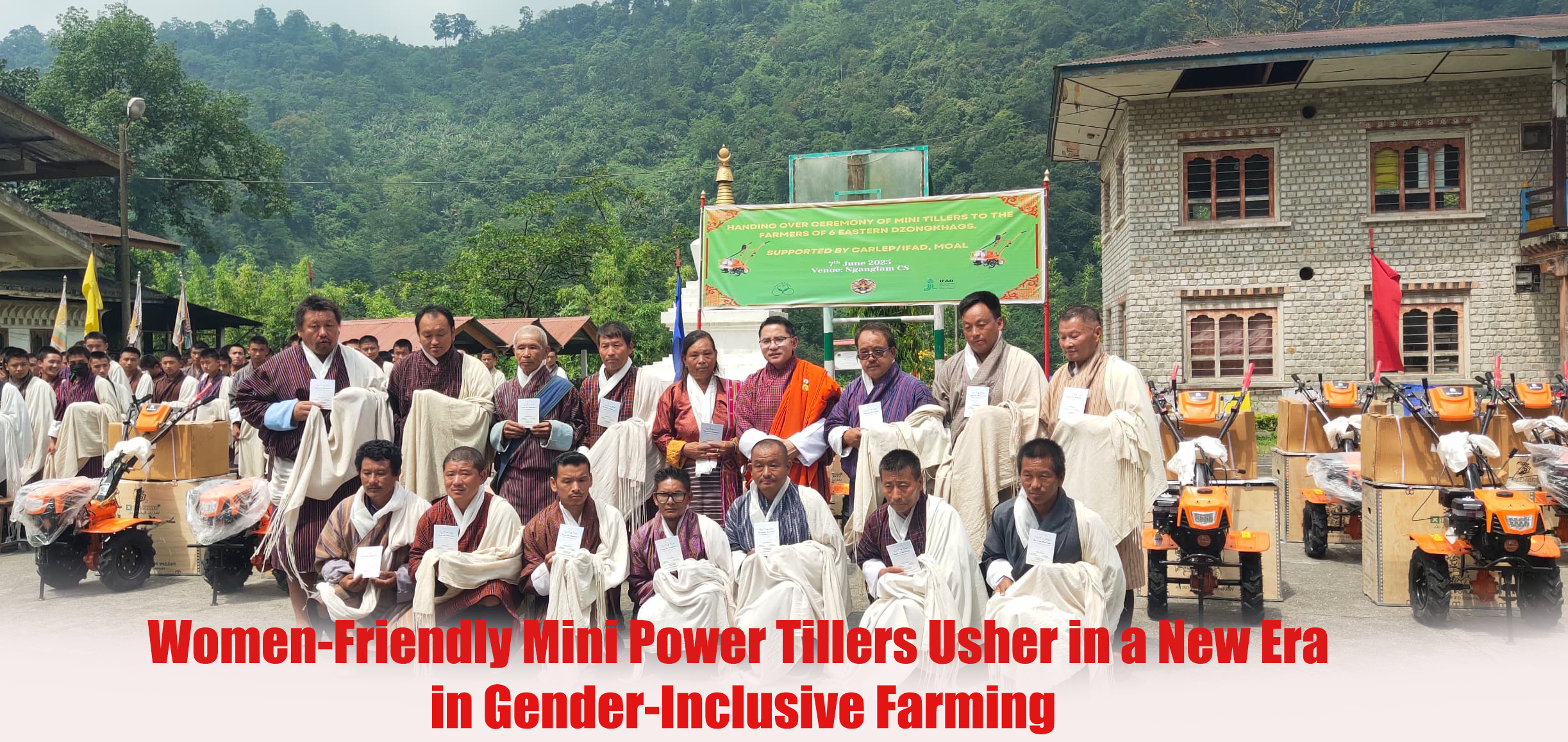
The distribution began on June 7 in Nganglam, where 15 individual farmers from Norbugang, Chokhorling, and Dechhenling Gewogs under Nganglam Dungkhag, Pemagatshel, received the mini tillers. Gracing the occasion as Chief Guest, Agriculture Minister Lyonpo Younten Phuntsho officially handed over 416 mini power tillers to DT Thridzins representing the six eastern Dzongkhags.
“These machines are lightweight, simple to operate, and designed for rugged terrain — ideal for our rural communities,” Lyonpo said. “Even elderly farmers and women can now plough their fields with ease.” He emphasized that the initiative not only empowers women but also aims to transition Bhutanese farming from traditional subsistence to modern, commercial agriculture — boosting productivity, improving incomes, and easing the labor burden in the fields.
Dorji Wangchuk, Programme Director of CARLEP, revealed that a proposal had been submitted for 600 mini tillers, of which 416 have already arrived and are being distributed. This mechanization effort is being complemented by the IMPACT project, implemented by the Agriculture Research and Development Centre (ARDC) in Wengkhar, which aims to offer continued support to beneficiaries and scale up results in the coming months.
The initiative directly addresses one of the most pressing issues in Bhutanese agriculture: labor shortages. As the rural working-age population continues to decline due to youth migration to urban areas, the burden on the remaining — often older and female — farmers has increased significantly.
Sangay Norzom, a 66-year-old farmer from Dezama village under Choekhorling Gewog, expressed her excitement to use the tiller. “I’ve never been trained to use machines, but this one feels manageable,” she said. “When the tillers are provided on a cost-sharing basis, why shouldn’t I learn? It will ease my work, save time, and solve the labor shortage in my fields.”
She now plans to expand her farming operations, grow a variety of crops, and increase her yields — though she admits to a small worry: “I just hope I can manage if the machine breaks down.”
Nima Gyeltshen, 75, from Norbugang village, echoed this optimism. “I’ve always farmed manually. But with this support from CARLEP, even farming on slopes becomes possible. Mini tillers don’t need men — they just need willing hands.” A lone tiller receiver from Dechheling Gewog, Jigme Wangchuk expressed gratitude to CARLEP and he expects to overcome the challenges of ploughing.
According to the Population and Housing Census Report (2017), the share of women in Bhutan’s agricultural labor force has risen from 52.5% in 2005 to 59.3% in 2017, a trend driven largely by the out-migration of young men and the aging rural population. The RNR Census (2019) and Labour Force Survey (2021–2022) further confirm that rural working-age populations are shrinking dramatically, while urban numbers grow — reinforcing the urgency of mechanization.
In recognition of these shifts, the MoAL has introduced a Gender Equality and Social Inclusion Strategic Policy Intervention. The strategy aims to:
• Build comprehensive data on gender roles in agriculture and rural livelihoods
• Ensure mechanisms that engage and empower women and vulnerable groups across the value chain
• Promote labor-saving, gender-sensitive technologies and climate-resilient farming systems
• Support women’s participation in cooperatives and groups, and
• Foster entrepreneurial skills among women and youth
The 416 mini tillers, each valued at Nu 40,789, are being distributed on a 50:50 cost-sharing basis, supplied by Agri Mart. Distribution across the six eastern Dzongkhags includes:
• Trashiyangtse: 142 tillers
• Trashigang: 70 tillers
• Mongar: 59 tillers
• Pemagatshel: 54 tillers
• Samdrupjongkhar: 49 tillers
• Lhuentse: 42 tillers
Financed by the International Fund for Agricultural Development (IFAD) and executed by the Ministry of Agriculture and Livestock, CARLEP is being implemented through its Programme Management Office at ARDC in Wengkhar, Mongar. The initiative is scheduled to conclude by June next year, marking the culmination of a 10-year journey in transforming Bhutan’s rural agricultural landscape.
This initiative is more than just a distribution of machines — it is a symbol of empowerment, a statement of inclusivity, and a step toward a more sustainable and prosperous future for Bhutanese farmers, especially women. As mini tillers turn over the soil of Bhutan’s farmlands, they also turn over a new chapter in the story of rural development — one in which everyone, regardless of gender, has a hand in shaping the harvest.
Sangay Rabten from Nganglam