

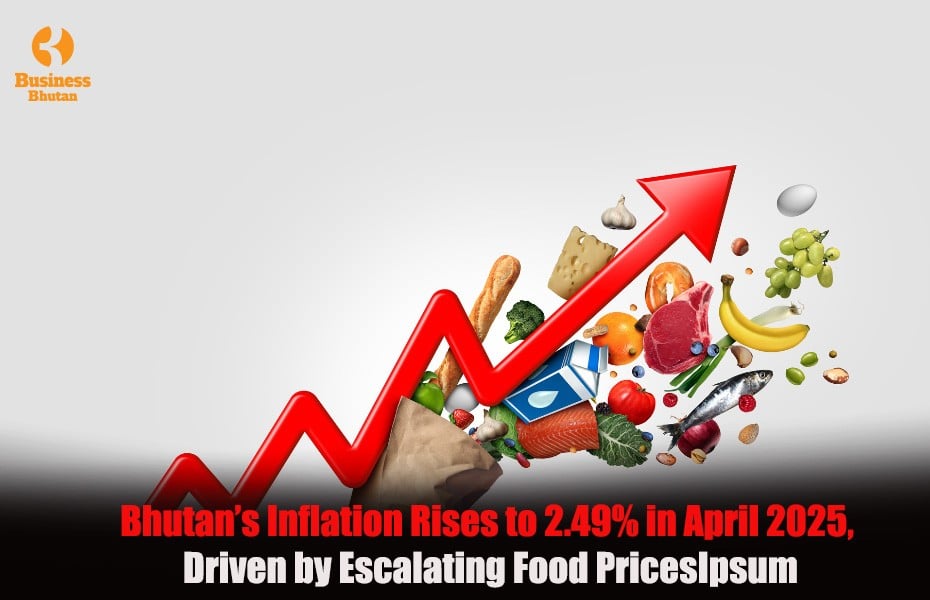
Bhutan’s year-on-year inflation rate rose to 2.49% in April 2025, marking a notable upward trajectory, largely propelled by a surge in food prices. This is according to the latest Consumer Price Index (CPI) bulletin issued by the National Statistics Bureau (NSB).
The NSB reports that the primary driver behind this inflationary pressure is the persistent escalation in the food and beverage sector, which continues to strain household budgets and erode consumer purchasing power. While inflationary trends across most other sectors remained relatively subdued, modest declines in transportation and communication costs provided some offsetting relief.
At the heart of the inflationary trend is a pronounced rise in food prices, which posted a year-on-year increase of 6.10%. The Food and Non-Alcoholic Beverages Index rose by 6.66%, underscoring Bhutan’s sustained exposure to external supply shocks and its high dependency on imported food items. These structural vulnerabilities leave the economy susceptible to volatility in international commodity prices and logistics disruptions.
Conversely, the Alcoholic Beverages and Betel Nut category registered a slight year-on-year decline of -0.52%, offering a marginal cushion to the overall food inflation rate. Meanwhile, non-food items recorded a decrease of -0.95%, primarily driven by a significant -6.66% drop in transportation costs, contributing to a partial balancing of the broader inflationary landscape.
The inflation dynamics in April 2025 reflect an economy facing sector-specific price pressures, particularly within essential consumption categories, even as other sectors exhibit stabilizing trends. As the government and central agencies monitor these developments, targeted policy interventions may be required to strengthen domestic production, improve supply chain resilience, and manage import reliance—particularly in the food sector.
Despite this, other sub-categories reported notable increases:
- Communication: +7.77%
- Clothing and Footwear: +7.14%
Month-on-Month Inflation Rises 0.49%
On a monthly basis, inflation increased by 0.49% in April 2025, driven by simultaneous rises in both food and non-food categories.
- Food Inflation (MoM): +0.90%, largely due to a 0.93% increase in the Food and Non-Alcoholic Beverages index.
- Non-Food Inflation (MoM): +0.27%, with notable contributors including:
o Miscellaneous Goods and Services: +1.78%
o Restaurants and Hotels: +1.04%
These gains were partially offset by continued declines in:
o Transport: -1.21%
o Communication: -0.55%
Regional Inflation Analysis
Thimphu Region
Thimphu recorded a 0.44% month-on-month CPI increase, with the food index rising by 0.92%.
- Food and Non-Alcoholic Beverages: +0.98%
- Alcoholic Beverages and Betel Nuts: Unchanged
- Non-Food Index: +0.92%
Central Region
Inflation rose to 0.63% compared to March, largely due to a 0.95% rise in food prices.
- Food and Non-Alcoholic Beverages: +1.03%
- Alcoholic Beverages and Betel Nuts: +2.25%
- Restaurants and Hotels: +1.51%
- Miscellaneous Goods and Services: +1.17%
- Transport: -1.22%
- Communication: -0.67%
Eastern Region
The Eastern region experienced a 0.59% rise in CPI, with both food and non-food prices increasing.
- Food Prices: +1.07%
o Food and Non-Alcoholic Beverages: +1.16%
- Non-Food Prices: +0.03%
o Restaurants and Hotels: +1.44%
o Clothing and Footwear: +0.97%
o Transport: -1.16%
o Communication: -0.47%
Western Region
The Western region’s overall CPI increased by 0.59% compared to the previous month.
- Food Inflation: +0.72%
o Food and Non-Alcoholic Beverages: +0.77%
o Alcoholic Beverages and Betel Nuts: +0.01%
- Non-Food Inflation: +0.46%
o Miscellaneous Goods and Services: +3.64%
o Clothing and Footwear: +1.00%
o Transport: -1.23%
o Communication: -0.53%
April’s inflation data reveals emerging macroeconomic pressures, largely influenced by food prices and sector-specific volatility. The NSB’s report highlights the need for continued policy vigilance, strategic import management, and domestic production enhancement to mitigate inflationary shocks and support Bhutanese households.
Sherab Dorji from Thimphu