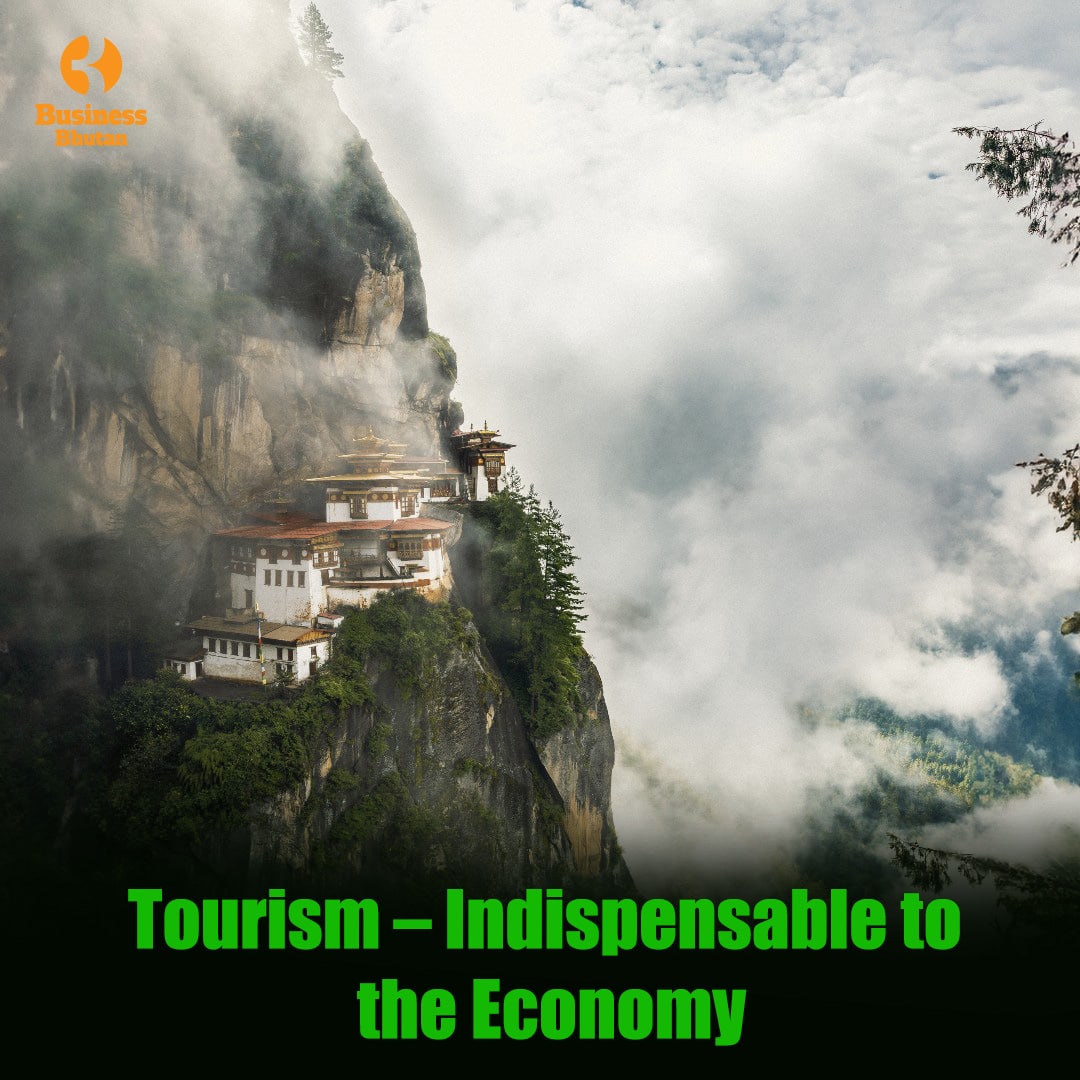
The importance of the Tourism Industry is underlined by the National Council’s (NC), Economic Affairs Committee (EAC), in its latest Review Report on the State of Tourism in Bhutan. From generation of income to providing employment and aiding the state through the payment of taxes, Bhutan’s tourism industry is an indispensible part of the nation’s economy.
According to the EAC, the tourism industry is one of the most significant contributors to the tertiary sector. In the last 14 years, the tertiary sector has made the highest contribution to Bhutan’s economy, accounting for an average of 51.08% of the GDP . The sector also provides the highest share of employment in the country, contributing 42% of the total workforce.
Additionally, in the last 14 years, hotels and restaurants, which are an integral part of Bhutan’s tourism industry has contributed an average of 1.71% to the national GDP . “In 2023, it employed approximately 4.7% of the country’s total workforce . Similarly, the transport and storage sector—which primarily includes land and air transport—contributed 7.68% to the GDP during the same period. In 2023, this sector employed around 3.7% of the total workforce.”
Bhutan’s tourism industry is broadly classified into five categories. According to latest data from the Tourism Establishment Census of Bhutan 2021, Bhutan has 6,819 tourism establishments. Of this, there are 3,778 transport operations and tour and travel agencies, which constitute 55% of the total. This is followed by food and beverage services with 2,243 establishments (32.89%), and accommodation services with 543 establishments (8%). Thimphu has the highest concentration of tourism establishments with 2796 establishments (41%), while Gasa has the lowest, with only 19 establishments (0.27%) .
The same census shows that the tourism industry employs an estimated 52,174 individuals, with 33,496 males and 18,678 females across various sectors. The highest employed is in the transport operation, tour/travel agencies, and reservation services category, accounting for 22,218 jobs. This is followed by the accommodation sector with 14,728 employees. The food, beverages, and entertainment sector also play an important role, providing employment to 13,234 individuals. Health and wellness and other tourism activities employ a smaller segment of the workforce.
In 2019, the estimated tourism revenue generated amounted to Nu. 18,010.68 million. This was contributed by tourism establishments across the five sub-sectors. The largest was generated from transport operators, tour/travel agencies, and reservation services, which accounted for 60.91% of the total followed by accommodation industry, contributing 31.06% of the revenue .
Records from the Department of Revenue and Customs (DRC), show that the revenue from Sustainable Development Fee (SDF) collection has generally increased from 2014-15 to 2018-19. It then declines in 2019-20 followed by a drop to zero in 2020-21 and 2021-22 due to travel restrictions related to COVID-19. However, there was a strong recovery in 2022-23 and it further increased to Nu. 2,331.83 million in 2023-24, the highest in the decade. “Despite tourists’ arrival not fully recovered to pre-pandemic levels, this sharp surge in SDF collection reflects that the revised SDF policy has effectively enhanced the revenue generation even with fewer arrivals, aligning with our ‘High value, Low volume’ tourism policy,” the EAC Report states.
Further, records from the Department of Immigration (DoI) indicate that between September 2022 and April 2025 the tourism industry generated USD 137.18 million and INR 438.39 million from the SDF; and USD 2.83 million and BTN 0.82 million from visa fees.
Data from the DRC shows that over the past 10 years, the tourism industry, particularly hotels and travel agencies, experienced a steady growth in both the number of tax filers and tax revenue. From 2015 to 2019, the total revenue rose from Nu 159.83million to Nu 237.85 million. However, there has been a sharp decline since 2021, with the total revenue declining by over 90% to just Nu 23.7 million, most likely due to the COVID-19 pandemic. Further, on an average, Nu. 355.61 million was collected as 10% sales tax on service from hotels and restaurants over the past 10 years.
While data from 2022 onwards indicate a slow recovery, the sector is yet to fully recover to its pre-pandemic levels, indicating the ongoing challenges, particularly for hotels.
Nidup Lham from Thimphu